

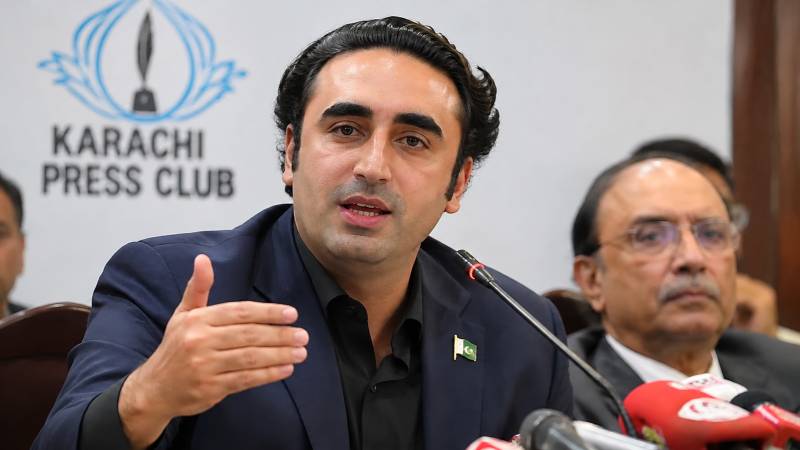
Bilawal Bhutto-Zardari's appearance at the Karachi Press Club on 17 November has exposed more than a growing rift within the ruling coalition. It has opened a debate about who actually governs Pakistan, who is responsible for its mounting failures and why those failures are suddenly being blamed on the country's provincial boundaries.
“The system has not collapsed; it has been made to collapse,” the PPP chairman declared. He called for a political reset, dialogue with the opposition, the release of political prisoners and recognition of the political mandate denied to the PTI. He warned that forcibly dividing Sindh could lead to bloodshed in Karachi and criticised the unprecedented weakness of the media under current laws and political pressures.
The reaction was swift. Defence Minister Khawaja Asif challenged Bilawal to come with “clean hands”, reminding him that the PPP had governed Sindh for 18 years and shared power with the PML-N at the Centre since 2022. Information Minister Attaullah Tarar defended a referendum as a constitutional way of ascertaining public opinion. Parliamentary Affairs Minister Tariq Fazal Chaudhry and Minister of State Talal Chaudhry accused Bilawal of double standards. Health Minister Mustafa Kamal went further, warning that Bilawal would be responsible for any bloodshed over new provinces.
Planning Minister Ahsan Iqbal then revealed that a 14-province arrangement was being discussed: four provinces each in Punjab and Sindh, three each in KP and Balochistan, with the possibility of separate provincial status for Islamabad. He said a committee had been recommended but no progress had been made. He also pointed to the March 2027 Senate elections as a reason why the matter might need to be settled soon.
The political spectacle became even more curious when Bilawal disclosed that neither the prime minister nor any cabinet member had formally discussed the proposal with him or President Asif Ali Zardari, despite several ministers publicly campaigning for it. Is this government policy or an idea being floated through selected ministers to test political reactions?
PTI secretary general Salman Akram Raja endorsed Bilawal's diagnosis of systemic failure, insisting that the country's largest political party could not be excluded from a political settlement. Jamaat-i-Islami chief Hafiz Naeem-ur-Rehman, while supporting smaller administrative units through constitutional means, challenged Bilawal over the PPP's own history in Sindh and questioned the privileged position of political families, including the Sharifs and Zardaris in the sugar industry. His intervention raised another question about the relationship between political power and economic privilege.
There is a serious point in Bilawal's criticism, but he cannot escape the obvious contradiction in his own position. His party has governed Sindh since 2008, participated in the federal coalition and helped pass constitutional amendments that weakened institutional checks and balances. The Bhutto-Zardari family cannot claim political credit for ruling Sindh while disclaiming responsibility for its condition. Nor can Bilawal present himself as an outsider to a system from which his party has repeatedly benefited.
The Sharifs deserve no less scrutiny. Khawaja Asif's challenge to Bilawal should be extended to Nawaz Sharif, Shehbaz Sharif and Maryam Nawaz. The PML-N has dominated Punjab for much of the past three decades, with the Sharif family at the centre of its politics. Its model of governance has relied heavily on centralised authority, patronage and highly publicised infrastructure projects rather than building strong institutions and improving the lives of the poorest citizens.
The immediate issue, however, is the extraordinary proposal to create as many as 14 provinces and hold a referendum. What exactly would voters be asked? Whether they favour more provinces in principle? Whether Punjab should be divided? Whether Karachi should be separated from Sindh? Whether South Punjab should become a province? These are entirely different questions involving boundaries, identity, resources and political representation. A single yes-or-no vote cannot resolve them.
Article 48(6) provides for a referendum on a matter of national importance with parliamentary approval. But a referendum cannot replace the constitutional procedure for changing provincial boundaries. Article 239(4) requires a two-thirds majority in the provincial assembly concerned for an amendment altering its boundaries. Neither a television debate nor a nationwide plebiscite can bypass this requirement.
Pakistan's security and economic crises reflect deeper institutional failures, including the establishment's influence over national policy, flawed Afghan strategy, costly power agreements and an economy built around political privilege.
More fundamentally, the proponents of new provinces have yet to produce a credible plan explaining how multiplying provincial administrations would improve governance. Where are the proposed boundaries, fiscal arrangements, administrative structures, projected costs and measurable benefits? Pakistan does not suffer from a shortage of governors, ministers, secretaries and government offices. It suffers from a concentration of power and resources in political and bureaucratic elites and an absence of accountability. Consider the evidence.
Karachi has effectively remained under the extraordinary security umbrella of the Rangers for nearly three decades. Yet the city continues to suffer from dysfunctional municipal services, poor infrastructure, inadequate transport and failures of civilian administration. The PPP must answer for its record in governing Karachi. But so must the federal establishment, which has exercised an extraordinary security role in the city for decades. If such prolonged intervention cannot produce competent civilian governance, how will another administrative unit solve the problem?
In Khyber Pakhtunkhwa, the resurgence of militancy exposes the disastrous consequences of the establishment's Afghan policy. For decades, the pursuit of strategic depth and the cultivation of militant proxies shaped national security thinking. The Taliban's return to Kabul in 2021 was initially celebrated in some establishment circles as a strategic victory. Pakistan is now confronting the blowback through TTP attacks, insecurity and deteriorating relations with Kabul. This is not simply a failure of provincial administration. It is the consequence of national security policies formulated and pursued by the establishment. Those who made the strategic decisions cannot now blame provincial governments for the consequences.
Punjab offers an equally uncomfortable test of the Sharifs' claims of administrative competence. In my August 2025 investigation, Why Punjab's Record Education Spending Isn't Getting Children Into Classrooms, I documented how the province's education budget had increased more than thirteenfold since 2008, reaching Rs812 billion in the 2025–26 allocation. Yet approximately 10 million children aged 5–16 remained out of school. Only around 40 per cent of Grade 5 pupils could fluently read a Grade 2 text. More than 85 per cent of the education budget went towards recurrent expenditure, while development spending remained below 15 per cent.
The neglect of South Punjab is particularly indefensible. Despite its population of nearly 40 million and its agricultural wealth, poverty incidence there is 2.5 times the provincial average and human development is 32 per cent lower. The number of out-of-school children is 2.2 times higher. The Sharifs have dominated Punjab's politics for decades. They cannot keep advertising their development credentials through Lahore's infrastructure projects while presiding over such entrenched regional deprivation. South Punjab has a legitimate demand for greater political and fiscal autonomy. Its grievances cannot be dismissed as political mischief.
The PML-N's economic record is no less damaging. Its power-sector policy is a glaring example. The original IPP framework was introduced under the PPP government in 1994, but the PML-N substantially expanded generation capacity during its 2013–18 tenure through long-term power-purchase agreements, guaranteed returns, dollar-indexed obligations and take-or-pay arrangements. The result has been an enormous capacity-payment burden, including payments for plants that are not generating electricity.
Households and businesses are paying the price. High electricity costs have become embedded in production costs, adding to structurally persistent inflationary pressures and making Pakistani exports increasingly uncompetitive against regional rivals. They have also aggravated circular debt and fiscal pressures. The Sharifs cannot claim economic modernisation while leaving businesses saddled with some of the region's highest electricity costs. The PPP introduced the original framework; the PML-N bears substantial responsibility for its costly expansion. Neither can escape accountability.
These examples point to a much larger failure: Pakistan is a failing state, not because it has four provinces, but because its institutions have been captured by political, bureaucratic and economic elites. The establishment has exercised decisive influence over national security, foreign policy and the political system since the 1977 coup. It has repeatedly intervened in civilian government, shaped national priorities and weakened institutional restraints, yet has escaped accountability for the consequences. Political parties, including the PPP and PML-N, have repeatedly accommodated this dominance when it suited their interests.
The media has compounded the problem. Much of Pakistan's television talk-show industry has become an extension of the political narrative being promoted by powerful quarters. Too many anchors, prompted by whatsapp messages from powerful officials, spend their programmes amplifying statements from ministers, speculating about the establishment's intentions and staging confrontations between political personalities. They rarely ask the questions that matter: Who devised the Afghan policy? Why has Karachi required decades of exceptional security intervention? Who is responsible for the IPP contracts and capacity payments? Why does South Punjab remain so deprived? Who benefits from the concentration of public resources and economic privilege?
An anchor who merely repeats the day's approved talking points is not performing journalism. The failure is not simply one of professional courage; it is the abandonment of journalism's basic purpose. Bilawal was right to draw attention to the weakness of the media, but the responsibility also lies with journalists and television anchors who have allowed themselves to become stenographers of the powerful.
Pakistan's economic crisis is rooted in the same political economy. Tax exemptions, privileged access to land, protected markets, subsidies and politically allocated contracts reward proximity to power rather than productive enterprise. Agricultural income and property wealth remain inadequately taxed. Debt servicing and administrative expenditure crowd out investment in education, health and technology. The country has failed to make the transition from a rent-seeking economy to one based on productive investment, technological upgrading and competitive exports.
The remedies are not mysterious. Article 140-A must be implemented through genuine devolution of political, administrative and financial authority to elected local governments, backed by functioning Provincial Finance Commissions. The tax system must bring agricultural income, property wealth and privileged sectors within an equitable regime. Energy policy must be rebuilt around competitive costs and reliable supply rather than guaranteed returns to politically connected interests. Education spending should rise towards 3 per cent of GDP within five years, while investment must increase towards 25–30 per cent of GDP over the coming decade.
None of this is possible without political legitimacy. Parliament must regain authority, elections must be credible, the judiciary must be independent and the media must be free to scrutinise those in power. And if the establishment believes it can govern the country better than elected representatives, it should have the courage to drop the pretence of civilian rule, dispense with its political proxies and take direct responsibility under martial law. It cannot continue to exercise power from behind the curtain while holding others accountable for the consequences.
Bilawal is right that the system has been made to collapse. But his party helped make it happen. The Sharifs cannot lecture others about governance while evading responsibility for their political and economic failures. And the establishment cannot continue demanding more power while blaming politicians and provincial arrangements for the consequences of policies it has dominated for nearly five decades.
Pakistan does not need 14 provinces or a referendum designed to distract from its failures. It needs an accountable state, a political system that derives authority from the people and an economy that rewards production rather than proximity to power. Until those who have presided over its decline are held responsible, changing the map will change nothing.