

For months, I tried hard not to write this. I am a Pakistani Bihari, a public health doctor, a gender justice expert. I have built a life far from Dhaka, the city where I was born, though I cannot say so officially, and far from the so-called camps there and the katchi abadis of Karachi. I told myself enough had already been written about us. That no new account of the abandoned Biharis was needed. That my own wounds were beside the point. I was wrong. No degree, no career, no careful reinvention of myself has lessened this one pain: the betrayal that runs quietly through my community, generation after generation, while our people go on surviving in Karachi's poorest lanes.
A handful of Bihari-origin elites, meanwhile, build their careers. They take their seats in parliament, in the civil service, in academia. They collect their invitations from powerful capitals and embassies. None of this is wrong in itself, success and recognition are not sins. What is wrong is the absence of ownership, the insensitivity, toward the very community they come from, and the ease with which they look away. I keep returning to an image I am not proud of but cannot shake.
Picture a woman who, in 1971, chose to stay loyal to a man called West Pakistan, even as the household she had married into, East Pakistan, came apart around her. She was not alone; many Urdu-speaking families made the same choice, and some, far from all, and the record does not support painting an entire community with one brush, joined the razakar militias fighting alongside the Pakistan Army. When the so-called war ended in December 1971 and Bangladesh was born, the man she had been loyal to did not bring her home. Estimates of Biharis killed in the reprisals that followed range wildly, from roughly a thousand by the most conservative counts to well over a hundred thousand by community estimates, with Pakistan's own 1974 inquiry settling on tens of thousands.
Whatever the true number, what is undisputed is what came after: she was left standing in a house that no longer wanted her, and the country she had chosen issued statements of sympathy and little else. I want to be clear that this is a political metaphor, not a claim about the actual women who suffered real violence in that war; their story is not mine to borrow for a different argument. Strip away the metaphor, and here are the facts. Under the 1974 tripartite agreement between India, Pakistan and Bangladesh, some 170,000 Biharis were repatriated. Another 250,000 to 300,000 stayed behind, scattered across a hundred-odd camps, Geneva Camp in Mohammadpur the best known. Stateless. Denied citizenship, education, work, property, for decades. In 2008, Bangladesh's High Court finally granted citizenship to those born after 1971, or minors at the time, with the right to vote. Paper statelessness ended. Poverty and stigma did not. Pakistan, meanwhile, has mounted no serious repatriation effort since the 1980s, despite absorbing millions of Afghan refugees in those same years.
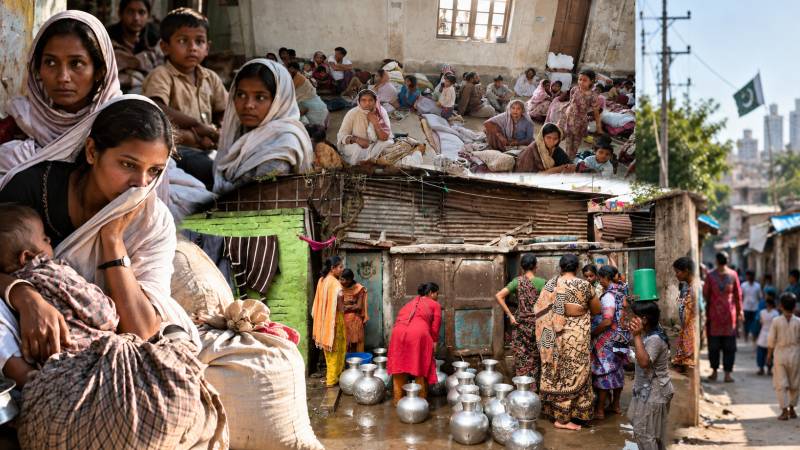
My heart aches for those Afghans too; this is not their fault, and I do not raise it to diminish their suffering. But Biharis and other Urdu speakers raise the comparison often. Officials rarely answer it. That is the story on the Bangladesh side. There is a quieter one on this side of the border too, in Karachi's low-income neighbourhoods: Orangi, Baldia, Korangi, where families who reached Pakistan after 1971, or in the irregular waves of the late 1970s and 1980s, still struggle for identity documents.
MQM lawmakers have raised this at the Karachi Press Club, citing tens of thousands of residents whose national identity cards were confiscated or withheld because their nationality was "suspected." Community mobilisers in Orangi describe generations unable to secure an NIC, and therefore unable to secure formal employment, a bank account, or a passport, despite having lived in Pakistan their entire lives. Not history. An administrative failure, still running, in a city many of us call home. What does morality mean here? What does humanity mean? What, if anything, is left of the Two-Nation Theory, when a state can do this to people who chose it, again and again, for more than fifty years? These are not rhetorical questions. They are the only honest place to start.
What would an accounting look like? Not another sympathetic op-ed, mine included. Not another line about Bihari "sacrifice," wheeled out every December. It starts with Pakistan counting and respecting us properly. Dhaka and Islamabad would need to sit down and finally settle what is owed: morally, politically, financially. Strategic pauses, dressed up as diplomacy, are inhumane. Not another sympathetic gesture (I notice, writing that word, that I no longer reach for my favourite one, empathy; perhaps I have surrendered too), but sustained, unglamorous diplomacy. And those of us who got out, out of the so-called camps, those 4x4 to 7x7 cages, out of the katchi abadis, through school, a profession, nothing nobler than good timing, would have to stop letting our own escape stand in for our community's.
I know how this reads to some in my own community: grievance better kept private, ingratitude toward a country that did, after all, take some of us in. I understand the instinct; displaced communities often police their own complaints harder than outsiders do, fearing it reads as disloyalty all over again. But that fear, and the silence around this complex violence, will not protect us.
And yet I love this country. I have learned that love can make you helpless, even zalil, abased, and that you go on loving it even when it does not love you back in kind. This is not hatred of Pakistan. It is closer to the opposite. But loving a place does not mean living inside it painlessly, and the people who remind me of that most often are not strangers. They are the people I live among day and night, the ones we call dost, friends, one word doing the work that older Persian and Urdu literature never asked a single word to do.
This is not what hostility from strangers sounds like. It is what casual dismissal from your own circle sounds like: offered lightly, meant kindly, and carrying, underneath the joke, the same message the state has been sending for more than fifty years, that the account is closed, that a signpost is compensation enough, and that to keep asking is itself the offence.
It is these friends, not trolls, not anonymous critics online, who say things like: "Aur kya chahiye, aap to Islamabad mein mazay mein rehti hain" (what more do you want, you live comfortably in Islamabad after all), as though a postal address settles a fifty-five-year-old question of belonging. Another, naming her own community, which I will not repeat here since it was not offered for print, told me: "hum bhi hain, aur hum bhi Islamabad mein wahan nahi rehtay jahan aap hain" (we are that too, and even we do not live in the part of Islamabad where you do), as if two minorities' unequal access to the same city somehow cancelled each other into fairness.
One friend, weary of the subject altogether, said: "Yaar band karo likhna, aur kitno ko bulana chahti ho, ek tum ko bula liya hai na, kafi hai, bhugat rahe hain, bolti chali jaati ho, na comma na full stop" (enough, stop writing, how many more do you want to invite in, we already let you in, didn't we, that is enough, we are bearing the consequences, you just keep talking, no comma, no full stop); the joke, I think, was aimed at my run-on sentences, though it usually lands on the subject I was raising instead.
Another closed the matter entirely with his bureaucratic memo: "Islamabad mein Parveen Shakir Road hai, aur kya chahiye aapko" (there is a Parveen Shakir Road in Islamabad, what more do you want). Parveen Shakir is the empress of Urdu poetry, and she earned that honour entirely on her own; the road named for her was a bureaucratic courtesy to a great poet, not a gesture of solidarity with a shunned community. My bureaucrat friend borrowed her achievement anyway and offered it to me as full and sufficient restitution.. And more than once, said flatly, without any unkindness intended, which is somehow worse: "Muhtarma, aap history parh lein, Biharyun ka wavaila mat karen" (Madam, go read your history, stop wailing on behalf of the Biharis).
None of these people think of themselves as unkind. They are, by their own account, my “friends” (most of them are above my pay grade), in a country I have chosen to go on loving. That is exactly the point. This is not what hostility from strangers sounds like. It is what casual dismissal from your own circle sounds like: offered lightly, meant kindly, and carrying, underneath the joke, the same message the state has been sending for more than fifty years, that the account is closed, that a signpost is compensation enough, and that to keep asking is itself the offence.
The dismissal is not limited to living rooms. Dr. Eqbal Ahmad does not need my appreciation. We already know how tall he stood. He was born in Gaya, Bihar, though his family moved directly to West Pakistan in 1947 rather than east; a Bihari childhood is part of his story too, even if it is rarely told that way. In 2012, Bangladesh awarded him its Friends of Liberation War Honour for his solidarity with Bengal against the Pakistan Army, accepted posthumously by his niece, Hajra Ahmed, an eminent educationist and cofounder of Khaldunia school. He earned that recognition, and I do not dispute it for a moment.
Twelve other Pakistanis received the same honour that year, for the same kind of courage, several of them, like him, already gone by then, their awards accepted by others in their place. I cannot know what any of them would have said, or asked the world to also remember, had they lived to stand at that podium themselves. What I do know is that in the years since, among the living who carry that same recognition and the same moral authority, none has used it to put our genocide, the one visited on Biharis, into the same sentence as Bengal's. And what saddens me more, what feels like its own quiet betrayal, is that no one around me, no one in my own community, has ever asked why, not even about the man born in Bihar himself. That asymmetry has never been questioned.
I have made versions of this argument before, in places willing to publish a Bihari byline. They earn a polite nod and nothing more: no invitation to expand into a book, no seat at an academic conference, no literary prize. Meanwhile, accounts of 1971 written from the outside, critical of the Pakistan Army, sympathetic chiefly to the Bengali nationalist story, and mentioning Biharis only as footnotes or as perpetrators, traitors, etc., find their way into university syllabi, into award shortlists, into the catalogues of serious publishers.
I have made the specific case, with specific titles, elsewhere. I will not repeat it here, because the point is not any one book, it is the pattern those books belong to. I do not begrudge those books their scholarship or their right to exist. I only ask why an account written by a Bihari, about Bihari statelessness, is filed under grievance and special pleading, while every other account of the same year is filed under history. I do not know if this essay changes anything. Fifty-five years on, a woman is still standing in a house that both countries claim was never really hers, and no one currently in power on either side of the border is in a hurry to invite her in.
I do not write as a woman with “many tragedies.” I write as someone who keeps taking painful material and trying to make meaning out of it: turning memory into language, abandonment into metaphor, and history into testimony.