

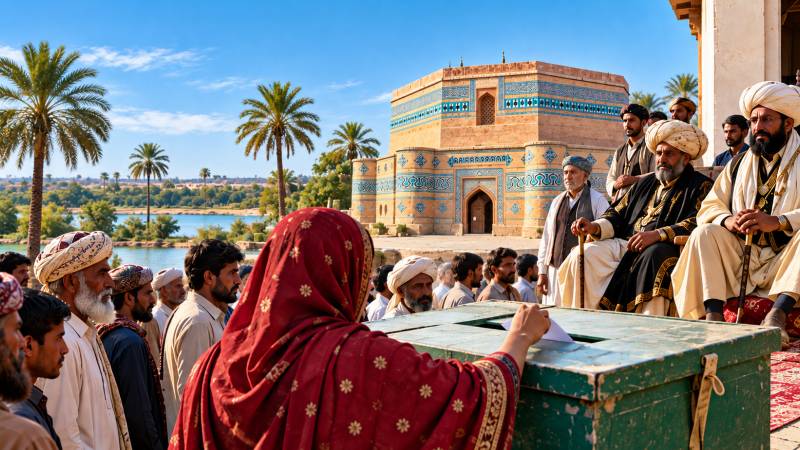
Whenever an opportunity arose, the people of Dera Ghazi Khan expressed their disapproval of the colonial political settlement, by voting against Sardars in general elections. The people wanted to have a sigh of relief of the oppressive political class who dominated the political scene for decades. But efforts remained futile as Sardar continued enjoying the favour of the ruling elite of the country, particularly of Punjab that wanted to see the region underdeveloped to plunder its rightful share of resources. Let me leaf through the pages of history to examine how the Velvet Revolutions unfolded in the region.
In 1863 the British introduced a local body system in the Dera Ghazi Khan region with the aim to educate the natives, therefore, the important task before the committee was to look after the schools. The purpose was to materialise Lord Macaulay's objective that sought the native class who could act as , “interpreters between us and the millions whom we govern.”
The Municipal Committee was taken care of by the majority of the nominated body under the supervision of the Deputy Commissioner. A few of the natives were elected from their respective wards who were mainly the advocates for only the educated person could contest the election. The voters were the selected few who were landowners or tax payers. It was not an election based on universal adult suffrage. The president used to be from the Muslims and the vice president from the Hindus.
In the District Board the sardars were given preference , consequently, Sardar Jamal Khan Laghari became the first chairman of the District Board of Dera Ghazi Khan. The Board forged an alliance among Baloch tribal and landed leaders, Muslim non-tribal dignitaries, and the Hindu urban elite within a shared institutional framework. Such was the elite clout in the region and the practice persisted in the post partition political scenario as well.
The purpose of this historical reference is to illustrate how the colonial establishment catered for the Sardars and the landed elite. They became their allies to help them to consolidate and perpetuate British rule in the region. It promoted the politics of patronage in the region. After the partition the landlords and Sardars still held a sway over the political arena of the country. But an interesting event occurred in local bodies elections of 1960, held with General Ayub Khan's nod, then the Martial Law Administrator of the country. A cobbler defeated the local landlord in 1960 elections in one of the constituencies of the region. This event is cited by Herbert Feldman in his book Revolution in Pakistan: A Study of the Martial Law Administration.
The Sardars have by no means disappeared from the political landscape; their continued electoral victories, supported by administrative structures that largely replicate the colonial system, reveal both the persistence of inherited privilege and the limits of Dera Ghazi Khan’s velvet revolutions.
In 1970 general elections , held under the universal adult suffrage , a candidate of Jamat Islami , Nazir Ahmed won the National Assembly election by defeating a Sardar. He belonged to a lower middle class strata and ran an Homeopathic Clinic in the city. While the local Sardars maintained their dominance in the Provincial Assembly, this suggests that their lingering political influence within their constituencies stemmed from the power and privileges bestowed upon them under colonial rule.
During Zia ul Haq’s Martial Law, Sardar Feth Muhammad Khan Buzdar, the father of Usman Buzdar, the former chief minister of Punjab, was nominated for the membership of the Federal Council (Majlis-i-Shoora) 1983-84. Hence, the Tumandar once again found his way into the corridors of power and the nexus between the Sardars and the establishment was established. The non-party 1985 elections showed an important pattern.The established tribal/landed families remained prominent as the non-party elections were designed to consolidate the erstwhile elite in the country.
Whereas, the 2013 general election witnessed the emergence of a contestant to the political elite. Zartaj Gul contested the election from NA-172 Dera Ghazi Khan-II on a PTI ticket. She lost, securing an impressive 38,643 votes, finishing only 746 votes behind Sardar Muhammad Jamal Khan Leghari. He is the eldest son of Sardar Farooq Ahmed Leghari, former President of Pakistan. Zartaj Gul’s inimitable performance in the election demonstrated that the electoral hold of the traditional political families could be seriously confronted. The challenge to the traditional political elite reached a dramatic shift in the general elections of 2018, when Zartaj Gul, contesting on a PTI ticket, defeated Sardar Awais Ahmad Khan Leghari, the younger son of Sardar Farooq Ahmed Leghari. Her victory established that even the most deeply entrenched political families could be defeated through the ballot.
The trend continued in 2024 when Sardar Zulfiqar Khan Khosa, former governor of Punjab lost elections to a less prominent contestant. While contesting as an independent candidate, Zartaj Gul retained her place in the National Assembly by defeating Sardar Mehmood Qadir Khan Leghari and Sardar Doost Muhammad Khosa,former chief minister of Punjab. Another less known candidate had also won the election as an independent contestant but the wee hours found Sardar winning.
The Sardars had by no means disappeared from the political landscape. The politically established Khosa and Leghari figures continued to win other constituencies in the district with the support of a bureaucracy that largely replicated the colonial administrative structure. Perhaps the real story of Dera Ghazi Khan’s velvet revolutions lies in these recurring challenges to inherited political authority.