

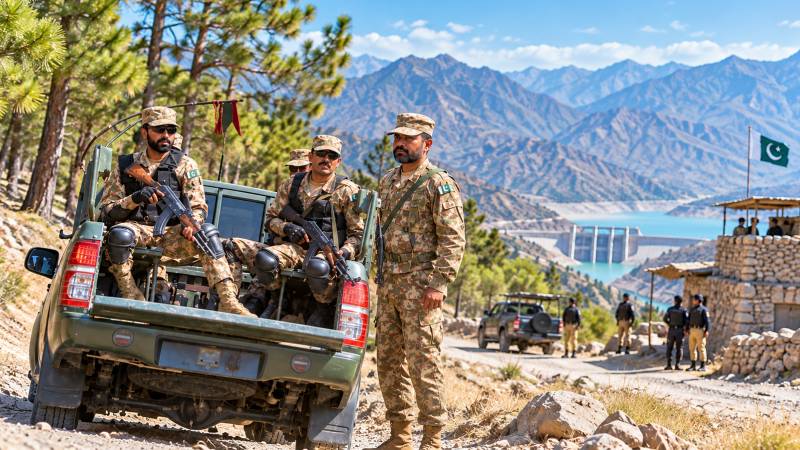
Pakistan has no shortage of institutions dealing with terrorism. The challenge is how effectively their efforts are connected, and whether investigations examine the entire chain of events rather than isolated aspects of an attack. The judicial commission constituted to investigate the July 6 terrorist attack on the Mangi Dam pumping station in Ziarat was initially expected to examine the attack and the deaths of police personnel. Its scope, however, has since widened to include questions about digital misinformation, delays in compensation to victims’ families, and the registration and regulation of religious seminaries. Each of these issues may deserve attention, but bringing them under one inquiry risks producing a collection of separate concerns rather than a coherent explanation of what happened and why.
The Mangi attack itself illustrates why such a reconstruction is necessary. Initial reports on July 7 said that nine policemen, including two station house officers, had been killed and that the whereabouts of five others were unknown. The report said additional personnel had been dispatched and an operation to recover the missing policemen was under way.
Later reports provided a different and much more detailed account. According to Balochistan Police, reinforcements had been sent towards the post, but when they moved closer they came under fire and were initially unable to advance. After the post ran out of ammunition, the remaining personnel attempted to withdraw in two groups. One group reached safety, while another group of 18 policemen encountered the attackers and was taken hostage. Those 18 were subsequently killed, and their bodies were found in the mountainous Zarghoon Gar area.
This sequence raises questions that go beyond the initial attack. The first report described the engagement as lasting for hours. If the fighting continued for that length of time, the inquiry needs to establish when the attack was reported to the relevant command authorities, when reinforcement was requested and ordered, how long it took to arrive, and what prevented it from reaching the post before the situation deteriorated. The later police account cites extremely difficult terrain, limited observation, distant fire and possible ambush sites as factors that slowed the movement of reinforcements. These constraints clearly mattered, but they do not by themselves explain the delay: the attackers were operating in the same difficult terrain. The inquiry should therefore examine whether the more decisive factors were the relative strength and firepower of the two sides, the availability of ammunition and appropriate weapons, the deployment of the reinforcing force, or other operational constraints. Without establishing these facts, it is difficult to assess why reinforcements could not reach the post before it was overrun.
The subsequent hostage-taking raises another question. Eighteen policemen were taken away at gunpoint and later killed. Whether they were moved together or in smaller groups, the operation required the attackers to maintain control of a large number of captives and move through difficult terrain. The inquiry should therefore establish whether the militants’ movement after the post was overrun was detected or tracked, what surveillance and intelligence resources were available, and whether any attempt was made to intercept them before the hostages were killed. If a militant force could attack a police installation, take 18 personnel hostage and subsequently move them without being intercepted, that would raise serious questions about surveillance, intelligence-sharing, deployment and preparedness.
The record-keeping itself also deserves scrutiny. Why did the authorities initially report five policemen missing when the subsequent account established that 18 had been taken hostage? More than a month later, an August 18 report announcing the judicial commission described 31 policemen as having been martyred after being kidnapped. Yet the same report gave a different total in its detailed account, stating that nine were killed at the scene and 18 after being kidnapped. The discrepancy requires clarification, particularly because the detailed figures add up to 27 rather than 31.
If a militant force could attack a police installation, take 18 personnel hostage and subsequently move them without being intercepted, that would raise serious questions about surveillance, intelligence-sharing, deployment and preparedness.
The authorities themselves appear to have recognised that the response required examination. On July 8, the Ziarat superintendent of police was suspended, while a four-member inquiry committee was constituted to establish the complete sequence of events and assess deployment, preparedness, response, command, control and coordination. Its mandate specifically included examining possible negligence, operational lapses and failures of command and coordination. This does not establish where responsibility ultimately lies, but it makes those questions legitimate subjects of inquiry.
The same principle applies to attribution. Establishing that a militant organisation received support, guidance or other assistance from outside Pakistan may be important, but it does not by itself explain how an attack was planned, facilitated and executed on the ground. An investigation must also establish how the attackers obtained information, identified their target, moved into the area, acquired logistical support and operated after the attack. If there was foreign involvement, the evidence should establish its nature and mechanism. If local individuals or networks were involved, they too must be identified. Attribution should therefore be the outcome of tracing evidence rather than a substitute for examining the operational chain that made the attack possible.
The same distinction is relevant to the digital sphere. The commission has reportedly asked the National Cyber Crime Investigation Agency (NCCIA) to prepare a strategy against misleading online campaigns. Countering unlawful digital activity can certainly form part of a wider security response. But a cybercrime investigation agency cannot by itself provide a comprehensive counter-terrorism strategy. Misleading propaganda that facilitates violence should not automatically be equated with criticism of government policy. The two require different responses.
The inclusion of madrassa registration raises another question. The reporting on the proceedings so far does not indicate that a madrassa has been identified as being involved in the Mangi attack. If the commission has evidence connecting a particular institution or individual to militancy, that connection should naturally be investigated. But if the issue is the broader registration and regulation of seminaries, then it is a longstanding governance problem rather than an explanation of the Mangi attack.
Pakistan has attempted to regulate madrassas before. Registration and oversight have repeatedly been proposed, including during the Musharraf era and again after the 2014 Army Public School attack under the National Action Plan. The relevant question is therefore not simply whether another registration exercise should be launched, but why previous efforts failed to produce a durable system. If thousands of institutions remain outside an effective and sustainable regulatory framework, the inquiry should examine the institutional reasons rather than simply repeat an old policy prescription.
Compensation for the families of the slain policemen presents a different but equally important issue. Reports that some families faced delays because of deficiencies in succession certificates point to the need for an immediate administrative solution. A special hearing to resolve individual cases is useful. But the larger question is whether service and family records of police personnel are maintained in a way that allows compensation and other benefits to be processed promptly after a death. A system that requires bereaved families to repeatedly prove information that the state should already possess deserves institutional correction.
The broader security picture also requires integration. At a recent workshop in Gilgit, experts discussed India’s military modernisation, nuclear stability, arms control and emerging technologies, including developments following Pulwama and Pahalgam. Such issues are clearly relevant to Pakistan’s strategic assessment. The question is not whether India should be part of that assessment. It plainly is. The issue is whether different threats are being assessed as interconnected where evidence warrants it, rather than through separate institutional silos. A state confronting militancy, regional rivalry, cyber threats and internal vulnerabilities cannot afford to treat each problem as an entirely separate file.
Pakistan does not lack institutions dealing with terrorism. What remains difficult is integrating their work. The Mangi incident illustrates the problem at a very basic level: before deciding who was responsible, the authorities must establish how many personnel were actually at the post, who was killed, who was missing, when the missing personnel were known to have been taken hostage, what reinforcements were doing while the engagement continued, and how the attackers subsequently moved with their captives. Widening the scope of an investigation is easy. Producing a coherent understanding of why an attack happened and ensuring that the same vulnerabilities cannot be exploited again is much harder. Patchwork remedies may address individual symptoms. They cannot repair structural fractures.