

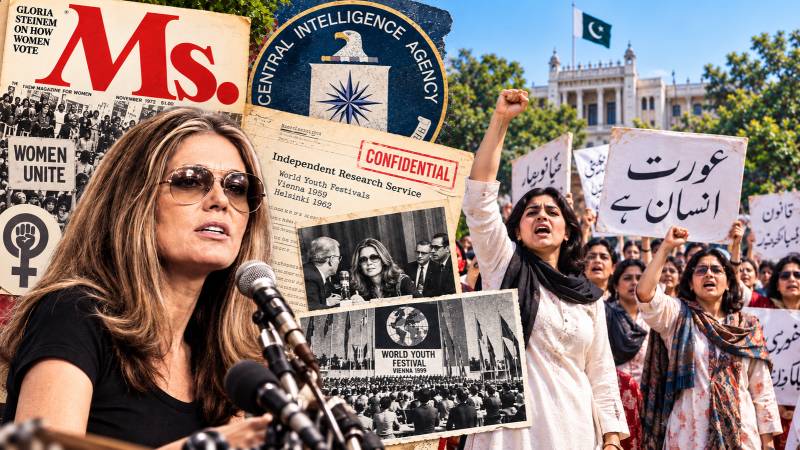
Gloria Steinem's relationship with the CIA is sometimes treated as an embarrassing footnote to the life of America's most famous feminist. It deserves more serious attention. Before becoming the public face of American feminism, Steinem headed the Independent Research Service, an organisation covertly financed by the CIA to organise American participation in the World Youth Festivals in Vienna in 1959 and Helsinki in 1962. Steinem knew where the money was coming from and subsequently defended her relationship with the Agency.
The CIA's purpose was hardly mysterious. During the Cold War, it did not restrict itself to supporting conservative organisations. Its own historical account describes an emerging strategy of “promoting the non-Communist left” — intellectuals, students and organisations capable of competing with communist influence from within broadly progressive politics. Steinem's activities were consistent with this wider Cold War strategy.
The episode illustrates a sophisticated form of political influence. Governments do not necessarily have to dictate what activists say. By deciding whom to finance, which organisations and publications to support and which causes to amplify, they can alter the relative strength of competing political currents. Some acquire institutions, professional staffs, research capacity and international platforms that others lack. Influence can operate through patronage and institutional selection without requiring direct control. There are striking parallels in Pakistan from the 1980s onwards.
The women's movement that confronted General Zia-ul-Haq emerged in conditions of political repression. Women challenged discriminatory legislation and an authoritarian state at considerable personal risk. Their struggle intersected with broader progressive politics concerning democracy, class, labour and social justice. The women's demonstration in Lahore in February 1983 against the proposed law of evidence, for example, was political resistance to an authoritarian state, not a development-sector project.
Yet during roughly the same period another institutional model was emerging: the professionally staffed NGO increasingly supported by international development agencies. The funding was substantial and sustained. Canada began supporting the Pakistan NGO Support Program in 1987, seeking to build NGO networks, promote women's participation and strengthen organisations as agents of social, economic and political change. Western support subsequently expanded. In 2010, USAID launched a five-year, $40 million Gender Equity Program intended, among other objectives, to strengthen Pakistani organisations advocating gender equality and women's empowerment. In 2019, Canada announced another C$21 million for programmes promoting women's civil and political rights, including political participation and civic empowerment.
Over several decades, an externally financed infrastructure developed around gender, human rights, governance, political participation, research and advocacy. Foreign donors did not create Pakistani feminism, and accepting foreign money does not make an organisation an instrument of its donor. But financing on this scale inevitably affects which organisations acquire professional staffs, research capacity, networks, international exposure and access to policymakers and the media.
Governments do not necessarily have to dictate what activists say. By deciding whom to finance, which organisations and publications to support and which causes to amplify, they can alter the relative strength of competing political currents.
One of the most visible trends in post-1980s progressive politics was the declining centrality of class and broad social-justice politics and the growing institutional prominence of gender and other issue-specific rights agendas. The decline of Pakistan's left had many causes: Zia's repression of progressive politics and organised labour, the international retreat of communism and the deterioration of left-wing political parties among them. It cannot simply be attributed to NGOs or foreign donors.
But the simultaneity is important. As organised left-wing politics weakened, an increasingly professional and externally financed NGO sector expanded. Gender, governance and human rights acquired organisations, salaried professionals, research programmes and international networks at a time when the institutional infrastructure supporting class politics, trade unionism and redistribution was deteriorating. The effect need not have been planned for it to alter the centre of gravity of progressive politics.
Earlier left-wing politics tended to locate women's oppression within wider structures of economic and social power. A landless female agricultural worker was not only a woman confronting patriarchy; she was also a landless worker confronting a landlord. A poorly paid factory worker faced gender discrimination but also the power of capital over labour. Women's emancipation therefore overlapped naturally with land reform, unionisation, wages, ownership and redistribution.
The NGO model increasingly organised social problems into specialised programme areas. Gender became one field, alongside governance, reproductive health, human rights and capacity building. Problems rooted partly in political economy could consequently be reformulated primarily in terms of representation, legal rights, awareness or empowerment. These were legitimate concerns, but the language could remain progressive while the politics became less threatening to established structures of economic power.
This evolution has been described within feminist scholarship itself as the “NGO-isation” of feminism. In The Women’s Movement in Pakistan: Activism, Islam and Democracy (I.B. Tauris, 2018), researcher Ayesha Khan describes how the 1990s became associated with the “NGO-isation” or “de-politicisation” of the women’s movement. She records concerns within the movement that increasing involvement in NGO work diverted activists from building a broader political movement. Khan also cites feminist scholar Rubina Saigol’s argument that, without donor funding, the movement would have retained more of its political and leftist character, and that its growing orientation towards development and human rights reflected donor priorities.
The LUMS Women's History Archive makes a similar point. It describes the post-Cold War influx of Western-funded NGOs and says that the emphasis on development and the need to accommodate donors' political vision “dampened some of the more radical edge” of earlier resistance. Research on Pakistani homeworkers provides an even more concrete example. A peer-reviewed study based on three years of fieldwork found that competition for donor funding undermined indigenous narratives of resistance and concluded that the NGO network had “depoliticized what should have been a class-based feminist struggle.”
That finding goes to the heart of the issue. Gender politics did not necessarily reinforce class politics; within some NGO structures it could displace it. The institutional transformation also changed the nature of activism. Political movements traditionally depended upon members, volunteers, mobilisation and political organisation. NGOs required salaried professionals, consultants, workshops, conferences, research grants, advocacy campaigns and monitoring frameworks. Activism increasingly became capable of providing professional careers. A political movement seeks to mobilise constituencies and change relations of power; a development project must also satisfy objectives, budgets, timetables and measurable outcomes agreed with whoever finances it.
Professional organisations can produce valuable research, provide essential services and campaign effectively for legal reform. But professionalisation changes incentives. Organisations require budgets; budgets require grants; grants have funding criteria. If substantial resources are available for gender mainstreaming, governance or political participation, organisations working in those areas acquire resources and longevity. If comparable resources are unavailable for organising agricultural workers, strengthening trade unions, campaigning for land redistribution or challenging concentrations of wealth, those struggles operate at an institutional disadvantage.
Even political vocabulary changed. Mobilisation became “advocacy”, political organisation “capacity building”, citizens “stakeholders”, and political objectives measurable “deliverables”. The terminology itself is not the problem. It reflects a development-sector framework different from a political movement organised around changing relationships of economic and political power.
The distinction between class and gender is particularly artificial in Pakistan because for millions of women the two are inseparable. A woman working in agriculture, domestic service, a brick kiln or a factory experiences patriarchal discrimination, but her vulnerability also derives from poverty, property relations and weak bargaining power. A feminism concerned with political economy therefore asks not only whether women are represented but who owns the land, who controls capital, why labour is weakly organised and how concentrations of economic power reproduce inequality.
Separating gender from these questions can have a political consequence. An elite-dominated system can accommodate programmes promoting women's representation, professional advancement or “empowerment” more easily than a movement simultaneously demanding women's equality, land redistribution, stronger labour rights and a redistribution of economic power. The former may change who participates within an existing structure; the latter challenges the structure itself.
Here the parallel with Steinem becomes relevant. The circumstances were different: her organisation received covert CIA funding during the Cold War, whereas Western funding of Pakistani NGOs has generally been overt development assistance. But the mechanism of influence bears comparison. The CIA understood that political outcomes could be affected not only by confronting the left but by strengthening particular currents within progressive politics. Western governments later spent substantial sums building parts of Pakistan's civil-society infrastructure while specifying the broad areas in which those resources were to be deployed.
The evidence does not establish a centrally directed Western project to replace class politics with gender politics in Pakistan. But neither should the opposite assumption — that foreign money was politically neutral — escape scrutiny. As organised left-wing politics weakened, a foreign-funded NGO sector expanded, while gender, governance and issue-based rights acquired increasingly well-resourced institutional platforms. One consequence may have been an indirect dilution of class-based politics: resources and professional opportunities increasingly flowed towards forms of progressive activism that did not necessarily challenge existing relations of property, labour and economic power.
That possibility deserves examination precisely because it requires no conspiracy. Donors pursue their priorities; NGOs respond to available funding; activists gravitate towards institutions capable of employing them; research follows grants; and public discourse is influenced by organisations with the resources to produce research, engage the media and lobby policymakers. Over time, these individually rational choices can collectively reshape the character of political activism.
Political influence does not require control. Funding can alter the balance among competing ideas by influencing which acquire institutions, professional careers, research capacity, networks and amplification. Gloria Steinem's CIA history provides a striking example of how American Cold War strategists understood this principle. Pakistan's experience since the 1980s raises uncomfortable questions about how external funding may have influenced the evolution of progressive politics. If we want to understand why the priorities of progressive politics changed, following the ideas is not enough. We must also follow the money.