

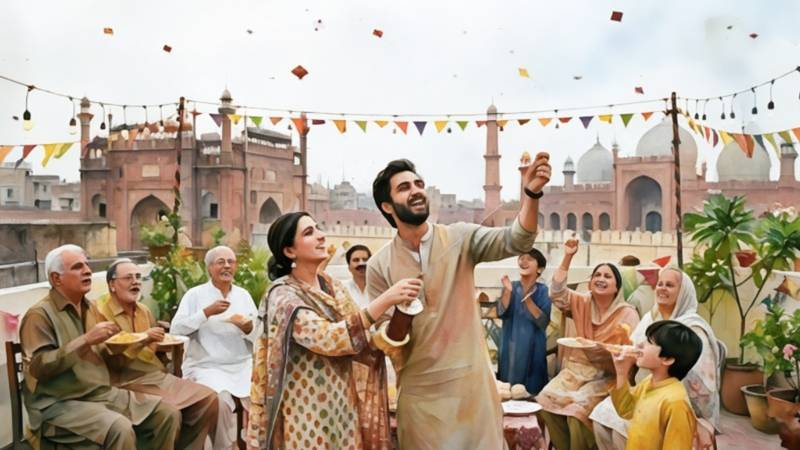
Basant has never been a ticketed event.
It has never required an entry pass, a designated enclosure, or a controlled venue to justify its existence. For generations, it has lived where Lahoris live—on rooftops, between families, across shared walls, under an open sky that belonged to no authority and everyone at once.
That is precisely why the current framework adopted by the Defence Housing Authority (DHA) Lahore has unsettled so many residents. The issue at hand is not kite flying alone. It is the more fundamental question of who gets to define culture once the state permits it—the people who practise it, or the administrator who seeks to manage and monetise it.
After years of prohibition, the Punjab government has allowed Basant for a limited period across Lahore, subject to safety protocols. This decision, cautious as it is, reflects an acknowledgement that cultural expression cannot be suppressed indefinitely—only regulated responsibly. The emphasis, rightly, has been placed on banning hazardous kite strings, enforcing penalties, and reducing risk without extinguishing joy.
Yet within this permission lies a contradiction that has proved difficult to explain.
Under the current DHA notification, kite flying is permitted within specific, ticketed venues—most notably DHA Phase 9 Prism and designated areas of Raya—while residents are discouraged, warned, and in some cases implicitly threatened for celebrating the same festival on their own rooftops.
The logic does not hold.
If flying a kite is deemed safe inside a crowded, ticketed enclosure reportedly costing PKR 3,000 per person, it does not become inherently unsafe when the same act is performed on a private rooftop across the road. Wind does not change its behaviour at administrative boundaries. Neither does common sense.
When cultural festivals are reduced to gated experiences, neighbourhoods disengage. Rooftops fall silent. What remains is spectacle without participation—visible, organised, and profitable, but hollow
I believe this is where the policy shifts from safety to selective permission.
Public reaction to this distinction has been sharp, but not reckless. It reflects a frustration rooted in lived experience rather than defiance.
“So it’s safe if I pay and stand in a crowd, but unsafe if I fly a kite on my own roof?”
“If Basant is allowed across Lahore, under what law does a housing authority suspend it inside private homes?”
These are not calls for disorder. They are questions of consistency.
Supporters of the DHA policy argue that concentrated venues allow for better monitoring and risk management. On paper, this argument has merit. In practice, it collapses under the nature of the festival itself.
Basant is not a concert. It is not a rally. It is not an event that can be contained without being altered. It is, by design, a decentralised celebration—one that unfolds across rooftops, lanes, and neighbourhoods. Its safety does not come from herding people into one place, but from eliminating specific hazards wherever they exist.
If public safety is the objective, enforcement must focus on illegal and dangerous kite strings, not on restricting lawful behaviour wholesale.
More troubling still is the precedent such selective enforcement sets.
DHA Lahore is not a sovereign entity. It exists within Lahore and falls under the jurisdiction of the Punjab government. Once a cultural activity is permitted citywide, no clear legal basis has been publicly articulated for how a housing society can prohibit it within privately owned homes, while simultaneously commercialising the same activity on its own land through ticketed events.
This duality—restriction for residents, monetisation for attendees—creates a perception of double standards that administrative language alone cannot resolve.
I believe this is where DHA has misread both the law and the mood.
Residents are not demanding the removal of safety protocols. They are not asking for unchecked freedom. What they are asking for is dignity and coherence, the right to celebrate responsibly within their own homes, without being treated as potential offenders simply because celebration cannot be invoiced.
There is also a social cost to ignoring this distinction.
When cultural festivals are reduced to gated experiences, neighbourhoods disengage. Rooftops fall silent. What remains is spectacle without participation, visible, organised, and profitable, but hollow.
A public authority must understand the difference between governance and overreach. Governance facilitates life. Overreach suffocates it.
If DHA Lahore genuinely wishes to support Basant, the path forward is neither radical nor complicated. Enforce bans on hazardous strings rigorously. Confiscate illegal material wherever it appears. Coordinate with law enforcement where necessary. Facilitate public gatherings without exclusivity. And, most importantly, allow residents to celebrate peacefully on their own rooftops, as Lahoris always have.
Culture cannot be preserved by fencing it in.
And joy, once commercialised, ceases to be communal.
Basant deserves to be regulated responsibly.
It also deserves to remain free.