

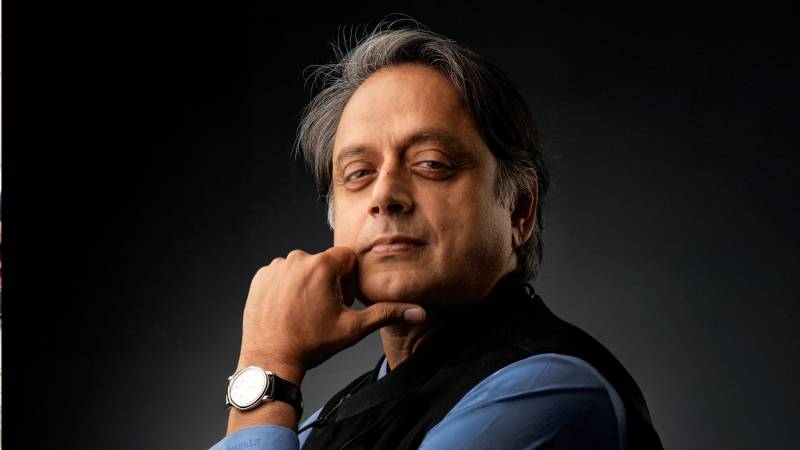
Author’s Note: This article was penned on February 15 this year in response to Dr Shashi Tharoor’s op-ed in The Indian Express. It was sent to an Indian publication, which was initially interested but then backed off. The author then tried another Indian publication, which was interested in placing it in both the print and the web editions. But that was not to be after their editorial meeting, in which the majority view was that it would unnecessarily put them in the crosshairs of the current Indian government. Below, The Friday Times is printing it without any update.
“If you board the wrong train, it is no use running along the corridor in the opposite direction.” (Dietrich Bonhoeffer, pastor, theologian, dissenter; 1933)
Written during the Nazi era, Bonhoeffer’s advice was stark: if a society or state has got the direction fundamentally wrong, it can’t run in the opposite direction to get it right. It needs to get off that train.
Easier said. How does one get the Daedalion wings to escape the maze, the bind?
India’s politician, diplomat and public intellectual Dr Shashi Tharoor penned a column last month for The Indian Express titled “For India-Pak peace is not weakness, dialogue is not defeat”. It’s an improvement on what he wrote last year in April, “Hit Hard, Hit Smart”, though it still gets the cause and effect wrong. I shall come to that. But let me begin with what he wrote last year, a column that was dictated more by the flow of immediate passions than an understanding of war, its conduct or why the Sturm und Drang of war lays to rest the flawed assumption that the adversary is a cut-out.
I am not going to flyspeck Dr Tharoor’s recommended strategy in that column because that would take us into the complexities of war, a phenomenon much written about but whose intricacies continue to elude even the managers of violence. That said, to establish the point, I would take two examples from Napoleon Bonaparte’s campaigns, a general who spoke of coup d’œil but still made disastrous decisions because the battleground tactics are not the same as the politico-strategic objective, Clausewitz’s Zweck, for which the battles (Ziel) are fought.
Bonaparte began his Russia campaign while suffering from the Spanish ulcer. He crossed the Neman River in June 1812 even as an Anglo-French army led by the Duke of Wellington was arraying to give battle to the French at Salamanca. The French were defeated at Salamanca in July 1812. By then, Bonaparte had already lost about 100,000 troops in today’s Belarus, by some estimates.
The interesting, some would say ironic, fact is that he did not miscalculate Russia’s expansive terrain. If anything, he understood it perfectly, focusing diligently on logistical preparations for the campaign for an entire year. Despite extensive preparations and remarkable organisational skills, his campaign extended, in time and space, beyond his original calculation because the Russians wouldn’t give him an early decisive victory and burnt everything as they lured him deeper into their territory.
The biggest problem with war and neat war plans is that they don’t survive the “storm of steel” to use Ernest Junger’s phrase because the adversary has his own will, capabilities and agency
Humans seek clarity. When dealing with complexity, we try to parse and find the passepartout that can unlock the internal logic of multivariate relationships. But it’s difficult enough to predict outcomes even as a conflict unfolds, let alone project trends into new situations where specifics may differ from past events. As military historian Cathal Nolan has put it, “More often, war results in something clouded, neither triumph nor defeat. It is an arena of grey outcomes, partial and ambiguous resolution of disputes and causes that led to the choice of force as an instrument of policy in the first place.”
Dr Tharoor got it wrong with his hit hard and hit smart advice. But he is in good company. If legendary generals and state machineries can get war and its outcomes wrong, one shouldn’t be tough on him. Passions can defenestrate (it’s Dr Tharoor’s favourite word!) cold calculation. They can also make us oblivious to what should be obvious: in war, you are not applying force to an inanimate object. The biggest problem with war and neat war plans is that they don’t survive the “storm of steel” to use Ernest Junger’s phrase because the adversary has his own will, capabilities and agency. He has a vote.
With the recent column, Dr Tharoor seems to be melting at the edges. That’s good. But he still gets the basics wrong. For the purpose of parsing, I will only consider Kashmir since it has come to define Pakistan-India relations. He analyses it as an India-Pakistan problem defined by “Pakistan-sponsored terrorism”. This is wrong. Kashmir is about Kashmiris and their right to self-determination. And resistance is not terrorism. That fact goes back to UNGA resolutions, a body of which Dr Tharoor was once a leading light. Secondly, Kashmir remains restive, India’s all-is-well mantra post-August 5, 2019, notwithstanding.
But before I get to the self-determination part, which India continues to deny Kashmiris, even as the Congress-affiliated intellectuals pay lip service to “ordinary Kashmiris” who presumably want to live peacefully, let me talk terrorism.
The wounds of history may be deep, and the provocations of the present real, but Dr Tharoor is right in assessing that “permanent disengagement is not a solution
Even before 9/11, but more loudly since then, states have deliberately conflated resistance with terrorism. Terrorism is not just a word. It denotes the exercise of power, power over a people who are resisting hegemonic control. In this construct, language is not just important; it’s crucial.
Terrorism is supposed to evoke a response, a negative one. But its placement in the language is more than that. It is about setting a context and wielding power.
Robin T Lakoff, a linguistics professor who wrote the book The Language War, says, “…since so much of our cognitive capacity is achieved via language, control of language — the determination of what words mean, who can use what forms of language to what effects in which settings — is power. Hence the struggles I am discussing…are not tussles over ‘mere words,’ or ‘just semantics’ — they are battles.”
On August 5, 2019, the Bharatiya Janata Party (BJP) government led by India’s Prime Minister Narendra Modi and fired by the Hindutva ideology (a sociopolitical, racist concept distinct from Hinduism) changed the status of Jammu and Kashmir. Doing so was part of the party’s manifesto. The fact, however, is, as definitively presented by the late AG Noorani, that the Congress-led governments had begun to hollow out the constitutional arrangement with J&K even as that compact was made.
In Pakistan, we do not accept that internal arrangement because we do not accept the very Instrument of Accession that Hari Singh had presumably signed with India. I am not even getting into questions about the veracity of that document. Even if such a document were signed and on the date as claimed, Singh, as multiple works concede, had lost control of his territories and had no locus standi in the matter.
That issue, of self-determination, remains unresolved and on the agenda of the UN. There aren’t just two parties in this matter. There are three, and Kashmiris on both sides are central to it. India continues to prescind Kashmiris and subject them to slow, structured violence just like Israel does to the Palestinians. In fact, India has taken much from the Zionist playbook.
Dr Tharoor says India needs to formulate a policy “that is firm on security, flexible on contact, and clear on purpose — to prevent conflict, not merely postpone it”. This is a pious but half-baked whiteboard exercise, which will crash on the rocks of BJP’s internal politics, a fact that Dr Tharoor would concede. A more empathetic Indian intellectual, former diplomat and politician, Mani Shankar Aiyar, has been speaking of the imperative of an “uninterrupted and uninterruptible” dialogue between Pakistan and India for over two decades. That is the approach to take, wedded to a process that sets the premise of the problem right.
The wounds of history may be deep, and the provocations of the present real, but Dr Tharoor is right in assessing that “permanent disengagement is not a solution. It is a surrender to cynicism”. That “cynicism”, unfortunately, is central to the BJP’s policy not just vis-à-vis Pakistan but also, internally, to the Muslims in India. That fact, too, Dr Tharoor will be hard-pressed to deny.
Dr Tharoor believes that “Indians have a well-justified mistrust of the Pakistan military and in particular of its ‘deep state’”. Let me inform him that this distrust runs both ways. But he is right when he says, “peace is not weakness — and dialogue, when conducted wisely, is not defeat”.
To this I will say, “Sir, get the premise right, which means looking at this not from a unilateral lens of what India needs and must have, but to understand that diplomacy is the art of empathising with other actors’ interests and agency. If India under this government can do that, Pakistan will eagerly respond and positively.”