

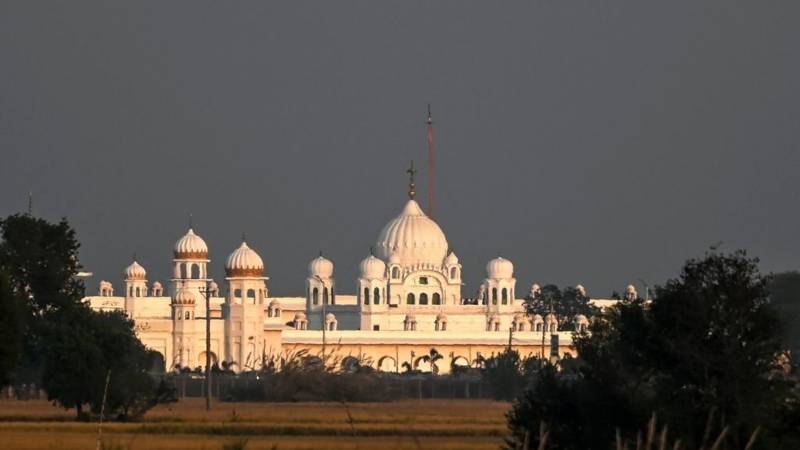
Among the thousands who once walked through the Kartarpur gate was Gurbej Singh, a soft-spoken man from a small town in Madhya Pradesh. In 2023, he travelled with a group of pilgrims to Pakistan to celebrate the birth anniversary of Guru Nanak, his third visit across the border.
Singh’s parents had migrated from Pakistan in 1947, leaving behind the fields and friends of their childhood. Like many Hindu and Sikh families uprooted during Partition, he had grown up listening to stories of horror and longing. Crossing over, he said, felt like stepping into those memories.
“It’s an experience of a lifetime,” he recalled. “All the notions that we carried for years broke. Everyone there was warm and hospitable. You just want to go back.”
His words mirror the quiet yearning of many Indian Sikhs who, despite distance and politics, still see Kartarpur as sacred home ground, a bridge that heals wounds geography has refused to forget.
When the Kartarpur Sahib Corridor opened in November 2019, it was more than an infrastructure project; it was an act of faith in a season of hostility. Just months earlier, India had revoked Jammu and Kashmir’s special status, setting off one of the sharpest diplomatic freezes in decades. Troops massed along the border. Airspace was restricted. Yet, against this backdrop of mistrust, the gates to Guru Nanak’s final resting place swung open.
India’s Prime Minister Narendra Modi inaugurated the passage with uncharacteristic warmth, thanking then Pakistani Prime Minister Imran Khan “for understanding the public sentiment.” The five-kilometre stretch linking Dera Baba Nanak in Indian Punjab to Kartarpur Sahib in Pakistan was hailed as a miracle of faith over politics, a corridor of hope through decades of division.
For once, both sides spoke of peace. “The corridor will bring our countries closer,” officials declared. Newspapers called it a bridge of hope. Television channels described it as the most positive story in decades.
But faith, no matter how fervent, was never going to be enough to withstand the winds of geopolitics.
Five years later, the corridor lies silent. In May this year, after the Pahalgam terror attack and India’s subsequent Operation Sindoor, brief but fierce border clashes froze multiple confidence-building measures. The Kartarpur Sahib Corridor, once touted as a symbol of lasting peace, became one of the casualties.
For the Sikh community, the closure was devastating.
Kartarpur Sahib was never just a shrine. It was an experiment in faith-based diplomacy, a reminder that borders cannot contain devotion
“It’s like going back to the days when we could only see Kartarpur through binoculars,” said Daya Singh, a Sikh scholar and peace activist. “If our teams can play cricket in third countries, why can’t our people pray in each other’s shrines?”
The Pakistan High Commission in New Delhi has continued issuing visas under the 1974 Bilateral Protocol on Visits to Religious Shrines, allowing limited pilgrimages to other Sikh holy sites such as Nankana Sahib and Panja Sahib. But access through the Kartarpur Corridor itself, which once allowed up to 5,000 pilgrims a day to cross visa-free, remains barred.
Sikh organisations had hoped that Guru Nanak’s birth anniversary this November would bring a reopening. “We are still hopeful,” said Paramjeet Sarna, president of the Delhi Shiromani Akali Dal. “Kartarpur is not about politics — it’s about peace.”
The bridge that rose above history
For decades, Indian Sikhs could only glimpse the white domes of Kartarpur Sahib through binoculars from Dera Baba Nanak, across the barbed wire fence. The shrine where Guru Nanak spent the final 18 years of his life lies barely four kilometres inside Pakistan, on the banks of the River Ravi.
When the corridor finally opened, emotion overcame politics. Pilgrims wept as they stepped on Pakistani soil without visas for the first time. Elderly men bent to kiss the earth. Partition survivors saw it as a reunion delayed by seventy-two years. Even as Delhi and Islamabad exchanged sharp words over Kashmir, Sikhs from both countries prayed together under the same roof. For a brief moment, faith succeeded where diplomacy had failed.
Ajay Bisaria, India’s former High Commissioner to Pakistan, views the corridor’s closure as part of a recurring cycle. “Every thaw between India and Pakistan comes under strain after a security crisis,” he said. “Kartarpur survived Pulwama and Balakot, which was remarkable. But the May conflict tested the limits of public goodwill.”
Still, Bisaria remains optimistic. “People drive policy,” he said. “Kartarpur will reopen because it represents something larger than politics, a shared heritage.”
That shared heritage was tested even before the corridor’s inauguration. During early negotiations, Pakistan proposed allowing entry without passports, a gesture it called Khule Darshan De Daad, or open, unrestricted pilgrimage. India refused, insisting on formal documentation and viewing the offer as a political manoeuvre.
Despite the mistrust, both sides managed a remarkable compromise: a visa-free passage monitored but not fenced by bureaucracy. It worked until it didn’t.
Guru Nanak’s message beyond borders
More than five centuries ago, Guru Nanak preached that humanity transcends creed. Travelling from Kabul to Cuttack, he spoke of equality, compassion, and dialogue. For Muslims, he became a Pir; for Hindus, a Guru. His teachings, sung by farmers and fakirs alike, remain a moral compass for the subcontinent.
“Jab lag dunee-aa rahee-aa Nanak, kichh sunee-ai, kichh kahee-aa.” (As long as you live, listen and say what is good.)
“Ho-ay ikatar milhu mayee-re bhaa-ee dubiDhaa door karahu liv laa-ay.” (Come together, brothers, and remove your differences.)
These verses, etched into Kartarpur’s marble, now echo across empty courtyards as a reminder that the Guru’s call for dialogue still awaits an answer.
Kartarpur Sahib was never just a shrine. It was an experiment in faith-based diplomacy, a reminder that borders cannot contain devotion. When it opened, it showed what South Asia could look like if empathy, not enmity, shaped policy.
Reopening the corridor will not erase decades of mistrust. But it would mark a return to something more human, a recognition that peace often begins with small gestures: a handshake, a shared prayer, a corridor across a river.
For India, restoring the passage would signal confidence, not concession. For Pakistan, it would affirm that goodwill can endure beyond symbolism. And for the millions of Sikhs who still stand at Dera Baba Nanak, gazing through the fence, it would mean faith rewarded.
From the Indian side, Kartarpur’s gleaming white domes still shimmer across the border, reflecting the afternoon light off the Ravi. The sight is both beautiful and painful, a dream visible, but just out of reach.
The pilgrims who once walked its marble paths now wait again, their prayers carried by wind across the divide. Among them is Gurbej Singh, who says he still looks towards Pakistan with quiet hope. “When I went there,” he said, “it felt like meeting family.”
The corridor of hope remains closed. But the faith it inspired and the bridge it built in people’s hearts refuses to be fenced in.