

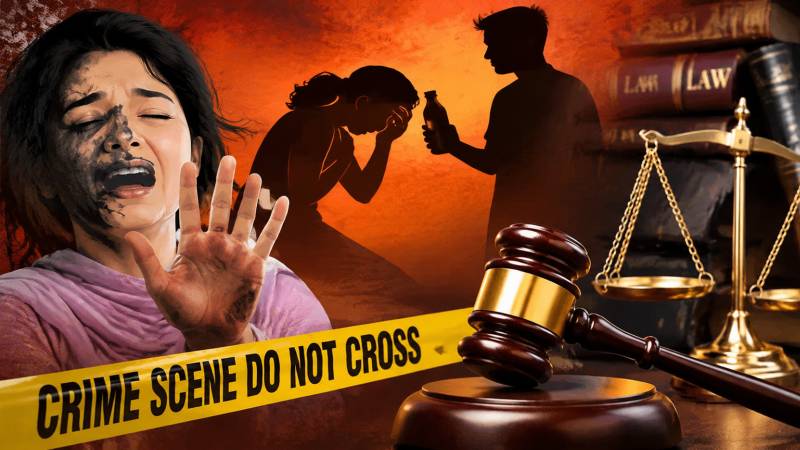
Imagine being a married woman in a conservative tribal society, where you are routinely beaten in the home where you expected to spend your life. One day, acid is thrown on your face by your in-laws. No one knows, yet you endure the pain for ten agonizing days. 10 days with acid burning your flesh, receiving no treatment and telling no one, because endurance is regard as a woman's only duty in a society that taught her to bear it.
Then, on a random visit, your brother discovers your condition, and your family finally rescues you from that prison house, and rushes you to a hospital. But here instead of receiving urgent emergency care, you are met with legal obstacles, and the hospital refuses to help until you produce a formal police complaint. This is not a tale or a story but a real-life misery of a woman from Balochistan.
According to the district police, a man named Kaleemullah threw acid at his wife in Killi Babbri, located in the Derangarh area of Mastung. The incident occurred on August 28, while the case was registered on September 7 on the complaint of the victim's brother. “At first, I was beaten up and I lost consciousness,” said the victim, in an audio recording released to the media, provided by her brother. “When I regained consciousness, my brother-in-law and sister-in-law were holding me down, and then my husband threw acid on me. My face started burning, and I lost consciousness again. When I revived again, my face was burned, but I was not even taken to a doctor for ten days. I just lay there.”
She was treated for two days in the burn unit of Civil Hospital Quetta. On the morning of September 10, she was shifted to Aga Khan Hospital in Karachi for further treatment on the directions of the government. As per the victim's brother, one side of her face is affected by acid. “The surgeries have resulted in good outcomes. After two weeks, doctors will start treating her one eye.” He hopes that the vision of her effected eye will be saved.
According to the First Information Report (FIR), the accused's brother is also involved in the acid attack and the domestic violence against her. Police have been searching for the main culprit and the others, but no arrests have been made yet. Ijaz Sumalani, the brother of the acid attack victim, alleged that he had first brought her to a government hospital in Quetta, but the hospital administration refused to admit her despite the severity of her acid-burn case. “I took her back to Mastung in this condition to get the police report,” he said “After that, we went to Ghous Bakhsh Hospital in Mastung, and from there she was referred back to Quetta.” She was lucky, at least, to live near the capital city, just 50 kilometers from her home. Had she been a resident of Taftan, she would have had to travel for two days to get back to Quetta, a journey that heavily depends on the law and order situation. “If the acid attack is recent, we provide first aid and then start treatment, if it is an older incident, we require a formal police complaint first,” said a doctor at the Burns Unit of Civil Hospital when asked about the SOP for admitting acid-attack victims.
“Legally, one cannot require a police report first from a patient who needs urgent treatment. The hospital should inform the relevant police station and complete the necessary legal formalities itself. The law is clear: first save the human life, then decide other things.” — Advocate Imran Baloch
Professor Habib Khajak, the head of the unit, says, “Patients with burns of any category can approach the burn unit, but medico-legal cases, whether burns or otherwise, are admitted through the emergency or trauma center. A medical officer, such as a police surgeon, must examine and refer the patient to the burn ICU.” When asked why his unit had initially refused to admit the victim, he advised contacting the investigating police officer regarding the reasons for the delay in reaching the medical facility. The MS hospital was contacted both on call and Whats App, but he did not responded. Saeed, the investigating police officer of the case, further updates, “The accused and his brother have not been arrested yet. We wrote a letter to the FC, and they have replied and are cooperating with the police. The accused was stationed in Muslim Bagh, but currently, he is an absconder.”
When asked about the delay, he said the police were not responsible for it. “When the victim approached us, we started taking action, and completed all the legal formalities promptly.” "In general practice, the law dictates that once a criminal act happens, the plaintiff must register the case as soon as possible. A delayed complaint gives the benefit of the doubt to the opponent. The purpose of requiring a police report in a hospital is not to harm the patient, but to facilitate and protect them if the case goes to court," says Quetta-based lawyer Advocate Imran Baloch.
Legally, one cannot require a police report first from a patient who needs urgent treatment, he stated “Instead, the hospital should inform the relevant police station, something both the doctors and the hospital administration can do." Baloch further explains, “In case an acid attack happens in Dalbandin and treatment is possible only in Quetta, the police station near the hospital can record the victim's statement. Furthermore, the police can register a case regardless of jurisdiction, which is called a Zero FIR. The law states: first save the human life, then decide other things.” He suggests that there should be a police station, or at least a dedicated police unit, in every government hospital to help patients complete police paperwork at a single location, and the unit must be empowered to lodge a Zero FIR so that medical treatment can proceed uninterrupted.
The acid-attack victim from Mastung did not initially catch the authorities' attention because her case did not go viral in the media, and there was no shocking footage of the attack. Here, to get justice, one must be on screen, only then might dormant authorities be awakened. The tragic irony is obvious, this happened at Quetta Civil Hospital, the very same institution where Dr. Mahnoor Nasar was seriously injured in June 2026 after a hospital lift operator threw acid on her, and the same hospital that allegedly refused to admit the Mastung victim initially.
The Masutng acid victim was referred to Karachi for treatment following local media coverage which drew attention to the unequal treatment of victims. The Balochistan Alliance to End Violence against Women and Girls (EVAW/G Alliance) and the Aurat Foundation (AF) have expressed deep concern over increasing incidents of violence against women in the province. The alliance has condemned the Mastung acid attack while demanding immediate and complete medical treatment, psychological support, legal assistance, and protection for the victim. The last acid attack case in Balochistan was registered with us in 2019, and until the end of 2025, no other case had occurred, according to Allauddin Khilji, resident director of AF. He shares that at least four cases have already been registered this year.
Acid attack cases in Balochistan are low compared to other provinces. According to Home Department data, seven cases of acid attack have been registered in the province since 2021. However, the Mastung incident has highlighted a pattern of how acid attacks and other cases of gender-based violence (GBV) often go unreported in the province due to various factors, most notably societal stigma. Furthermore, these two acid attacks on female occurring in such a short span of time have heightened concerns regarding the protection of women and the prevention of such violence in Balochistan.
On August 31, the Balochistan Assembly adopted a resolution presented by the Women’s Parliamentary Caucus (WPC) calling for the severest possible punishments for perpetrators of acid throwing, immediate and effective rehabilitation, and free medical, financial, legal, and psychological support for victims. The resolution also stresses strict regulations and oversight regarding the purchase, sale, and transportation of acid. Recently, the provincial assembly amended the Anti-Terrorism Bill on September 3, shifting the jurisdiction for acid attacks and crimes against the state directly to Anti-Terrorism Courts to bypass bureaucratic delays and ensure rapid, time-bound trials for the accused.
"Under this amendment, acid throwing is now classified as an act of terrorism, and such cases will be tried in Anti-Terrorism Courts rather than ordinary courts. The amendment also empowers the authorities and revises the requirements concerning public prosecutors and Additional District Public Prosecutors (ADPPs)," says Advocate Imran Baloch.
On Sep 8, the Senate Standing Committee on Interior approved a bill to enhance the punishment for acid attacks from life imprisonment to death. In its landmark judgment in August, the Supreme Court of Pakistan called acid attacks more heinous than homicide. The court has recommended the establishment of a national acid survivors’ rehabilitation fund and called for a digital system to monitor all acid sales in real time across all provinces and the federal capital. Punjab is the only province in the country that passed a specialized provincial law in April 2025 to regulate and control the sale of acid. The Mastung acid attack victim was rescued by her brother, an employee of a private company earning less than minimum wage. Ijaz said he had promised his sister that he would not let the accused escape justice under any circumstances, and brought him before the court to ensure justice for her. He vowed to take care of his sister and her 11-month-old child.