

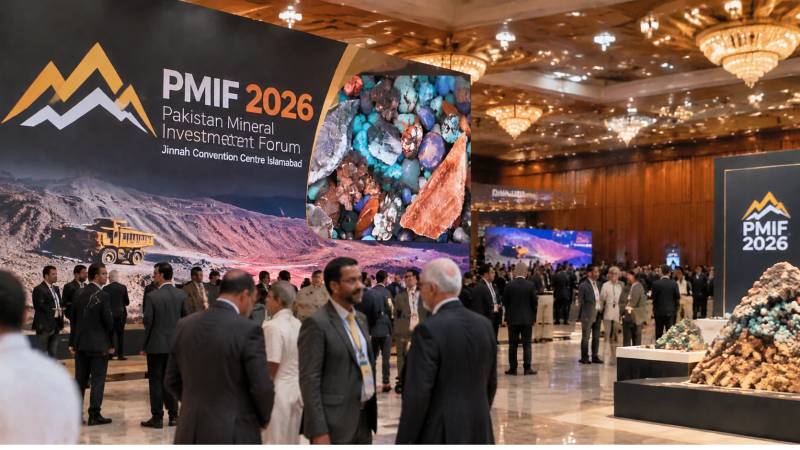
When the second Pakistan Mineral Investment Forum (PMIF 2026) convenes at Islamabad's Jinnah Convention Centre on November 12, the spotlight will be on the country's vast mineral potential and its ambitions to attract international investors. Yet beneath the presentations, investment pitches and diplomatic engagements lies a more fundamental question: how can Pakistan attract the capital and expertise it desperately needs without compromising its economic sovereignty?
Pakistan's mineral wealth has long been presented as an opportunity to transform its economic fortunes. From copper and gold in Balochistan to other largely untapped mineral deposits across the country, the potential is considerable. But geological potential alone does not translate into economic prosperity. The country's history of political instability, regulatory uncertainty, contested resource ownership and difficult relations with international investors offers a cautionary tale. Developing economies routinely confront the challenge of balancing investment protection with the right to regulate their natural resources. For Pakistan, however, this debate has acquired particular urgency as the government seeks to position mining as a major pillar of economic recovery.
Pakistan's relationship with international investment arbitration dates back several decades. It signed the Convention on the Settlement of Investment Disputes between States and Nationals of Other States (ICSID Convention) in 1965 and ratified it in 1966. The convention established a framework through which disputes between states and foreign investors could be resolved through international arbitration, provided the parties had consented to it. Such arrangements can provide investors with confidence that contractual and investment disputes will not be determined solely through domestic political or judicial processes. However, they can also expose governments to substantial financial liabilities when investment agreements are breached or international obligations are violated.
The Reko Diq dispute demonstrated the potential consequences. In 2011, Pakistan's decision to deny the mining lease to Tethyan Copper Company, a joint venture involving Barrick Gold and Antofagasta, triggered an international legal battle. In 2019, an ICSID tribunal awarded the investors approximately $5.84 billion in damages and interest. The award was a major setback for Pakistan, which was already struggling with a precarious economic situation. It also exposed weaknesses in the country's approach to negotiating, regulating and managing major foreign investment projects. The dispute was eventually resolved through a restructured agreement in 2022, bringing Barrick Gold back into the project alongside Pakistani federal and provincial entities. The revised arrangement offered Pakistan another opportunity to develop one of the world's significant undeveloped copper and gold deposits.
But Reko Diq should not be understood merely as a story of a foreign investor returning to Pakistan. It is also a lesson in the importance of contractual transparency, institutional competence and the careful balancing of commercial interests with public accountability. The challenge becomes even more complicated when the geographical concentration of mineral resources is considered. Balochistan, which holds some of Pakistan's most significant mineral deposits, has experienced decades of political alienation, insurgency and insecurity. Its mineral potential cannot be separated from these realities.
For international mining companies, security is an essential consideration. Large-scale mining operations require long-term commitments, substantial infrastructure and predictable regulatory environments. Persistent insecurity increases costs, discourages investment and makes project implementation considerably more difficult. Yet security alone cannot provide the foundation for sustainable development. Balochistan's longstanding grievances concerning political representation, resource ownership and the distribution of economic benefits must be addressed if large-scale mining is to enjoy meaningful local legitimacy. Communities living in resource-rich districts should not merely be spectators to projects taking place on their land. They should have a tangible stake in the economic opportunities these projects generate.
This requires transparent revenue-sharing arrangements, employment opportunities for local populations, investment in education and infrastructure, environmental safeguards and meaningful consultation with affected communities. Without these measures, even commercially successful mining projects risk deepening existing grievances rather than contributing to political and economic stability.
The establishment of the Special Investment Facilitation Council (SIFC) represents another significant development in Pakistan's efforts to attract foreign investment. Created to coordinate investment-related decisions across federal and provincial institutions, SIFC seeks to overcome bureaucratic obstacles and provide investors with a more predictable environment. Its emphasis on civil-military coordination reflects the government's assessment that conventional institutional arrangements have struggled to deliver the speed and consistency required for major investment projects.
There is a practical argument for such coordination. Investors considering projects involving billions of dollars need clarity on regulatory approvals, land acquisition, infrastructure, security and long-term government commitments. Fragmented decision-making and frequent policy reversals can undermine even the most promising investment opportunities. However, the concentration of investment facilitation within a powerful institutional framework also raises important questions about transparency, parliamentary oversight and the respective roles of civilian governments, provincial authorities and the military establishment.
Investment facilitation should not come at the expense of institutional accountability. Nor should the urgency of attracting foreign capital become an excuse for bypassing established legal and constitutional processes. Pakistan's recent diplomatic outreach, including its engagement with international investors and renewed efforts to strengthen relations with the United States and other economic partners, demonstrates an awareness of the importance of international capital. The challenge is to translate diplomatic goodwill into commercially viable projects that deliver measurable economic benefits.
The government's presentation of Pakistan's mineral potential to international investors, including during high-level engagements with US President Donald Trump, was part of this broader effort. PMIF 2025 similarly sought to position Pakistan as an attractive destination for mining investment. But promotional events and memorandums of understanding are only the beginning. The real test is whether they produce actual investments, operational projects, technology transfers and employment opportunities. There is also a broader economic question that Pakistan must confront: will it simply extract and export its mineral resources, or will it use them as the foundation for domestic industrial development? Countries that have successfully leveraged natural resources have generally understood that the real value of minerals extends beyond their extraction. Processing, refining, engineering, manufacturing and associated services can create employment, develop technical expertise and generate economic activity far beyond the mining sites themselves.
Pakistan must therefore think beyond the immediate attraction of foreign mining companies. It needs a coherent mineral development policy that connects extraction with industrialisation, local capacity-building and technological advancement. This also requires acknowledging the risks associated with resource-dependent economies. Weak institutions, opaque contracts, environmental degradation and unequal distribution of revenues can turn natural wealth into a source of political conflict rather than national prosperity.
As PMIF 2026 approaches, Pakistan has an opportunity to move beyond the rhetoric of untapped potential. The country needs investment, but it also needs institutions capable of negotiating favourable agreements, enforcing regulations and ensuring that the benefits of resource extraction are distributed fairly. The choice is not between foreign investment and national sovereignty. Nor is it between opening the country's resources to international capital and protecting them from exploitation. The real challenge is to develop an investment framework in which these objectives reinforce rather than undermine each other.
Pakistan's mineral wealth could become an important driver of economic transformation. But the success of that ambition will not be measured by the number of foreign investors attending conferences in Islamabad or the value of memorandums signed. It will be measured by what happens after the cameras are switched off: whether investments materialise, whether local communities benefit, whether institutions remain accountable and whether the country's natural resources contribute to a broader process of sustainable economic development. That is the real test facing Pakistan as it prepares to welcome the world to PMIF 2026.