

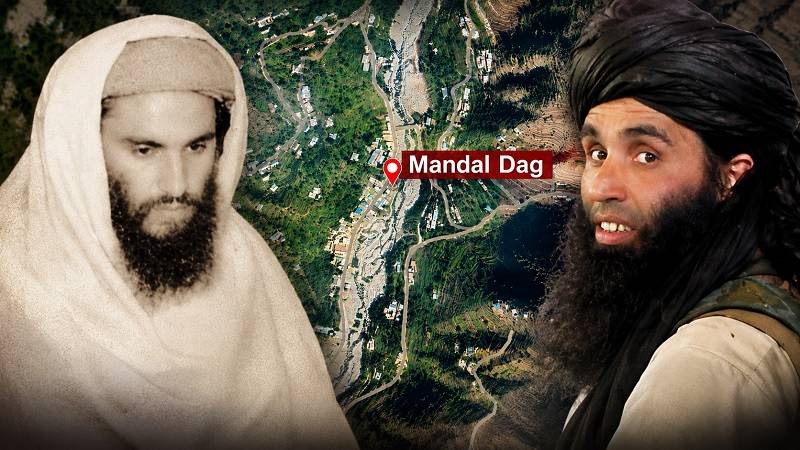
On an afternoon in mid-December 2008, the local Taliban tied a corpse to the back of a jeep and dragged it from Mandal Dag, a remote mountain village in Matta tehsil of Upper Swat, to the crossroads at Gwalerai, about two kilometres away. The body had been dug out of its grave that day. It belonged to Pir Samiullah, a Sufi spiritual guide who, until a few days earlier, had been the most prominent man in Swat to raise a tribal army against the Taliban.
For three days, his body was left hanging at the crossroads. Fear kept people in nearby villages confined to their homes or forced them into silence. On that same day, in the same village of Mandal Dag, two captives, a 70-year-old man named Mishkar and his 68-year-old brother, Malik Khan, were slaughtered in front of villagers. The message was unmistakable; this was the fate awaiting anyone who dared to oppose the Taliban.
For me, that December also marked a personal turning point. It was the time I said goodbye to my village. I have never had the chance to return and resettle there.
Pir Samiullah and eight of his followers were killed in a gun battle, while 22 others were captured. He was the first prominent local figure to organise a lashkar, or tribal militia, to drive the Taliban out of the area.
When the Taliban stormed his village, the first shot in its defence was reportedly fired by a woman. She stood her ground for hours before she was finally killed. Her story survives in the memories of villagers, but her resistance, like that of so many others, has never been properly documented. The courage she displayed that day deserves to be recorded, as do the stories of the other people who resisted and whose names have largely disappeared from the historical record.
It is worth recalling that, in October 2008, Gwalerai was also the village where elders from surrounding communities gathered in a mosque and gave the Taliban three days to leave. On 26 October, around 80 elders travelling to a follow-up jirga at Wenai were ambushed near Aghal, a village before Wenai, where the routes to the Peochar and Beha-Roringar valleys diverge. They were taken hostage, and at least 12 were shot and hanged.
The Taliban also attacked people attending the jirga in Gwalerai. Sixteen people were killed. Some survivors still carry the wounds of that violence, while some of the victims were slaughtered and their bodies hung from telephone poles. I still remember the face of our friend, Kaka Ji, who used to sell us hunting guns. His story, too, deserves a separate account.
Yet amid the bloodshed, the destruction of villages and the killing of community leaders, few accounts have asked a more fundamental question: who was Pir Samiullah? Why did a Sufi from a remote mountain valley become one of the Taliban’s most dangerous local enemies? And what, if anything, had he been promised before he took up arms?
A boy from the mountains
Samiullah was born in 1979 in Mandal, a narrow, remote mountain valley about 20 kilometres north of Matta. The surrounding hillsides are home largely to Gujjars, a pastoral community whose settlements extend above the Pashtun villages along the river. Samiullah belonged to the Kattani clan of the Gujjars.
His father, Muhammad Umar Khan, worked as a chemical supervisor at the Khazana sugar mill near Charsadda between 1989 and 1996. Samiullah attended primary school there before moving to a government school in Peshawar’s Khyber Bazaar.
He left school in the sixth grade.
The Taliban also sought to bring him into their so-called movement. He refused. Threats followed, along with demands that he stop preaching, close his shrine and eventually leave the area.
In 1996, the family returned to Mandal Dag. According to his brother, Muhammad Saleem, Samiullah had been devout from childhood and spent much of his time in the mosque. He had no formal madrasa education. Instead, his religious formation came through a succession of spiritual teachers.
The seeker
In 1996, according to Saleem, the prayer leader at the family’s local mosque, Qari Muhammad Naeem, introduced the teenager to Muhammad Shirin, known as Marghuzar Baba. A Sufi who spent long periods in retreat in the hills around Marghuzar, the former seat of Swat’s princely rulers, Baba became Samiullah’s spiritual guide.
Samiullah became his disciple. His father initially opposed his involvement in Sufism but eventually relented at the elder’s request.

Pir Samiullah
The relationship lasted about three years before ending over an incident at the mosque in Mandal Dag. Samiullah was a vocal opponent of the Tablighi Jamaat. When visiting Tablighi preachers arrived in the village, he threw their bedding out of the mosque and told them to leave.
The preachers complained to Marghuzar Baba. Although Baba was not himself a Tablighi, he did not oppose the movement. He subsequently expelled Samiullah from his circle. Baba died in March 2016.
Samiullah then continued his search for spiritual guidance across the province and beyond. He spent a short time with a pir in Thana, in Malakand, before being directed to another spiritual guide in Sher Garh, near Mardan. His journey eventually took him to Pakpattan in Punjab, where he spent three to four years.
There, under a Lahore-based teacher, Pir Saeed Ahmad, he trained in the Qalandariya Nizamiya Sufi order.
When Samiullah returned to Mandal, he had acquired religious knowledge, a spiritual lineage and a growing reputation. He established himself at a mosque, and people began coming to him for guidance. As his following expanded, he moved to a nearby house and began running a langar, a communal kitchen providing free meals.
His followers came not only from across Khyber Pakhtunkhwa but also from Punjab and Sindh. He travelled to the shrines of Sufi saints, attended their annual urs celebrations and took selected disciples with him. He also made an annual pilgrimage to the shrine of Ajmer Sharif in India. By one cautious estimate, his following in Matta tehsil alone exceeded 10,000, most of them Gujjars.
For a man with little formal education, Samiullah had established a considerable spiritual and social presence. His authority rested not on an official position or a state institution but on his religious standing, his personal relationships and the trust of his followers. That influence would eventually make him a target.
Why the Taliban wanted him gone
By 2008, Mullah Fazlullah’s Taliban had spread across Swat. Police had withdrawn to Mingora, parallel courts had been established, and the police station in Matta had been renamed a Taliban station. Many people who might otherwise have resisted had fled to Islamabad, Peshawar or abroad.
The Taliban’s strategy was not limited to confronting the security forces. They also targeted people capable of mobilising resistance within their own communities: elders, influential figures and men who commanded the trust of their neighbours. Such people were often accused of spying for the security forces.
Pir Samiullah fitted that profile.
He had a substantial following, enjoyed considerable support among the Gujjars and belonged to a Barelvi Sufi tradition that differed from the religious outlook of a movement whose local supporters were largely associated with Deobandi and Panjpiri currents.
He called the Taliban Kharijites, a term with a long and deeply contested history in Islamic theology, and challenged Fazlullah to a public religious debate on several occasions. The debate never took place.
The Taliban also sought to bring him into their so-called movement. He refused. Threats followed, along with demands that he stop preaching, close his shrine and eventually leave the area.
Instead of abandoning his village, Samiullah barred the Taliban from entering Mandal Dag, The confrontation became increasingly visible: the Taliban established a checkpoint at one end of the road between Roringar, a village before Mandal Dag, while his followers dug in at the other.
Samiullah faced opposition beyond the Taliban as well. Followers of other religious traditions in the valley, including Deobandi, Panjpiri and Ahl-e-Hadith adherents,mocked his teachings.
I still remember the propaganda directed against him. One rumour claimed that the Pir travelled to Madina for Friday prayers using a roster rather than an aeroplane. The absurdity of the claim did not prevent it from circulating.
At one point, a disciple in Dera Ismail Khan offered Samiullah land there and urged him to relocate. The plot, according to the account shared with me, remains in his name. But Samiullah refused to leave his valley.
For him, Mandal Dag was not simply a place of residence. It was the centre of his spiritual life, his following and his authority. Leaving would have meant surrendering all three.
First blood
According to local residents, the fighting began on 5 September 2008, when the Taliban attacked Mandal Dag despite an existing truce.
Abdul Malik, a resident of Mandal Dag, told me that 60 people died that day, including four supporters of the Pir.
He said the Taliban claimed to have lost 55 men of their own and that Ibn Amin, the Taliban’s governor for Matta, acknowledged heavy losses over the militants’ radio. The reported dead included a senior commander, Shamsher Khan, who was Ibn Amin’s cousin.
One of the Pir’s four dead was his youngest brother, 26-year-old Imran Ali. Imran was wounded in the fighting and was being taken to the district hospital at Saidu Sharif when the vehicle carrying him was stopped at a Taliban checkpoint in front of Roringar High School.
According to Muhammad Saleem, the Pir’s brother, Imran was told that he would be spared if he denounced Samiullah as a kafir, or unbeliever. Instead, he denounced Fazlullah.
Saleem says Imran was shot 14 times. He further recalls that, after his brother had died, his body was fired upon more than 500 times.
Other members of the party were taken to the Taliban headquarters at Peochar.

Imran Ali, Pir Samiullah’s younger brother. The Taliban shot him more than 500 times.
From that day, the feud became an open war, although truces lasting two days or longer were reached at different points along the way. None resolved the underlying dispute.
A jirga of kin
The valley’s own traditions offered a possible way out. Elders from the Gujjar community convened a jirga and invited the Taliban to negotiate.
Three or four rounds of talks followed, but they failed to produce a settlement. The Taliban would not agree to let the Pir remain, while the Gujjars were unwilling to expel him from their community.
At the final jirga, the Gujjar elders agreed to ask Samiullah to leave.
The offer
According to local accounts, rumours circulated that the Pir had been promised substantial support if he agreed to fight the Taliban. The reported assurances included 40 trained men to operate the weapons that would be supplied, along with financial assistance to cover the costs of the lashkar.
The estimated cost of maintaining the force was said to be three crore rupees over six months.
The scale of the proposed support mattered. Many of the men who made up Samiullah’s lashkar were labourers who travelled to sugar mills in Punjab and Sindh to earn a living during the winter.
They were not full-time fighters. The money was reportedly intended to compensate for the wages they would lose by remaining in the valley to defend their homes and families.
Some weapons were indeed received, according to the some sources. But the extent of the promised assistance, the precise terms of any arrangement and the commitments made require further verification.
Samiullah accepted the reported promises without consulting the Gujjar elders. Many objected to his decision and subsequently left the valley.
According to his family, Samiullah believed that the loyalty of his followers, the support of the Gujjars who remained and the weapons he expected to receive would be enough to defeat the Taliban. He chose to fight rather than abandon his village.
It was a decision that would determine the fate of his family, his followers and much of the community around him.
The central question remains: what exactly had been promised, who had made those promises, and why did the support apparently fail to arrive when it was most needed?
The collapse
The Taliban moved first. On 10 December 2008, they stopped trucks at a checkpoint in Parao, a village near Aghal, and detained more than 250 labourers travelling from Mandal Dag to sugar mills in Punjab and Sindh. Most were relatives of men fighting in the Pir’s lashkar.
The captives were taken to Peochar. The Taliban then sent a list to Mandal Dag, accompanied by a warning, anyone who continued helping the Pir would see those men killed.
The threat struck at the heart of the resistance. Many of the fighters were not professional combatants but men whose families, livelihoods and social ties were rooted in the valley. With so many relatives in Taliban custody, some members of the lashkar began to abandon the fight.
The detention of the labourers was therefore more than a hostage-taking operation. It weakened the militia by placing its members’ families directly in danger and undermining their ability to continue resisting.
The attack on Mandal Dag followed. Hundreds of Taliban advanced on the village from four directions: Sam Sar, Spin Sar, Charma and Roringar.
According to Samiullah’s family, his men fought for days. But the weapons that had been delivered could not be used effectively, and the trained men reportedly promised to help never arrived. There was no adequate resupply. Instead, mortar rounds fell indiscriminately across the valley, which his supporters say restricted their own movements and compounded the difficulties of defending the village.
The resistance gradually collapsed. Samiullah continued fighting until he was wounded. According to the family account, his injuries were serious enough that he could not be taken to Upper Dir for treatment because the mountain route via Spin Sar was controlled by the Taliban.
He eventually died of his wounds. Accounts of his burial differ slightly in their details. Local sources say he was buried in Sulathanr, in the mountainous area above Mandal Dag, on Sunday, 14 December on the fourth night. The Taliban located his grave and exhumed his body.
The destruction of Mandal Dag continued. The Taliban set fire to Samiullah’s house and hujra, the traditional guesthouse where visitors and community members gathered. They also burned the homes of 15 elders and followers.
Dozens of houses were damaged or destroyed, while valuables and livestock were looted. Four men, Fazal Rehman, Saeedullah, Ziarat and Khuna Gul, were also slaughtered in nearby villages.
On 15 December, the search for Samiullah’s grave ended in a wooded area. The Taliban dug up his body, tied it to a jeep and dragged it through the valley.
It was a public display intended to demonstrate what happened to those who dared to resist them. The killing had not been enough. They had to deny him even the dignity of remaining in his grave.
The last words
Those who were around Samiullah in his final hours recall him saying: “We fought on our own. They can drag our bodies out of graves, but they can’t erase our story.”
Whether the promises made to him were unrealistic from the outset, misunderstood or deliberately left unfulfilled is a question that needs answer. The assistance his supporters say they expected did not reach Mandal Dag in the form they had anticipated.
His body was removed from its grave, and his family has never learned where it was taken.
The people who might have been able to provide further answers have also been scattered or lost. Many opponents and witnesses are no longer alive, while others have left the valley and have not had the opportunity to return.
For the family, the loss remains unresolved. There has been no grave to visit, no final resting place to mourn and no definitive account of what happened to his body after it was dragged away.
For those who remember Mandal Dag, his disappearance represents something larger than the destruction of a single grave. It is part of a wider history in which violence erased not only lives but also the physical places and social bonds through which communities preserved their memories.
What came after?
In the months following Samiullah’s death, the Swat Taliban consolidated their control. As one contemporary analyst observed, tribal communities no longer dared to mount resistance on the same scale. In February 2009, the government signed the Malakand agreement.
The army returned in force during the spring, and Swat became the scene of a major military operation. Taliban commanders fled to Afghanistan, while Fazlullah later became the leader of the Pakistani Taliban. He was killed in a US drone strike in 2018.
The public record of the conflict in Swat contains the names of commanders, military operations and political agreements. But it often leaves out the people who experienced the violence at the village level, the elders who tried to negotiate peace, the labourers taken hostage, the woman who fired the first shot in defence of her village, the men who refused to abandon their homes and the families who never recovered their dead.
In the years that followed, peace committees and state-backed tribal lashkars became established components of counter-insurgency efforts in Khyber Pakhtunkhwa. Community leaders and local militias were increasingly recognised as important actors in resisting militant groups. Yet Pir Samiullah is rarely mentioned in that history.
His resistance preceded the more widely remembered mobilisation of tribal lashkars against militancy. His story also raises difficult questions about the relationship between local communities and the state: what happens when people are encouraged, directly or indirectly, to resist armed groups, but are left to face the consequences with inadequate support?
The men of Mandal Dag were not an organised military force. Many were labourers, relatives and ordinary villagers who took up arms because they believed they had to defend their homes. Their leader was a Sufi spiritual guide, not a career soldier.
They confronted a movement that could use threats against families, seize hostages, destroy homes and turn a dead man’s body into a public warning.
The consequences extended far beyond the battlefield. The destruction of Samiullah’s house and hujra struck at the centre of a spiritual community. His death deprived his followers of their guide, while the dispersal of the villagers weakened the social world in which his influence had flourished.
The title of this story refers to the end of an era, not the disappearance of Sufism itself. Sufi traditions have continued elsewhere. But the killing of Samiullah and the destruction of his community marked a devastating rupture in the particular spiritual and social life he had built in a little valley of Mandal Dag.
The questions that remain
Eighteen years later, the questions surrounding Pir Samiullah’s final stand remain unanswered.
Who made the promises of support that persuaded him to continue fighting? What precisely was promised, and what was delivered? Why did the reported reinforcements never arrive? Who bears responsibility for the consequences faced by the men who fought, the families who lost their homes and the community that was forced to scatter?
These questions are not simply about one man or one failed resistance. They concern the relationship between the state and the citizens who take extraordinary risks when institutions retreat and armed groups impose their authority.
The story also demands that we reconsider whose lives become part of history. The public record of the conflict in Swat contains the names of commanders, military operations and political agreements. But it often leaves out the people who experienced the violence at the village level, the elders who tried to negotiate peace, the labourers taken hostage, the woman who fired the first shot in defence of her village, the men who refused to abandon their homes and the families who never recovered their dead.
I remember those days not as distant history but as part of my own life. I remember leaving my village and never having the opportunity to resettle there. I remember people whose stories deserve to be told, including Kaka Ji of Gwalerai, whose face remains in my memory. And I remember that the destruction of a community cannot be measured only by the number of people killed or houses burned.
It must also be measured by what disappears afterwards, the friendships, the livelihoods, the shrines, the shared memories and the possibility of returning home.
Pir Samiullah was a Sufi from a mountain valley who refused to leave his mosque and his people. The Taliban killed him, dragged his body through the village and took away his final resting place. But the questions surrounding his death and the lives of those who resisted alongside him, remain. If the promises made to him were not kept, who will answer for them?
And in a region where the dead are so often remembered only as numbers, who will remember the Sufi of Mandal Dag who chose to stay?
Author’s note: This report draws on my personal memories of the Taliban’s rise in Swat, my experience of the violence in my home valley, and accounts shared by Pir Samiullah’s family and local residents. It seeks to document a chapter of Swat’s history that remains largely absent from the public record.