

Indian women joke about fear. In Pakistan, we mistake visibility for safety. Some of us dance anyway.
Last night my mother called from the other room, her voice thick, rundhi hui. A relative had told her that in August 2026 I had finally written about my childhood sexual abuse in a piece for Hum Sub.
I told her, without emotion, that it was old news to me. I had only added details about the traits of an abuser and my own abuser because I write about the multiple abuses I have faced and link them to my work on prevention, protection and response. I named no one: not the abuser, not the harassers at my workplaces, not my husband.
Her sentence stayed: "Yeh tum ne kya kiya? Apne baap ki izzat ka kuch to khayal kiya hota." What have you done? You might have thought of your father's honour. So the fault lies with me. In my head I answered her:
Ammi jaan, do you remember what an angry, short-tempered child I was? You called me your pagal beti. Izzat was always placed in my body: my lips, my breasts, my uterus. I could never scream, never report. Even as a pre-teen, I knew that a middle-class, intelligent girl could not afford to. I know now that I should have been allowed to speak much earlier. For baap ki izzat, I became a doctor, a consultant. I paid off the house-building loan. I became a pendulum. Perhaps what looked like stubbornness was bravery. What looked like endurance was resilience. Some saw intellect; some saw integrity. Others suspected a spouse, money, connections, some explanation other than my own work. Very few simply saw a woman. A woman who has yet to be acknowledged as the head of her own household. I had carried the responsibilities. Somehow, the recognition never arrived.
The disclosure cost me. I am fine now, though some who exited afterwards probably file me under "mental case." Then I scrolled, and there were India's women on the streets again, this time with rhymes. Ek sandwich, do cake, ladkon ke bahane hote hain fake. One sandwich, two cakes, boys' excuses are all fake. I laughed so hard I could hear myself crying, tasting my own salted tears. Then I got stuck on one word: excuses.
The excuses are the whole story. She should not have been out. Look at her clothes. Boys will be boys. Think of the family's honour. The Delhi marches keep asking why the girl is locked in when it is the man who should be locked up. Another banner told parents to check their son's intent, not their daughter's location.
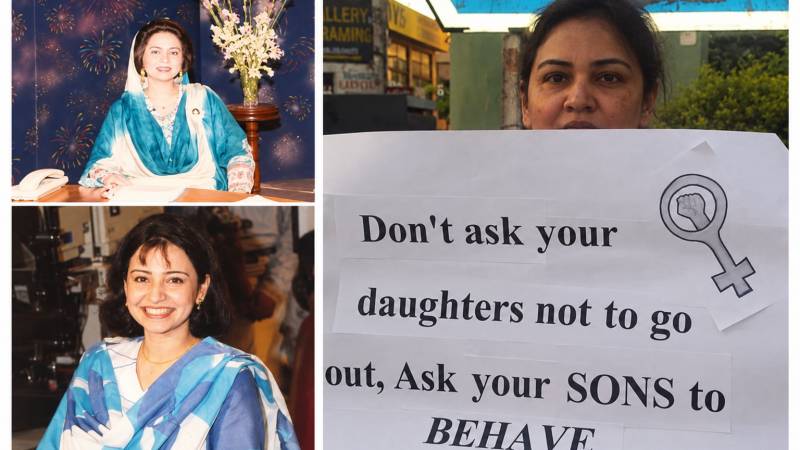
I have stood at this argument before. After the Delhi gang rape of December 2012, I took a placard to a protest in Islamabad, while much of the city's activist elite was busy with New Year plans and a high-profile begum advised me, kindly, that it was the weekend and protests could wait. I worked hard, I am educated, and I still cannot escape the class act. The placard said: Don't ask your daughters not to go out, ask your sons to behave. Thirteen years on, reading the new slogans, I felt baffled, proud and tired, because the argument has not moved an inch.
The news behind the jokes is brutal. A nine-month-old. A nine-year-old. A twenty-nine-year-old. A forty-nine-year-old. A ninety-year-old. A twenty-five-year-old accused of assaulting his sixty-three-year-old mother. Courts in more than one Indian state have convicted sons of assaulting their mothers, with life sentences reported in Uttar Pradesh and Tripura. Every age we like to call safe, and so often the man knows her name. That is when a respectable sentence started forming in my head: Pakistan mein to aisa nahin hota. It does not happen in Pakistan. Does it?
Name any Pakistani language, Urdu, Pashto, Punjabi, Balochi, Sindhi, Brahui, Saraiki, and try to find one crisp, everyday word for incest. Yeh to yahan nahin hota. VAWG and incest, we say, live in "foreign-funded NGO reports." That is what we tell ourselves. But how many cases have I seen managed, personally and professionally? Thanks to Instagram, they are now reported in Lahore, Pindi, Islamabad, Peshawar, Abbottabad, Quetta, Hyderabad, Karachi… Take any district, any village, any union council.
I have lived through three phases of this sentence. First, denial. Then the silence broke, and I was a bit relieved that at least the enforced silence had been broken, not ended. Now we are in open discussion: panels, hashtags, seminars with good lighting. Women look empowered, and I do mean look.
Going through my old PTV photographs, I noticed how the screen has changed. On 14 August 1997, I am hosting a special transmission for Pakistan's fiftieth birthday, a fireworks backdrop behind me, a landline at my elbow, and the dupatta over my head, because it was, after all, the Independence Day of the Islamic Republic of Pakistan. In April 1998, while hosting a current affairs show, I am laughing, the dupatta on my shoulders. Between 1995 and 1998 I was a pendulum, swinging between Benazir's government and Sharif's.
Violence has no dress code. It finds the veiled and the unveiled, the girl and the grandmother, the poor boy caught in bachabazi and the boy from the ‘good family’.
In 1999 I returned from Amsterdam with a postgraduate degree and began piloting Gender Watch. For the first six episodes, PTV asked me to ensure the female host's head was covered. Then came 12 October 1999, General Musharraf and his enlightenment, and I was asked to remove the dupatta. Flabbergasted, I went to the late Khalid Mehmood Zaidi and Syed Akhtar Viqar Azeem. Sirs, how could I? They gave me the helpless smile of talented government servants chained by the system. Today, PTV screens women without the dupatta too. Girls ride past on scooties, some covered, some not, and nobody blinks. It's progress. But what about safety?
We argued about the dupatta for decades, as if the problem lived in the cloth. It never was the cloth. It was the gaze. The purdah-nasheen, the woman in niqab, the woman whose face you can see, like mine: no class is exempt. Violence has no dress code. It finds the veiled and the unveiled, the girl and the grandmother, the poor boy caught in bachabazi and the boy from the "good family." A woman at a podium is not a woman safe at the bus stop. We have mistaken being seen for being safe.
And it does not stop at death. I am working on a report titled "Necrophilia: Aurat qabar mein bhi mehfooz nahin", a woman is not safe even in the grave. In bitter jest, I wonder what kind of kafan would protect her from these men. Ek qabar. Ek aurat, murda. Aur in mardon ka kya... bharosa? A little dark humour, the only kind this subject permits.
I speak with some authority because counting is what I did. In 2000 I designed the study that began data collection on violence against women and girls in Pakistan, for the non-profit I created with my late husband. Later I worked on a number of such data reports. I produced Gender Watch, the award-winning series that put the Urdu word sinf in front of ordinary viewers. I have authored many books and dozens of research papers and manuals, and I was named an Ashoka Fellow for my work on dowry violence and youth. I mention this without enthusiasm because I notice the design in other people's reports. I am cited less often than I am copied. That is very Pakistani too: women's work, especially when the woman has no lobby and a godmother rather than a godfather, is borrowed more readily than it is credited.
Boys' excuses are fake, say the girls across the border, and they are right. Ours are just better dressed: scripture, "culture," and, when all else fails, izzat.
Some feminisms march. Mine dances, and I claim it as different, not lesser. The Sufi tradition around Rumi turned longing and loss into the whirling of the dervishes. Mi raqsam. I dance. I do not dance because nothing hurts. I dance because I refuse to let the hurt choose the music. So, to everyone applauding the girls across the border: lovely. Now come home, and ask your sons to behave. I will be the one dancing.
Pic 1:- Top: 14 August 1997. Special transmission for Pakistan's 50th birthday, dupatta on head, as the occasion demanded. Bottom: Off camera, April 1998. Same channel, same host, dupatta on shoulders.
Pic 2:- The author at a protest in Islamabad, winter 2012-13, after the Delhi gang rape.