

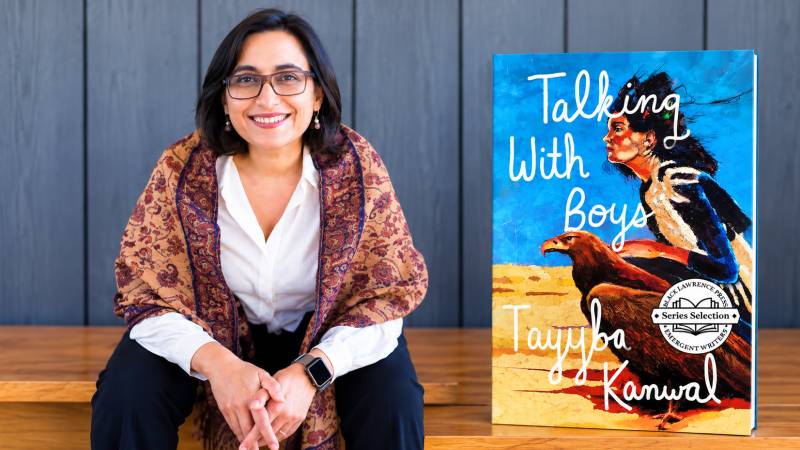
Book: Talking with Boys
Author: Tayyba Kanwal
Publication: Black Lawrence Press, 2026, 186 pp.
Tayyba Kanwal’s Talking with Boys opens with a young woman named Amal sliding out of her school uniform in the back seat of a convertible and pulling on a green silk kurta. She is racing toward a mosque, not to pray, but to marry a boy her family has forbidden her to see. The wind slams her. She raises her arms to it. And somewhere between the highway and the strip mall masjid, she becomes the author of her own escape. That wind, restless and impossible to contain, captures the spirit of Kanwal’s women, who keep pushing against the boundaries drawn around their lives.
Moving between Lahore, Dubai and Houston across seven decades, Kanwal’s fifteen interconnected stories trace the lives of Pakistani and Pakistani-American women who are neither victims nor heroines in the conventional sense. They are architects of their own survival, working within the structures that confine them to find cracks of possibility. The collection’s dedication, “to the steel in the silk”, captures its central tension: these women are vulnerable without being passive, and constrained without surrendering their agency. Amal marries Zee not in a grand romance but in a calculated act of self-rescue, laying her nikahnama on her vanity as “her only announcement of her planned desertion.” Yet she is no romantic heroine. When Zee leaps from the car ready to play knight, she flinches: “Why did men think that signing a paper suddenly shifted reality?” She has not escaped constraint so much as chosen the terms on which she will confront it.
Kanwal’s refusal to sentimentalize gives these stories much of their force. Her women are never simply good. Mariam, the narrator of the title story, admits to directing an “evil eye” at her baby sister Sana. A wife in “Little Mother” discovers “infinite reserves of fortitude” when her husband falls ill, but we sense she is also discovering a hunger she never knew she had.
In “Mrs. T Receives a Gift,” a wealthy empty-nester who has begun teaching kindergarten finds her newfound independence systematically dismantled by her husband’s gifts; first a bracelet from her son, then a box of cash meant to render her salary superfluous. Her response is neither confrontation nor submission but something stranger: she encases the bracelet in wax, a quiet act of burial that is also an act of reclamation. The bracelet functions as a mechanism of control; encasing it turns an object intended to define her dependence into an object she controls.
The title story operates on an entirely different register. Here we meet Mariam, the hearing elder sister of Sana, who is deaf. The story unspools as a quiet meditation on communication and its failures: between sisters, between parents, between cultures. “Baba had never needed to tell me, but I knew that, like other girls in our circles, I wasn’t supposed to talk to boys,” Mariam confesses. “None of our mothers had male acquaintances.” And yet Sana finds her own language. She signs with a boy named Dylan. She brings him to her sister’s wedding years later, introducing him in the only tongue that has ever truly belonged to her: “He speaks my tongue,” she says, in their childhood family signs. The tenderness of the scene is inseparable from its conflict: the language that once enabled family intimacy now becomes the means through which Sana asserts a life beyond the family. The mother, Huma, who has fought bureaucracies and nosy aunties to secure Sana’s education, now finds herself undone by her daughter’s autonomy. “Why would you do this to me for some—just some boy? After everything I’ve done for you?” she demands. But Sana has learned what her mother could not teach: that survival requires not only the steel of resistance but the silk of self-definition.
The collection is linked, characters reappearing in unexpected corners, their lives touching and diverging like tributaries of the same river. A tax agent mentioned in passing in one story becomes a father in another; an auntie’s casual gossip curdles into witness. This architecture mimics the claustrophobic intimacy of South Asian communities, where kinship, gossip and reputation can make private life feel permanently communal. But the connections are not merely formal. They enact something essential about Kanwal’s vision: that no woman’s story is complete without the stories of the women who came before her, and the women who will come after.
The collection’s interconnected stories suggest that survival is only the beginning: what ultimately matters is what women make from the lives they inherit—the relationships they reshape, the compromises they resist and the spaces they gradually claim as their own.
In “Little Mother,” a secretly pregnant young woman marries her late sister’s husband to protect her niece and to give her new in-laws an heir. In “I Breathed You First,” a sister watches helplessly as the woman she loves is married to her brother. In “Telling Tales,” a salon worker in Dubai discovers, through a haunted mirror, the secrets that have shaped the lives of everyone around her, and in doing so, finds the courage to claim her own story.
There is magic here too, slipped in so naturally you almost miss it. In “Mehr,” a daughter transforms into a bird to watch over her father, circling the minarets of Sianapur, scraping his arm with her talon because she cannot resist the game of being seen and unseen. In “Mailee and the Saint of Horses,” a blind saint carves stories into the walls of his hut, and a woman named Mailee memorizes them, becoming his hands and his voice. These touches of magic realism are not decorative; they are essential. By allowing the dead, the transformed and the impossible to enter ordinary domestic life, Kanwal gives material form to memories and attachments that realism alone might leave abstract. This complexity extends to the collection’s men, who are rarely reduced to instruments of patriarchy. Adnan defends his sister but excuses his father’s second marriage because “he’s from a different generation.” Baba distributes charity in his daughter’s name and then cannot bear her difference.
The foreman in “The Renaming of Tooti Sadak” ends up in a river because power, eventually, answers to other powers. And the women are never simply victims. They scheme, they compromise, they fail, and they begin again. The result is a moral landscape in which patriarchy is structural but never reducible to a single kind of man. The same interconnectedness that gives the collection its communal density occasionally makes coincidence feel slightly more deliberate than lived. Some narrative connections strain credibility, and the large temporal range means certain characters receive less development than they deserve. The risks are real, but so is the gain: the collection’s architecture allows individual lives to accumulate into a broader account of memory, migration and female self-fashioning.
In “Bungalow,” the final story, Zoya buys a decrepit house in Houston against all advice. She wants, she says, “a home I could learn, a space I could fashion.” It is a quiet ending, but the fitting one. After all the running, the signing, the surviving, the book lands on something deceptively simple: the desire to belong to a place of one’s own making. Zoya’s house is not a symbol of freedom; it is a house, with buckling beams and a faulty porch. She is not performing independence. She is fumbling toward it; the way real people do.
Against the familiar tendency to read Pakistani fiction in English through geopolitical conflict and trauma, Talking with Boys offers something more nuanced: women represented in the full particularity of their ordinary, complicated lives. They are not symbols but people, talking, signing, running, marrying, scheming, hoping, failing, and beginning again. Kanwal portrays female agency not as an escape from constraint, but as its negotiation through imperfect choices and difficult compromises. Survival is only the beginning; what matters is what these women make of it, the homes they fashion, the bonds they forge, and the selves they claim. That process of becoming, rather than survival alone, is the story Kanwal is ultimately telling.