

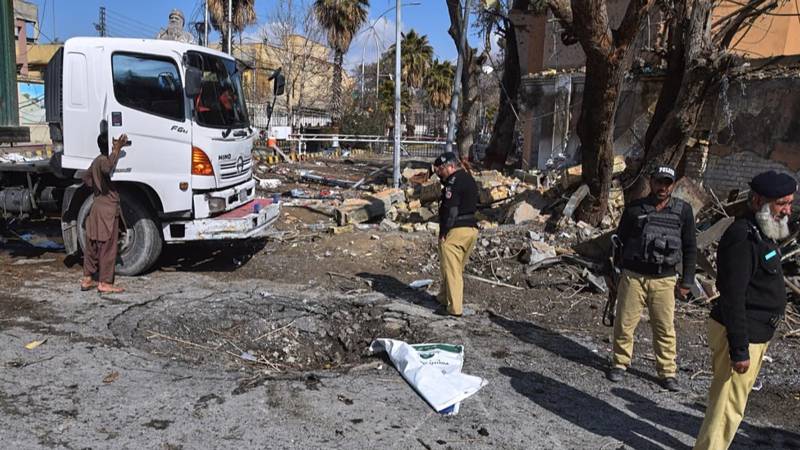
The coordinated attacks across Balochistan that left dozens of civilians and security personnel dead have once again exposed the fragility of the province’s security architecture. In just three days — from 31 January to 3 February — militant fatalities alone reportedly crossed 197, compared to 84 total fatalities recorded during the previous thirty days of January. The spike is not incremental; it is exponential.
But beyond the headline numbers lies a deeper problem: kidnappings are rising, and official reporting is inconsistent at a moment when clarity is essential.
The casualty figures themselves reveal the confusion.
The ISPR reported 41 militants killed on January 30 and 92 more on January 31, alongside 15 security personnel and 18 civilians. That placed the militant total at 133 after roughly 40 hours of operations.
Chief Minister Sarfraz Bugti then announced “145 killed in 40 hours,” along with 17 security personnel and 31 civilians. Yet his own breakdown reportedly included 41 militants (pre-operations), 92 during the principal operations, 15 security personnel, and 18 civilians, a sum of 166, not 145.
If 145 was meant to represent militants only, the correct militant figure at that stage was 133 (41 + 92). The ambiguity created the first fault line.
The following day, 22 additional militants were reported killed. If 145 were treated as the base, the total should have risen to 167. Instead, Tribune and Dawn carried a cumulative militant toll of 177.
If, however, the correct base was 133, then adding 22 yields 155, not 177.
The confusion deepened further on 3 February when print media, quoting state media, reported 197 militants killed, alongside 22 security personnel and 36 civilians. Reconstructed from a corrected militant base of 133, plus 22 on February 2, the total would stand at 155. To reach 197, an additional 42 militants would need to have been killed after February 2, yet that increase was not clearly itemised.
Kinetic operations can eliminate fighters; they cannot eliminate mistrust. Restoring confidence requires transparent reporting, consistent institutional messaging, civilian protection, and an honest acknowledgement of the scale of militancy
Taken at face value, the latest figures bring total fatalities to 255, including militants, civilians, and security personnel. On paper, it is a stark number. But because earlier totals were ambiguous, the aggregate itself inherits that instability.
The reporting trail illustrates how the confusion compounded:
| Report / Source | Terrorists | Security Personnel | Civilians |
| ISPR (30 January) | 41 | 0 | 0 |
| ISPR (31 January) | 92 | 15 | 18 |
| CM Bugti (Feb 1) | 145 | 17 | 31 |
| CM Bugti (Feb 2) | 177 | 0 | 0 |
| State Media / PTV (Feb 3) | 197 | 22 | 36 |
When base figures are unclear, every cumulative update multiplies uncertainty. What begins as a miscalculation evolves into a credibility problem.
More striking is what is missing from all official statements: injury figures. Nobody was reported wounded in this three-day-long conflict between the armed forces and the militants, a statistical anomaly in engagements of such intensity. Such an outcome would imply extraordinarily precise operations by both sides, a proposition that itself warrants independent scrutiny. In modern combat, fatalities without injuries are rare. The absence of wounded figures does not merely raise questions; it demands an audit.
Meanwhile, kidnappings are once again on the rise. In January alone, five workers were abducted. Insurgents stormed a jail in Mastung to free 30 prisoners and kidnapped Deputy Commissioner Hussain Hazara along with his family in Nushki, a troubling escalation that underscores growing audacity. When even senior officials are vulnerable, public confidence erodes rapidly.
The scale of militancy is equally sobering. Bugti acknowledged that 200–300 separatists participated in the recent attacks, not the 1,200 reported by the BBC. During 2025, insurgents mounted at least four large-scale assaults involving between 50 and 100 fighters in Kalat, Bolan, Quetta, and Kacchi. The ability to mobilise such numbers, and to strike across multiple districts in a near-simultaneous fashion, signals coordination, logistics, intelligence, and command structures closer to a proto-conventional force than scattered guerrilla cells.
The structural question is unavoidable: how are such formations assembled, armed, uniformed, briefed, and moved across terrain without prior detection? The movement of dozens of fully equipped fighters requires staging points, supply chains, transport networks, communications discipline, and local facilitation. It implies gaps in surveillance, intelligence penetration, checkpoint monitoring, or interdiction capacity. Large-scale attacks do not materialise spontaneously; they are the product of planning cycles that should, in theory, leave detectable signatures.
Unless those logistical pipelines and mobility corridors are identified and disrupted, the cycle of mobilisation and coordinated assault will remain repeatable.
Bugti has estimated 4,000–5,000 Baloch separatists active in the province. Separately, security assessments place the Tehreek-e-Taliban Pakistan (TTP) at roughly 7,000 fighters nationwide. Taken together, Pakistan may be confronting an internal militant presence of 11,000–12,000 fighters — sufficient not to defeat the state militarily, but certainly to paralyse governance, disrupt infrastructure, and steadily erode authority.
Official communiqués emphasise “neutralisation” and “successful clearance.” Yet district-wise breakdowns are mostly missing, operational timelines remain opaque, and critical data points are absent.
For the people of Balochistan, the result is a suffocating climate of uncertainty. Families wonder whether loved ones will return from work. Markets close in protest. Administrative authority weakens when officials themselves become targets.
This is no longer merely a counterterrorism challenge. It is a crisis of confidence.
Kinetic operations can eliminate fighters; they cannot eliminate mistrust. Restoring confidence requires transparent reporting, consistent institutional messaging, civilian protection, and an honest acknowledgement of the scale of militancy.
Guns can clear territory. Arithmetic must clear doubt.
Unless the state confronts both insurgent capacity and the weaknesses within its own narrative, the battlefield will continue to expand — and the credibility gap will widen with it.