

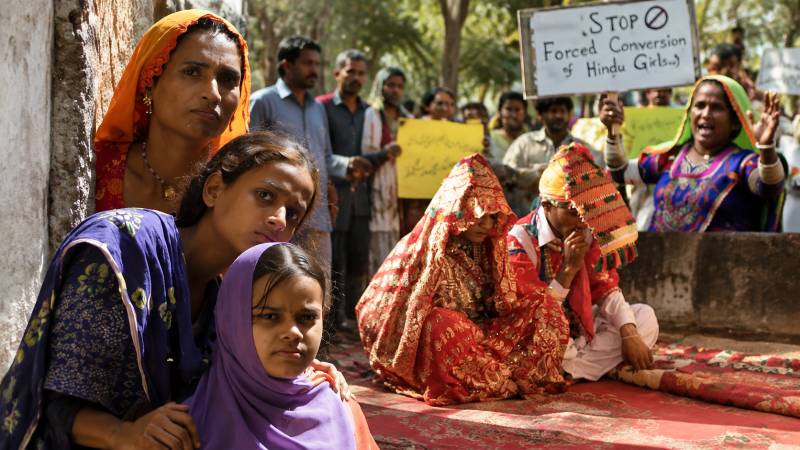
A Hindu girl disappears. Her parents search for her. A video then appears announcing a new name, a new faith and a marriage. When the family seeks her return, the discussion shifts towards a conversion certificate, while the questions that should come first remain unanswered: How old is she? Where has she been? Who controls her movements and her contact with her parents?
This recurring pattern demands an answer from the State. Religious freedom requires genuine choice. Children’s protection requires independent scrutiny. Neither can be established through a declaration recorded in circumstances that have not been investigated. The latest reported case concerns Bindiya Kumari, a fourteen-year-old ninth-grade student from Sibi, Balochistan, allegedly taken to Sindh, converted and married. On 29 October 2026, the Senate Minority Caucus, chaired by Senator Danesh Kumar, directed police to recover her. The Senate’s official account records a police request for seven days and an alarming dispute over a purported court petition cited to explain inaction. Legal representatives challenged its authenticity. Those claims require verification and a public explanation, not another administrative delay.
Bindiya’s case has precedents. HRCP’s State of Human Rights in 2020 named six Hindu girls in press-reported conversion cases: Mehak and Lata Kumari from Jacobabad, Sormi and Shanti from Tharparkar, Simran from Pano Aqil and Parsha Kumari from Khairpur. This is a documented set of reported cases, not a complete count or six findings of criminal guilt. Mehak’s case demonstrates why age matters. Her parents said she was fifteen. HRCP records that on 18 February 2020, a court found her underage and nullified her marriage; on 9 July, the Sindh High Court allowed her to live with her mother after she expressed that wish. A declaration of willingness had not removed the need to examine her age and circumstances.
Accuracy strengthens this argument. In the much-publicised Reena and Raveena case, the Islamabad High Court found in April 2019 that the sisters had not been forcibly converted and permitted them to live with their husbands. Likewise, the Supreme Court treated Rinkle Kumari, Dr Lata and Asha Kumari as adults in 2012 and allowed their choices. These outcomes must be acknowledged. Adult women’s autonomy deserves protection; allegations involving children demand the safeguards applicable to children.
Sindh already has a substantial legal foundation. The Sindh Child Marriages Restraint Act, 2013, passed on 28 April 2014 and assented to on 10 June 2014, defines a child in Section 2(a) as a person under eighteen. Section 3 penalises an adult male contracting a child marriage; Section 4 addresses those who conduct or facilitate it; Section 5 covers promoting, permitting or negligently failing to prevent it. Section 8 makes offences cognizable, non-bailable and non-compoundable. Section 9 requires conclusion of a trial within ninety days after the court takes cognizance. A conversion certificate creates no exception to these provisions. This Act regulates marriage. It should not be misrepresented as a separate law automatically invalidating every religious conversion below eighteen. Its actual protections are strong enough to demand enforcement on their own terms.
A changed name cannot erase a child’s age. A certificate cannot settle an allegation of coercion. The State must protect the child, investigate the circumstances and enforce the law.
The Constitution is equally relevant. Article 20(a) protects every citizen’s right to profess, practise and propagate religion, subject to law, public order and morality. Articles 9, 14(1) and 25(1) protect liberty, dignity and equal legal protection. Article 22(1) safeguards students against compulsory instruction or worship belonging to another religion. Article 36 directs the State to protect minorities’ legitimate rights and interests, although it is a Principle of Policy rather than an independently enforceable Fundamental Right. These guarantees belong to Hindu citizens as citizens of Pakistan. Islamic teaching offers no justification for coercion or enforced family estrangement. The Quran states: “Let there be no compulsion in religion” (Al-Baqarah 2:256). When Asma bint Abu Bakr asked about maintaining relations with her polytheist mother, the Prophet ﷺ instructed her to maintain those relations (Sahih al-Bukhari 2620). Conversion does not require abandoning a parent.
The Deobandi and Barelvi traditions, both rooted in present-day India and influential among Pakistan’s Sunni clergy, also provide relevant guidance. Darul Uloom Deoband’s Fatwa 376=377/B, preserved in an online reproduction, explicitly states: “Islam neither allows to convert non-Muslims forcefully nor to kill them.” It cites Quran 2:256 and affirms that a non-Muslim may remain in their religion. On the Barelvi side, a PTI report dated 2 December 2020 records that Mufti Musibur Rahman Rajvi of Markaz-e-Darul Ifta, associated with Dargah-e-Ala Hazrat in Bareilly, declared forcible and fraudulent conversion contrary to Islam. These are specific institutional rulings, not a single decree binding every follower. Pakistan’s madrasas and religious leaders should publicly reinforce them and cooperate with investigations into coercion and child marriage.
The continued denial of safe family contact therefore demands scrutiny. Parents cannot be given ownership of an adult daughter’s beliefs or choices. Equally, an alleged abductor cannot acquire control over a child by presenting a marriage certificate. A child must be heard privately, with independent assistance and protection from pressure by any side. Safe contact with her family should be facilitated unless a documented protection concern requires otherwise. Mian Abdul Haq, known as Mian Mithu, associated with Bharchundi Sharif near Daharki, and Pir Muhammad Ayub Jan Sarhandi of Samaro, Umerkot, are two controversial Sindh clerics repeatedly associated with allegations of forced conversion of Hindu girls. Both deny coercion. Naming them does not establish guilt; their influence must not obstruct impartial investigation either.
Courts should require the underlying records and give reasons for conclusions about age and consent. Religious standing cannot substitute for evidence. Sindh needs a consistent protection procedure: immediate action on disappearance complaints; coordination when a child crosses provincial boundaries; verification of original birth, NADRA and school records; independent legal assistance; and safe accommodation beyond the control of anyone accused. Medical age assessment, where necessary, should acknowledge its uncertainty. A private judicial interview must examine threats, confinement, communication restrictions and the circumstances of any conversion or marriage.
The government should publish anonymised figures showing complaints, recoveries, prosecutions and outcomes. Parliamentary deadlines should produce follow-up reports. Children’s identities and privacy must be protected while institutional performance remains open to scrutiny. Sindh’s Hindu families should not have to bargain with influence to establish whether their daughters are safe. Their children deserve education, family affection and the freedom to grow before confronting decisions imposed by adults. A changed name cannot erase a child’s age. A certificate cannot settle an allegation of coercion. The State must protect the child, investigate the circumstances and enforce the law.