

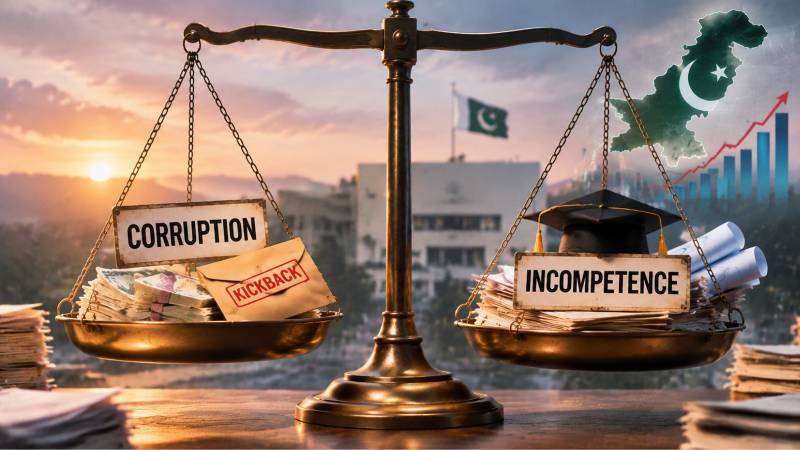
Ask anyone in Pakistan why the country is in trouble. The answer arrives before you have finished the question. Corruption. It is our favourite explanation for everything. But there is a quieter culprit that rarely makes the headlines. Incompetence. The two are not the same. A corrupt official knows what needs to be done and bends his authority to his own benefit. An incompetent one may have no dishonest bone in his body. He simply lacks the ability, the judgement or the professional capacity to deliver. One damages an institution through dishonesty, the other through ineffectiveness. And the second kind of damage is often deeper, precisely because nobody sees it. It stirs no controversy, makes no headlines and is far harder to prosecute.
We talk endlessly about ghost schools, missing funds, fake appointments, examination scandals. These are real concerns. A teacher who draws a salary without teaching is corrupt. But what of the teacher who arrives on time, completes every assigned duty and still cannot explain the subject? What of the university lecturer who has spent decades in academia without refreshing his knowledge, improving his methods or producing a single piece of meaningful research? We have no word for him. Stagnation, perhaps.
An education department can be free of scandal and still be incapable of designing a curriculum, evaluating its teachers or carrying out a reform. Money is allocated. Meetings are held. Reports are produced. The children learn nothing. The bureaucracy tells the same story. Files crawl from desk to desk. Decisions are postponed. Policies are conceived badly and implemented worse. How many projects have failed not because someone stole the money, but because those in charge did not know how to plan, build or supervise? How many policies were drafted by people who barely understood the problem they were meant to solve?
A clerk who demands a bribe to do his job is corrupt. An officer who cannot do it, despite the authority and resources, is incompetent. A system that tolerates the first and overlooks the second has a problem far deeper than individual misconduct. Yet our public conversation allows no such distinction. We judge those in power almost wholly by allegations of financial wrongdoing. Whoever escapes the charge is presumed honest and, by implication, acceptable. But honesty is not ability. A man can be entirely honest and thoroughly incapable of the work he has been given.
Think of what we have built to catch the thief. Accountability bodies. Audit institutions. Anti-corruption departments. A whole vocabulary devoted to exposing financial sin. We have fitted the locks, the alarms, the cameras. Nobody has asked whether the builder knew how to lay a wall. Where is the matching obsession with competence? Who systematically assesses the teacher, the senior bureaucrat, the hospital manager, the political appointee? Who asks whether they have delivered anything measurable? And what happens when they fail, again and again? Mostly, nothing.
The cures differ, too. Corruption demands transparency, accountability and punishment. Incompetence demands better recruitment, proper training, honest evaluation and, where necessary, removal. Treat the two as one disease and we shall cure neither. Nor should we assume that every failure is evidence of theft. Sometimes it is only outdated knowledge, poor management or the absence of professional standards. Naming the true cause is the first step towards a cure. Let me be clear. Corruption is an awful thing. It robs the poor, rewards the dishonest and corrodes the public's faith in every institution it touches. Nothing here is meant to excuse it. My argument is a narrower one. Our anger at corruption is so complete that it has crowded out every other question we might ask of those who govern us. We have spent decades searching for honest people to run this country. It is time to start looking for capable ones as well.