

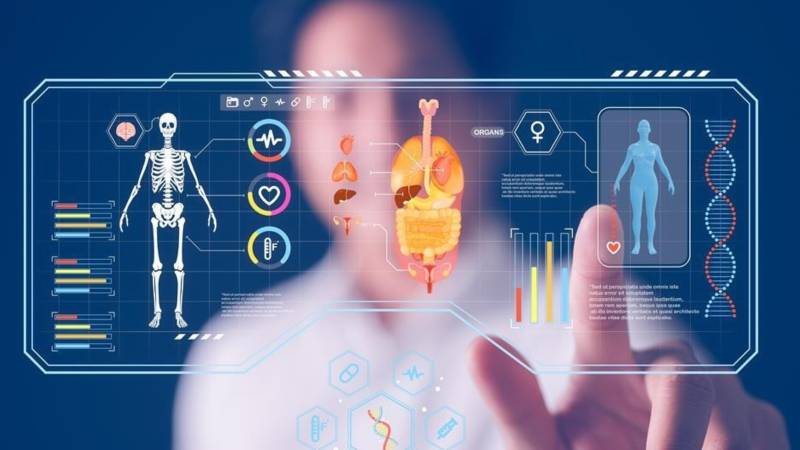
This essay began, unexpectedly, with a television show. Watching Star Trek, I found myself fixated on a small detail I had seen a hundred times before without really seeing it. The tricorder, that handheld device a doctor could wave over a patient and instantly see beneath the skin, map an injury, name a disease. It looked like pure fantasy. But I found myself wondering how far away such a device really is, and I started reading about handheld imaging, about diagnostic AI, about what a real medical scanner of the near future might actually be able to do.
That reading led me somewhere more personal. Someone in my family lives with tethered cord syndrome, a complication of spina bifida in which the spinal cord never fully formed, or later bound down by scar tissue cannot move and stretch the way it should as the body grows. So, I kept reading, not as a curious outsider but as someone closer to the dealing with it, trying to understand what our family was living with. How the condition develops, what treatment looks like today, where the research is actually heading. There was no miracle cure waiting in the literature though science is advancing by leaps and bounds with the assistance of AI. What I found instead was something more useful. A clear eyed view of how difficult healing becomes when anatomy, biology, technology and time all have to cooperate and a growing sense of how much artificial intelligence is already starting to change that cooperation, for better and, if we are careless, for worse.
That tension is really what this essay is about. AI is not a single force with a single destiny. It is closer to fire, or to the old idea of heaven and hell housed in the very same instrument. Capable of tremendous good with precision medicine, restored movement, a child spared a lifetime of pain and just as capable of devastating harm when it is captured by the wrong incentives, the wrong institutions, or the wrong hands. Both futures are already latent in the technology we have today. Which one we get will not be decided by the technology itself.
Now imagine that it is the year 2100. The device once imagined as a handheld medical scanner is no longer a laboratory concept. It is a small, soft edged instrument carried by every emergency physician and community health worker. It does not merely take pictures. It combines harmless forms of light, sound, magnetic sensing, molecular analysis and advanced computation. It can map the brain, spine, vessels, organs, bones and nerves in minutes. It compares today's image with a person's entire medical history and identifies changes too subtle for the human eye.
A doctor places it against the back of a child with suspected tethered cord. The scanner builds a living map of the spinal canal, shows where the cord is attached, measures blood flow and nerve activity, and predicts how a surgical release might affect movement, pain and bladder function. It does not make the decision. It makes the decision more informed.
That distinction defines the medicine of 2100. Artificial intelligence has become extraordinarily capable, but it has not become the owner of human life. It is a partner in reasoning, constrained by law, ethics, transparency and the patient's consent. Every recommendation comes with an explanation, a measure of uncertainty and alternative courses of action. The patient is not told, "The machine has decided." The patient is told, "Here is what the evidence shows, here is what remains uncertain, and here are the choices."
For children born with spina bifida, the century has brought a transformation. Prenatal imaging detects the condition early. In selected cases, surgeons repair the spinal defect before birth. Biological patches protect the exposed cord, while carefully tested cells encourage healthier development. The goal is no longer simply to close the opening. It is to protect neural tissue, reduce scarring and preserve the child's future function.
After birth, a child's nervous system is monitored through a secure digital model that is updated throughout life. The model combines movement, sensation, bladder pressure, gait, muscle activity, sleep, growth and imaging. It can distinguish a stable congenital limitation from a new deterioration that may indicate tethering. That distinction prevents two forms of harm, unnecessary surgery and delayed treatment.
Artificial intelligence has become extraordinarily capable, but it has not become the owner of human life. It is a partner in reasoning, constrained by law, ethics, transparency and the patient’s consent.
When the cord is genuinely tethered, the operation is more precise than anything available today. Robotic instruments move only where necessary. Microscopic imaging identifies functional nerve roots. New biological coverings reduce the tendency of scar tissue to bind the cord again. Surgeons can test each root during the procedure, preserving useful function while releasing pathological attachments. The operation remains serious, but it is no longer performed with the same degree of uncertainty.
For those who already live with neurological damage, medicine has learned that repair requires more than one intervention. Some patients receive cells derived from their own tissues or from carefully engineered universal cell lines. These cells do not simply "become new spinal cords." They support surviving neurons, restore myelin, reduce damaging inflammation and, in selected cases, form new relays. Molecular treatments make the environment more hospitable to growth. Biomaterials provide a temporary bridge. Stimulation teaches the nervous system how to use the new connections.
A patient with residual pathways below a lesion may receive a personalized spinal stimulation system. It senses intention, muscle activity and posture, then adjusts electrical signals in real time. Another patient may use a non-invasive system at home. A third may benefit from a brain–spine interface that translates the intention to move into stimulation below the damaged region. The purpose is not to create theatrical demonstrations for a research video. It is to help someone stand to transfer from a bed, walk safely to the bathroom, control a wheelchair, or use a hand to feed a child.
Bladder and bowel care has also changed. In 2026, families still had to choose among catheters, medication, injections, reconstructive surgery and experimental stimulation. In 2100, intelligent implants and wearable sensors continuously monitor bladder pressure, urine chemistry and kidney stress. They coordinate the bladder and sphincter, warn of infection before symptoms become severe and adjust treatment before damage occurs. Some people use regenerated bladder tissue, others use neuromodulation and many use a combination. The measure of success is no longer whether a device produces a dramatic moment of continence. It is whether a person can live safely, privately and independently while the kidneys remain protected.
The same principle applies to mobility. Exoskeletons are lighter, quieter and almost invisible beneath clothing. Robotic shoes compensate for weakness without forcing the user into a machine like gait. Wheelchairs navigate buildings, uneven ground and public transport automatically. Rehabilitation systems create thousands of small, meaningful repetitions while an AI coach adapts the challenge to fatigue, mood and physiological response. Technology does not erase disability or maybe it does in some ways. It nonetheless removes unnecessary dependence and enlarges the space in which a person can act. The transformation extends beyond medicine.
Energy is abundant, clean and locally managed. Desalination and atmospheric water systems have reduced the political power of scarcity. Precision agriculture has restored damaged soils while producing more food with less land. Materials that repair themselves have changed construction, transportation and manufacturing. Cities are quieter, greener and designed around human health rather than traffic. Many diseases are prevented through early molecular detection, personalized vaccines and continuous monitoring. Aging has become slower and healthier, although not abolished.
Education is no longer organized around the accident of birth. Every child has access to a patient tutor with the world's knowledge, but the tutor is required to cultivate judgment, imagination, empathy and courage. It cannot merely provide answers. It must teach the child how to ask better questions, recognize manipulation and understand the consequences of a choice.
Work has changed in similar ways. Machines perform much of the dangerous, repetitive and bureaucratic labour. Human beings devote more time to care, discovery, design, leadership and public service. Yet the world has not become automatically just. Technology still reflects the values of the institutions that control it. The same duality that started this essay never really goes away. A powerful AI can widen freedom or strengthen surveillance. A genetic tool can treat disease or deepen inequality. A medical scanner can serve a village clinic or become a privilege reserved for the wealthy. Heaven and hell, still housed in the same instrument. The decisive achievement of 2100, therefore, is not intelligence alone. It is the political and moral decision to govern intelligence wisely.
Humanity has learned that wisdom is not the opposite of technology. Wisdom is the discipline that tells technology where to stop, whom it must serve and what it must never be allowed to destroy. AI supplies memory, speed, pattern recognition and tireless analysis. Human beings supply meaning, responsibility, compassion and the ability to recognize that a person is more than a measurable outcome. The future will not be saved by machines acting without us, nor by humans refusing the tools that could relieve suffering. It will be built when the two forms of intelligence work together under institutions that are accountable to the public.
The child with tethered cord is a useful symbol for that future. It is not an abstraction to me, but someone in my own family. The problem is complex because the body is not a collection of isolated parts. The cord, the nerves, the bladder, the mind, the family and the social environment are connected. A narrow solution fails because it treats one structure while ignoring the system. The same is true of civilization. We will not solve poverty with technology while tolerating injustice, or solve climate change while rewarding destruction, or create peace with weapons and call it security. The great discoveries of the next century will matter only when they are joined to better institutions and wiser choices. In 2100, the handheld scanner may see almost everything beneath the skin. The more important question will be whether humanity has learned to see clearly above it. To recognize suffering, restrain power, share knowledge and use intelligence in the service of life. That is the world worth inventing.