

Democratic gains across Congress and key state elections signal a shifting American political landscape, as voters challenge Trump-era politics while prioritising economic security, reproductive rights, democratic accountability and political representation.
The midterm elections are turning America's political landscape from red to blue, raising the possibility of a shift from confrontational Republican politics towards a more moderate Democratic direction, with implications for both domestic and international audiences. The midterms were not merely about party politics; they represented a resounding rejection of hatred, racism, misogyny and economic insecurity, alongside a demand for healthcare, reproductive autonomy, gender equality, inclusion and citizenship rights. So far, the results suggest a vote for accountability.
As of November 4, Democrats are riding a wave of electoral momentum and are set to take control of both chambers of Congress. Before the midterms, Republicans held 53 seats in the 100-member Senate, compared with 45 Democrats and two Independents who caucused with Democrats. In the 435-member House of Representatives, Republicans held 218 seats, Democrats 214, alongside one Independent, with two vacancies. All 435 voting seats in the House were contested.
In the Senate, 35 seats across 35 states were at stake: 33 regular elections and two special elections in Florida and Ohio. By the morning of November 4, Democrats had secured control of both chambers. In the preliminary count, 33 of the 35 Senate races had been called, giving the Democratic caucus 54 seats, including two Independents, against 44 Republicans. In the House, 367 of the 435 races had been called, with Democrats securing 228 seats against 139 Republicans. These are preliminary race calls, not certified final totals.
The Senate elections produced seven significant Republican-to-Democratic seat flips across the country. In Kansas, Adam Hamilton defeated incumbent Roger Marshall, while in Iowa, Josh Turek unseated Ashley Hinson. In Texas, James Talarico defeated Ken Paxton, ending a long Republican hold on the state's Senate seat. Ohio also returned Democrat Sherrod Brown to the Senate after he defeated Jon Husted in the special election.
In Maine, Troy Jackson defeated incumbent Susan Collins; in North Carolina, Roy Cooper defeated Michael Whatley; and in South Carolina, Annie Andrews defeated Darline Graham. These victories marked a substantial shift in the Senate's political balance. Democrats also retained important seats in Georgia, where Jon Ossoff was re-elected, and in Minnesota, where Peggy Flanagan won the open seat vacated by Tina Smith.
The House results reflected a similar pattern, with Democrats flipping more than two dozen Republican-held districts. The gains included three of Iowa's four congressional seats, Indiana's 5th District and seats in South Texas. Bobby Pulido's victory over Monica De La Cruz was particularly notable in the Texas-Mexico border region, where Republican candidates had made electoral gains in 2024. These results came despite Republican investments in congressional redistricting and campaign spending.
Beyond choosing candidates, voters were also presented with competing policy agendas through 145 statewide ballot propositions across 40 states. These propositions offered important insights into the policy priorities promoted by the two parties and the extent to which voters accepted or rejected them. The ballot measures covered reproductive autonomy, gender and LGBTQ+ rights, voting eligibility, taxation, education and political representation. The results so far also offer a glimpse into voter preferences beyond the traditional Democratic-Republican divide.
Reproductive rights: Virginia voters approved constitutional protections for reproductive freedom, while Missouri voters rejected Amendment 3, which sought to reverse the abortion protections secured in 2024. Idaho voters, however, rejected a proposed statutory protection for abortion rights. This suggests that reproductive autonomy remained electorally significant, although outcomes varied by state.
Gender equality and inclusion: Arizona voters rejected Proposition 142, which sought to prohibit preferential treatment based on race or ethnicity in public institutions, but approved Proposition 318, extending restrictions on transgender participation in school sports and access to sex-designated facilities in private schools.
Voting rights: Ohio and North Carolina approved stronger voter identification requirements, while California and Arizona rejected proposed additional restrictions, including Arizona's Proposition 144 on voter identification and citizenship verification. Several states, including Arkansas, Kansas, South Dakota and West Virginia, approved measures reinforcing citizenship requirements for voting.
Taxation and cost of living: Florida voters approved an expansion of the homestead property tax exemption, while Arizona approved Proposition 316, restricting local grocery taxes.
Redistricting and political representation: Missouri voters rejected the Republican-backed congressional redistricting map, while Maryland approved a constitutional change affecting the state's congressional redistricting process.
Public safety and everyday governance: Arizona voters also approved Proposition 319, restricting the use of traffic photo-enforcement systems, but rejected a proposal requiring a minimum proportion of school expenditure to go directly towards classroom instruction.
Overall, voters neither endorsed nor rejected every proposition supported by a particular party. Instead, they made issue-specific choices. This demonstrates that party loyalty is not absolute and that voters are increasingly distinguishing between candidates, policies and their immediate concerns about rights, economic security and everyday governance.
The electoral picture is therefore not a simple division between liberal and conservative states. Voters in Arizona demonstrated that they do not necessarily endorse an entire party programme, as they individually assessed eight statewide propositions put forward by the Republican-controlled legislature. For example, they supported a ban on traffic cameras, the grocery tax exemption and restrictions on transgender participation in school sports, but rejected the proposed DEI restrictions, additional voter identification requirements and a measure imposing minimum classroom spending requirements. Virginia constitutionalised reproductive freedom, including access to abortion during the first two trimesters, contraception and fertility care. Missouri voters rejected the Republican-led attempt to reverse their earlier protections for abortion rights. However, Idaho voters rejected an abortion rights initiative.
The electoral picture is not a simple division between liberal and conservative states. Voters are increasingly distinguishing between candidates, policies and their immediate concerns about rights, economic security and everyday governance.
The midterms also produced several historic milestones in political representation. Democrat Abdul El-Sayed in Michigan became the first Muslim American elected to the US Senate. Minnesota's Peggy Flanagan became the first Native American woman to enter the Senate. In New Hampshire, Chris Pappas became the first openly gay man elected to the Senate. Annie Andrews became the first woman to represent South Carolina in the Senate.
These milestones were accompanied by the re-election of Palestinian-American Rashida Tlaib in Michigan and Somali-American Ilhan Omar in Minnesota. Both are prominent Muslim women in Congress, outspoken critics of US policy towards Israel and Palestine, and frequent targets of criticism from President Trump. Democrat Adam Hamawy also became New Jersey's first Muslim member of Congress. Meanwhile, Hakeem Jeffries of New York retained his House seat and is being mentioned as a potential candidate to become the first Black Speaker of the House.
Aber Kawas became the first Palestinian-American and the first Muslim woman elected to the New York State Legislature. The gubernatorial elections also produced significant breakthroughs in political representation. Georgia elected Keisha Lance Bottoms, the first Black woman to become governor of any US state. Texas elected Gina Hinojosa as its first Latina governor, ending more than three decades of Republican control of the office. New Mexico elected Deb Haaland, the first Native American woman to lead a US state.
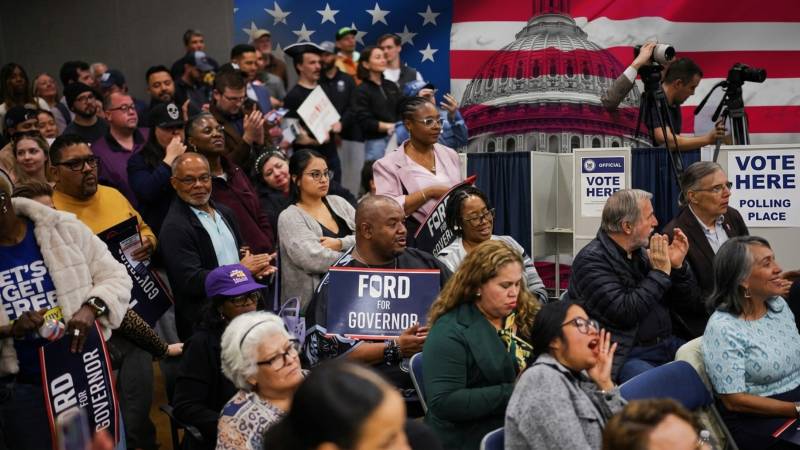
Florida elected Byron Donalds, making him the first Black Republican governor, while Wisconsin and Nevada elected their first Black governors, David Crowley and Aaron Ford, respectively. Minnesota and Ohio also elected their first women governors, Amy Klobuchar and Amy Acton. These outcomes widened access to executive office across gender, racial and Indigenous identities, while demonstrating that historic representation is not confined to one political party.
These victories represent more than individual breakthroughs, as voters also endorsed candidates' experiences, community work and policy priorities as deserving of representation in federal decision-making. They signal voters' willingness to support access to executive power across racial, ethnic and gender lines, even as the political and policy consequences of such representation remain to be seen. They also highlight the growing representation of religious, ethnic, Indigenous and LGBTQ+ communities in American politics.
Representation does not automatically translate into policy change. Nevertheless, electing individuals who can meaningfully participate in policy-making debates remains essential. A reading of the pre-election surveys alongside the results announced so far reveals several patterns in voter behaviour.
First, economic insecurity cuts across party lines. The cost of living, inflation, healthcare, housing and fuel prices were central to the election. Gallup's October 2026 survey found that 50% of registered voters considered the economy extremely important to their vote, while an equal proportion identified healthcare as extremely important. Meanwhile, 47% attached the same importance to the situation in Iran. Pew's October survey similarly found that the economy was the most widely cited issue, with 84% considering it very important to their congressional vote.
Second, voters are willing to distinguish between candidates and policies. Arizona illustrates this particularly well: voters approved some Republican-sponsored propositions but rejected others. A vote for a particular policy does not necessarily constitute an endorsement of the party that introduced it.
Third, reproductive autonomy remains electorally relevant. The outcomes in Virginia and Missouri demonstrate that voters can support reproductive protections even in a wider political environment dominated by competing economic and security concerns.
Fourth, party loyalty is not immutable. Texas, Kansas and Iowa demonstrate that voters can move away from established party alignments. In Kansas, the Associated Press's voter analysis found that Democratic candidate Adam Hamilton won around seven in ten moderate voters and approximately eight in ten voters under 30. Concerns about candidates' character, economic pressures and dissatisfaction with Washington also influenced the result.
Fifth, demands for accountability and democratic checks are becoming more prominent. Democratic gains in Congress, the rejection of the Missouri redistricting map and resistance to some proposed voting restrictions point to the growing importance of institutional accountability, representation and public trust.
What do these results mean for American domestic and international politics? As Democrats prepare to take control of both chambers of Congress, they will gain greater capacity to block legislation, scrutinise executive decisions, investigate the administration and influence federal spending and appointments. The Senate holds a particularly consequential position because of its role in confirming presidential nominees and approving treaties.
However, unified congressional control, once finalised, does not mean Democrats will be able to reverse the administration's policies. President Trump's veto powers will remain consequential, even if some media commentators describe him as a lame-duck president. The election results signal a shift in political power, the immediate consequences of which will become apparent through legislative disputes and increased congressional oversight.
Congressional control affects appropriations, military and foreign assistance, trade legislation, sanctions, and the confirmation of senior diplomatic and security officials. However, this does not mean that control over foreign policy is transferred away from President Trump. The president nevertheless retains executive authority and the power to veto legislation.
A change in congressional composition will, however, almost certainly result in greater scrutiny of executive conduct, the initiation of investigations and political negotiations concerning US positions on Iran, Ukraine, NATO, trade, tariffs, climate commitments and development assistance. For international allies and partners, the results signal that US policies may face stronger congressional checks and less reliance on unilateral presidential action.
Overall, the outcome is a reminder that political parties may shape election narratives, but voters retain the power to accept, reject or separate individual policy choices from their allegiance to a political party. Therefore, the results should not be interpreted as an outright rejection of every policy associated with President Trump.