

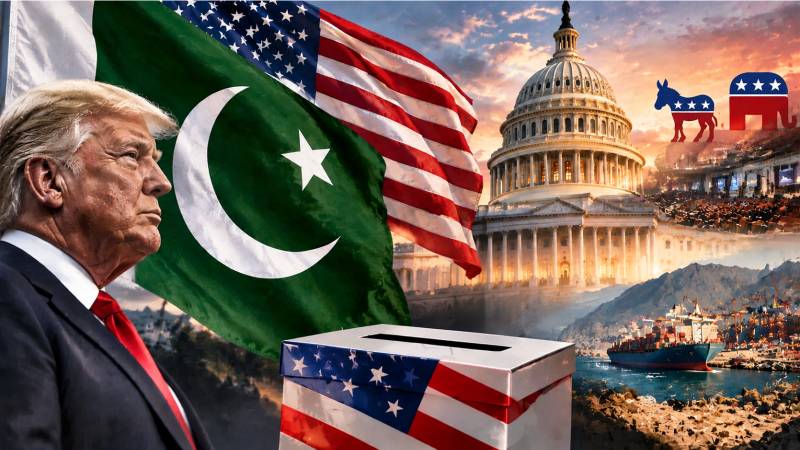
The United States midterm elections may have delivered a significant political setback to the Republican Party and President Donald Trump, but their implications for American foreign policy are likely to be considerably less dramatic than some observers might imagine. While the electoral results may reshape the domestic political landscape, alter the balance of power in Congress and complicate the administration’s legislative agenda, they do not necessarily herald a fundamental change in how Washington engages with the rest of the world. This is particularly true in the case of Pakistan, whose growing regional importance and evolving strategic relationships have increasingly become factors that American policymakers cannot afford to overlook.
There is a tendency, especially outside the United States, to interpret American elections as potential turning points in Washington’s relationships with other countries. This is understandable, given the enormous influence the United States continues to exercise over international politics, global financial institutions, security arrangements and diplomatic initiatives. However, the reality is that American foreign policy generally displays a remarkable degree of continuity, regardless of which political party controls Congress or occupies the White House.
Certainly, differences exist between Republican and Democratic administrations. Their approaches to multilateralism, international institutions, trade, immigration and military intervention can vary considerably. Yet beneath these differences lies a broad consensus on protecting American strategic interests, maintaining alliances, preserving military influence and preventing rival powers from challenging Washington’s global position. This continuity is not accidental. American foreign policy is shaped not merely by elected politicians but also by a vast institutional structure comprising the State Department, the Pentagon, intelligence agencies, congressional committees and an extensive network of strategic and economic interests. These institutions often operate within long-established policy frameworks that survive changes in political leadership.
Consequently, even a substantial shift in congressional control does not automatically translate into a corresponding transformation of America’s international relationships. There is another important consideration. President Trump will remain in office for approximately two more years. Whatever the domestic political consequences of the midterms, the presidency retains considerable authority over foreign affairs. The White House continues to direct diplomacy, conduct negotiations, manage international crises and exercise significant influence over national security decisions.
Congress can certainly impose constraints through legislation, budgetary allocations, oversight and the approval of certain appointments. Nevertheless, the president remains the central figure in the formulation and execution of American foreign policy. For countries dealing with Washington, including Pakistan, the administration’s priorities will therefore remain critically important. In Pakistan’s case, the argument for continuity becomes even more compelling when viewed against the changing strategic environment in South Asia and the wider region.
The real question, therefore, is not whether the American midterms will fundamentally change Washington’s approach towards Pakistan. It is whether Pakistan can translate its growing diplomatic engagement and strategic importance into durable economic, political and security gains.
Pakistan today occupies a position of considerable geopolitical importance. Its location at the intersection of South Asia, Central Asia, China, Afghanistan and the Middle East gives it a relevance that extends far beyond its immediate neighbourhood. Its military capabilities, nuclear deterrent, longstanding relationship with China and engagement with major Muslim countries make it an important participant in regional security calculations.
Recent diplomatic developments, including the emergence of the Makkah Alliance and the Badar Alliance, have added another dimension to this evolving strategic landscape. These arrangements, and the broader diplomatic and security cooperation associated with them, represent an attempt to develop new frameworks for regional engagement, conflict prevention and collective security. Their long-term significance will depend on how effectively participating countries translate political understandings into institutional cooperation and practical outcomes.
For Pakistan, however, their importance lies in the opportunity to play a more consequential role in shaping regional security discussions rather than merely responding to developments initiated elsewhere. The Middle East and South Asia are undergoing profound geopolitical changes. Traditional alliances are being reassessed, economic relationships are becoming increasingly important, and countries are seeking greater flexibility in their strategic partnerships. The growing emphasis on regional dialogue and security cooperation reflects an understanding that lasting stability cannot depend exclusively on arrangements designed by outside powers.
Pakistan’s participation in these developments potentially strengthens its diplomatic position and provides additional avenues through which it can contribute to regional stability. Washington will naturally evaluate such initiatives through the prism of American interests. It will examine their implications for regional security, relations with Iran, the Gulf states, China and other influential actors. But precisely because these developments affect important strategic interests, they are unlikely to be ignored simply because the political composition of Congress has changed.
This is an important distinction. Pakistan’s relationship with the United States should not be understood exclusively through the personalities occupying the White House or the electoral fortunes of either major American political party. It is also shaped by structural considerations that extend across administrations. These include regional security, counterterrorism cooperation, developments in Afghanistan, nuclear stability, economic engagement and the wider strategic competition involving China. While the relative importance attached to these issues may change, the underlying interests do not disappear after an election.
At the same time, Pakistan should avoid assuming that its geopolitical importance automatically guarantees favourable treatment from Washington. Strategic relevance creates opportunities, but those opportunities must be supported by diplomatic consistency, economic credibility and clearly articulated national priorities. The Makkah and Badar initiatives, for example, will acquire lasting significance only if they demonstrate their ability to facilitate dialogue, reduce tensions and contribute meaningfully to regional stability. Their success cannot be measured simply by the number of participating countries or the declarations issued at diplomatic gatherings.
For Islamabad, the appropriate response to developments in American domestic politics is therefore neither excessive optimism nor unnecessary apprehension. It is sustained diplomatic engagement based on an understanding of how American institutions function and how Pakistan’s own strategic position is evolving. There is also a broader lesson here. International relationships are increasingly shaped by multiple centres of power. Countries such as Pakistan have opportunities to diversify their diplomatic partnerships without necessarily abandoning longstanding relationships. Engagement with Washington need not come at the expense of cooperation with Beijing, Riyadh, Ankara, Tehran or other regional capitals.
Indeed, maintaining productive relationships across competing geopolitical groupings may become an increasingly important element of Pakistan’s foreign policy. The American midterms may influence the political atmosphere in Washington, sharpen partisan disagreements and affect the administration’s room for manoeuvre. They could also alter congressional scrutiny of foreign assistance, trade and security cooperation. These are developments Islamabad should monitor carefully.
But it would be a mistake to confuse changes in America’s domestic political balance with an inevitable transformation of its international priorities. Ultimately, American foreign policy will continue to be determined by calculations of national interest, strategic necessity and global influence. Pakistan’s task is to ensure that its own foreign policy is similarly grounded in long-term national interests rather than short-term political developments abroad.
The coming two years will undoubtedly produce further diplomatic challenges and opportunities. President Trump will remain a decisive actor in American international relations, while Pakistan’s expanding regional engagements will continue to shape its strategic choices. The real question, therefore, is not whether the American midterms will fundamentally change Washington’s approach towards Pakistan. It is whether Pakistan can translate its growing diplomatic engagement and strategic importance into durable economic, political and security gains. That, far more than the electoral fortunes of Republicans or Democrats, will determine the future direction of Pakistan’s relationship with the United States.