

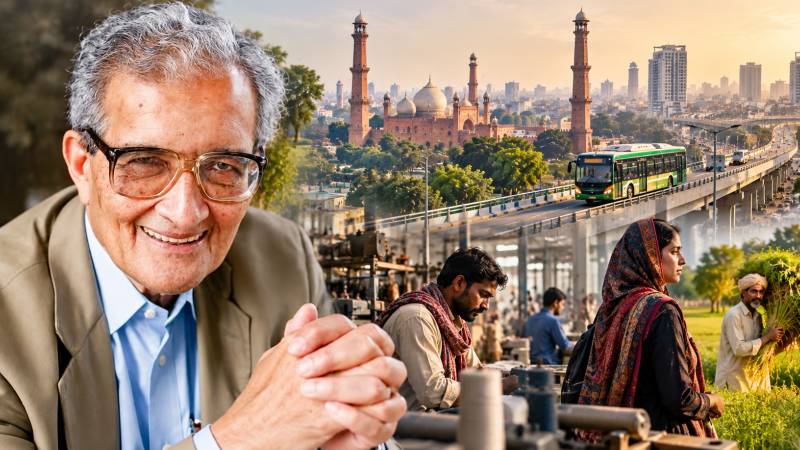
When a new road is built, a factory opens, or a city records higher economic growth, we usually call it development. But what if development is about more than what gets built or how much an economy produces? What if the real question is whether people have gained greater freedom to shape their own lives? This is where Amartya Sen’s ideas offer an important perspective for Pakistan, particularly for Punjab.
Sen’s approach to development moves beyond income and economic growth and asks what people are actually capable of doing and becoming. His influential capability approach argues that development should be understood in terms of people’s substantive freedoms: their real opportunities to live lives they have reason to value. Income matters, but largely because it can help people access education, healthcare, employment, mobility and other opportunities.
For Punjab, this provides a useful way of looking at development. The province has a huge population, major industrial centres, significant agricultural production and some of Pakistan’s largest cities. Yet the presence of economic activity does not necessarily mean that everyone has the same ability to benefit from it. The question, therefore, is not simply whether Punjab is growing, but whether that growth is expanding opportunities for the people who live there.
Consider education. A new university or school building may increase the physical capacity of the education system, but Sen’s framework pushes us to ask a deeper question: are students actually receiving the skills and opportunities they need to improve their lives? A child in a rural district may technically have access to a school, but if the school lacks qualified teachers, basic facilities or effective learning, the formal existence of that school does not necessarily translate into a meaningful capability.
The same logic applies to healthcare. A hospital can be constructed, but if a poor family cannot afford treatment, a woman cannot reach the facility safely, or essential medicines are unavailable, the existence of the building alone does not guarantee greater freedom. Development has to be measured by what people can actually access and use.
This distinction becomes particularly important in Punjab because of the province’s significant differences between regions and communities. Lahore has developed into a major centre for education, services and commerce, while cities such as Faisalabad, Sialkot, Gujranwala and Multan have developed distinct industrial and commercial identities. At the same time, large rural populations remain dependent on agriculture and often have very different levels of access to public services.
Amartya Sen’s central lesson for Punjab is that economic progress becomes meaningful when it expands human capability: the success of a road, school, hospital or economic policy should ultimately be judged by the choices and opportunities it creates for the people.
Sen’s framework suggests that these differences should matter when development policy is designed. Punjab has already taken steps that reflect some of these principles. The World Bank’s Punjab Human Capital Investment Project has focused on areas including health, nutrition, early childhood development and social protection. More recently, a World Bank education project was approved to improve learning and expand access for millions of children across Punjab. These are not merely social programmes; they are investments in the capabilities that determine whether people can participate productively in the economy.
This way of thinking can also change how Punjab approaches its cities. Take public transport. It is easy to view a bus system simply as an infrastructure project. But for a university student living on the outskirts of Lahore, reliable transport can determine whether attending university is realistically possible. For a woman, the availability of safe and affordable transport can influence whether a job is genuinely accessible. For a worker in Faisalabad or Gujranwala, connectivity can determine how easily they can reach employment. The road, bus or train is therefore only the means. The real outcome is the opportunity it creates.
This is one reason Sen’s ideas remain relevant beyond the traditional boundaries of economics. They encourage policymakers to connect apparently separate issues. Education affects employment. Transport affects access to education and jobs. Healthcare affects productivity. Gender norms affect labour-force participation. Urban planning affects the time and resources people have available to pursue education and work. In other words, development is interconnected.
Pakistan can also apply this thinking when considering women’s participation in the economy. Simply creating formal employment opportunities does not guarantee that women can take them. Access to education, safe transport, childcare, workplace conditions and social acceptance can all determine whether a woman is actually able to convert an opportunity into economic participation. A policy that measures only the number of jobs created may therefore miss an important part of the picture.
The same principle applies to young people. Pakistan has a large youth population, but demographic size becomes an economic advantage only when young people have the capabilities to participate productively. Education without employable skills can leave graduates frustrated. Employment without decent working conditions may provide income without creating long-term economic security. The objective should be to expand the range of meaningful opportunities available to young people.
This is where Punjab could draw an important lesson from Sen: development policy should focus not only on creating resources, but also on ensuring that people can convert those resources into real opportunities. This may also require changing how governments evaluate projects. Instead of asking only how many kilometres of road have been constructed, how many schools have been built, or how much investment has entered a city, policymakers could ask what those investments have enabled people to do. Are children learning more? Are patients receiving better healthcare? Are workers reaching jobs more easily? Are women entering the labour market? Are rural communities gaining greater access to markets and services?
These questions do not replace conventional economic indicators. GDP, investment and productivity remain important. Rather, Sen’s contribution is to remind us that they are means through which human well-being can improve, not complete definitions of development themselves. This perspective is particularly relevant at a time when Punjab is urbanising rapidly and its economic structure is changing. The province’s future will not be determined only by agriculture. Its cities will increasingly depend on manufacturing, services, education, technology, logistics and entrepreneurship. But whether this transformation produces broad-based prosperity will depend on the capabilities of the people who participate in it.
That is why Amartya Sen’s ideas offer something more useful than a theoretical debate for Punjab. They provide a different question to ask about almost every development decision: Does this investment expand people’s real choices? A new school should expand the ability to learn. A hospital should expand the ability to live a healthy life. Public transport should expand the ability to reach education and employment. Economic policy should expand the ability to earn a secure livelihood. And urban development should expand the ability of people from different backgrounds to participate in the life of the city.
Punjab does not need to copy another country or reproduce another government’s development model. Its circumstances are different. But it can learn from Sen’s central insight: economic progress becomes meaningful when it expands human capability. For Pakistan’s largest province, perhaps the next stage of development should therefore be measured not only by the size of its economy, but also by the opportunities available to the people who make that economy possible. That is the real challenge and perhaps the most useful lesson Punjab can take from Amartya Sen.