

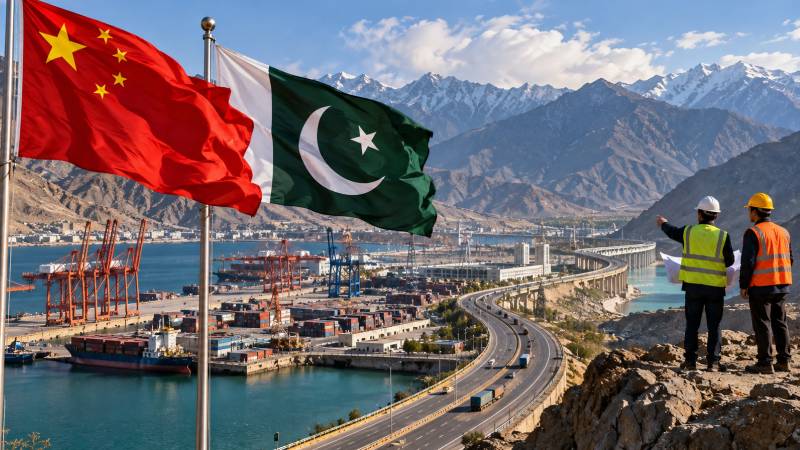
In an era defined by shifting power balances and contested narratives, the China-Pakistan relationship stands as one of the more durable strategic alignments of the twenty-first century. A recent wave of commentary has sought to reduce this partnership to a series of simplified claims: that Pakistan serves as a testing ground for Chinese weapons that the China-Pakistan Economic Corridor has failed, that high-level engagement stalled after 2015, that bilateral trade imbalances constitute exploitation, and that Chinese financing amounts to a deliberate debt trap. When examined against primary data from independent institutions and official records, these assertions do not withstand scrutiny. More importantly, they obscure a larger structural reality. The China-Pakistan partnership represents an early and concrete expression of a multipolar order in which countries of the Global South are constructing alternative frameworks for security, connectivity and development frameworks less dependent on the hierarchical arrangements that have characterised the post-1945 system.
The defence relationship clearly illustrates this. According to the Stockholm International Peace Research Institute’s data for 2021–25, China accounted for 80 percent of Pakistan’s major arms imports, an increase from 73 percent in the preceding five-year period. Pakistan’s overall major arms imports rose by 66 percent over the same interval. These figures reflect sustained technology transfer, co-production arrangements such as the JF-17 programme, and the supply of advanced platforms under terms that Western suppliers have historically been unwilling or unable to match without political conditionality. The volume of transfers does not, by itself, demonstrate that Pakistan functions as an experimental market. It demonstrates preference rooted in reliability and strategic congruence. In a region marked by persistent security dilemmas, states seek partners that can deliver capability without imposing external vetoes. That is a rational calculation, not evidence of subordination.
Infrastructure cooperation under the China-Pakistan Economic Corridor has followed a parallel trajectory. Official records indicate that 45 projects have been completed at a combined cost of approximately $25.61 billion. These include 17 energy projects that have added substantial generation capacity, 15 infrastructure schemes such as the Multan-Sukkur Motorway and the Lahore Orange Line Metro, and a range of social and economic initiatives. Delays in larger undertakings such as the Main Line-1 railway upgrade are real and well documented; they stem from financing sequencing, land acquisition, security management and bureaucratic coordination. Such challenges are common to complex, multi-year infrastructure programmes globally. They do not equate to systemic failure. The corridor has entered a second phase oriented toward industrialisation, special economic zones, agriculture, mining and technology cooperation, an evolution consistent with the maturation of large-scale connectivity initiatives rather than their abandonment.
Diplomatic engagement has remained continuous. President Xi Jinping’s 2015 visit to Pakistan was a landmark event, yet it did not mark the end of high-level interaction. In May 2026, Prime Minister Shehbaz Sharif held talks with President Xi in Beijing during an official visit that produced a joint statement reaffirming the all-weather strategic cooperative partnership and advancing work on CPEC 2.0. The seventh round of the China-Pakistan Foreign Ministers’ Strategic Dialogue took place earlier that year. These exchanges form part of an institutionalised pattern of consultation on bilateral, regional and global issues. The absence of annual presidential visits does not constitute disengagement; diplomacy is measured by the density of practical cooperation and the consistency of strategic alignment.
The China-Pakistan partnership represents an early and concrete expression of a multipolar order in which countries of the Global South are constructing alternative frameworks for security, connectivity and development less dependent on the hierarchical arrangements that have characterised the post-1945 system.
Trade and financing require equally careful treatment. Pakistan maintains a substantial merchandise trade deficit with China, driven by imports of machinery, intermediate goods, electronics and consumer products that support domestic industry and consumption. Official statistics from both countries confirm the imbalance. A deficit is an economic outcome shaped by comparative advantage, industrial structure and demand patterns. It does not automatically establish exploitative intent. Chinese financing, estimated in recent assessments at around $28–30 billion in outstanding obligations, constitutes a significant but not exclusive component of Pakistan’s external debt stock. The instruments employed have included concessional loans, commercial project financing and limited grants, with terms varying by project. Differentiation by instrument and purpose remains essential. Broader questions of debt sustainability in Pakistan are real and require rigorous domestic policy responses; they are not unique to Chinese lending, nor do they demonstrate a strategy of intentional insolvency.
The persistence of simplified negative framing around this partnership is itself revealing. Certain external narratives appear more comfortable with a South Asia characterised by managed rivalry and dependency than with one in which Pakistan develops reliable alternative sources of technology, capital and diplomatic support. Parallel critiques of Chinese overseas engagement elsewhere in the Global South often exhibit the same selective emphasis on risks while understating the absence of comparable alternatives from traditional sources. The post-1945 order delivered significant public goods, yet it also institutionalised hierarchies of access to capital, technology and security guarantees. As that order faces internal stresses and diminishing legitimacy in large parts of the developing world, partnerships such as the one between China and Pakistan offer practical demonstrations of South-South cooperation grounded in mutual interest rather than conditional patronage.
China’s broader approach emphasising infrastructure connectivity, industrial capacity building and non-interference in internal political arrangements aligns with the developmental priorities of many states that experienced the limitations of earlier models. Pakistan, for its part, brings geographic position, military competence and diplomatic continuity to the relationship. Together they illustrate one pathway toward a more plural international system in which stability is pursued through diversified partnerships rather than enforced uni-polarity. Chaos and permanent crisis may serve the interests of actors whose relevance depends on managing disorder; they do not serve the interests of populations seeking material improvement and strategic autonomy.
The China-Pakistan relationship will continue to face legitimate questions of transparency, project quality, debt management and equitable distribution of benefits. Those questions deserve rigorous, evidence-based debate. What they do not justify is the reduction of a complex strategic partnership to caricature. In the emerging architecture of the Global South, relationships of this durability are not anomalies. They are early indicators of a more distributed distribution of agency in world affairs. The test ahead lies not in the volume of sceptical commentary, but in the capacity of both sides to convert strategic alignment into tangible, broadly shared development outcomes. On that measure, the partnership remains a work in progress and a consequential one.