

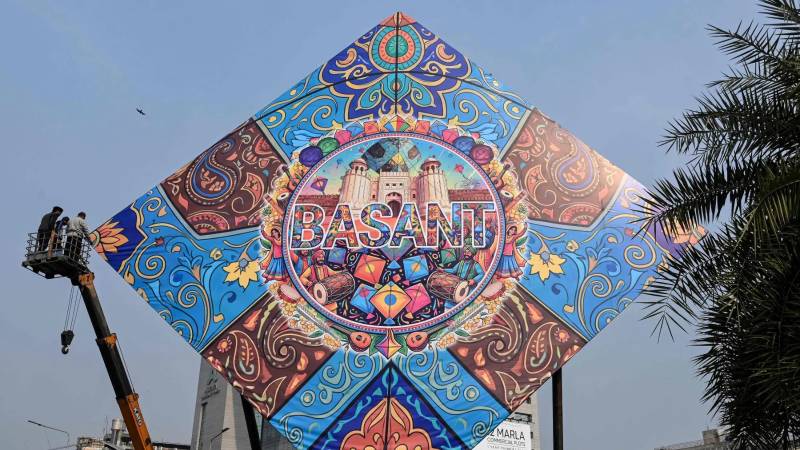
Basant is one of the subcontinent’s most beloved springtime festivals, long heralding the arrival of warm breezes and blooming mustard fields. In old Lahore, Basant was an exhilarating annual spectacle. As spring approached, the city would don a basanti (yellow) hue – from zestful kites swarming the skies to celebrants clad in vibrant yellow attire.
Rooftops turned into community fairgrounds filled with the beat of dhol drums and the exuberant shouts of “Bo kata!” (a victory cry when someone’s kite string is cut). For a moment, it felt as if the entire town had become one, united in the joyous revelry of spring. This was a festival that transcended divisions: historically, Hindus, Muslims, and Sikhs all joined in to celebrate Basant, illustrating its character as a cultural seasonal festivity rather than a ritual bound to any single faith.
In recent years – especially during periods when Basant was officially banned on safety grounds – debates have arisen over the true nature of Basant. Some have argued it is rooted in a religious incident, while others insist it is purely a seasonal folk celebration. One particularly contentious claim ties Basant to the memory of a Hindu boy named Haqiqat Rai, casting the festival in communal colours.
Detractors allege that Basant Panchmi (the spring fifth) is observed in honour of Haqiqat Rai’s martyrdom, implying it is a Hindu religious commemoration. This claim, however, is historically debatable, and examining Basant’s rich past reveals a much broader picture.
The story of Haqiqat Rai dates back to the 18th century and, over time, it has intertwined with Basant folklore. According to colonial-era chroniclers, Haqiqat Rai Puri was a young Hindu boy from Sialkot who became tragically embroiled in religious conflict.
William Ridgeway writes:
"Hakikat Rai was the son of Bagmalla Khatri of the Puri sub-caste, and a resident of Sialkote. His mother’s name was Kauran. At the age of seven, he was sent to school under a Maulvi. When he was twelve, he married the daughter of Kirpal Singh. After his marriage, while reading in the mosque, he happened to quarrel with his classmates of the Muslim faith. The latter abused Bhavani (the goddess Durga, wife of Shiva), which enraged him, and he in turn abused (Syeda) Fatima (R. A), the daughter of Muhammad (P.BU.H). Thereupon, the Muhammadans went to the Qazi and reported the matter to him. He at once pronounced a verdict of guilty and the penalty of death, according to the injunction of the Muslim scriptures. All the Qazis of Sialkote went to Amir Begh, the governor of the city, and asked him to kill the slanderer of the daughter of the Prophet. The governor, out of regard for the Hindu subjects, refused to deal with the matter and asked the Qazis to go to the Suba of Lahore for justice. They went to him and persuaded him to abide by the decision already pronounced. The Muslim administrators of justice were inexorable. The result was that two alternatives were proposed by the Suba – either Hakikat must embrace Islam and marry his daughter in marriage, or die. The undaunted lad preferred death and was mercilessly butchered at Lahore. This event is said to have occurred when Muhammad Shah was ruling at Delhi in the year 1791 of the Vikrama era (A.D. 1734)."
Haqiqat Rai’s refusal to surrender his faith made him a potent symbol for many, and his death came to be seen by contemporaries as an act of martyrdom.
The Lahore Gazetteer of the British era explicitly records that a huge Basant fair took place at Shah Hussain’s dargah. According to the Gazetteer, 40,000 to 50,000 people would assemble
Syed Muhammad Latif, a 19th-century colonial historian of Lahore, notes the aftermath of Haqiqat Rai’s execution. A small memorial shrine (samadhi) was built for the boy, and throngs of Hindus began visiting it to pay respects. According to Latif, an annual fair started to be held at this samadhi during Basant, effectively merging the celebration of spring with an homage to Haqiqat Rai’s memory.
Over time, this yearly Basant mela at Haqiqat Rai’s shrine became a well-attended tradition to welcome the spring. Based on such accounts, some have assumed that Lahore’s Basant festival itself was essentially a Hindu religious observance in remembrance of Haqiqat Rai.
During the later British colonial period – when Hindu-Muslim communal identities were often in tension – the figure of Haqiqat Rai gained renewed prominence. He was lauded as a dharamveer (faithful hero) who sacrificed his life for his religion, and his story was consciously highlighted as a symbol of martyrdom.
In 1895, for instance, a Punjabi dictionary compiled by Maya Singh defined the term “dharmi” in the context of Haqiqat Rai’s legend, meaning one who remains loyal to their faith or gives the ultimate sacrifice for it. Haqiqat Rai’s tale was even brought to the stage: plays were performed in Lahore and elsewhere dramatising his var (ballad) to extol unwavering devotion to one’s religion.
This martyr narrative around Haqiqat Rai thus became entwined with Basant in the public imagination, especially among certain Hindu communities who saw his martyrdom as hallowed.
However, a closer look at historical timelines and local traditions makes one thing clear: Haqiqat Rai’s story was attached to Basant later and was not the original reason for the festival. Latif’s own account indicates that Haqiqat Rai’s memorial observance was incorporated into the existing Basant fair, rather than Basant being created for him.
Basant, as a seasonal celebration in the Punjab, predates Haqiqat Rai’s 1734 martyrdom by a considerable margin. It was already a vibrant cultural event, to which the commemoration of Haqiqat Rai was added in Lahore so that devotees could honour him on a significant communal day.
Evidence shows that during Basant, the Hindu community of Lahore would remember Haqiqat Rai’s sacrifice, but Basant itself remained a spring festival open to all. An early 20th-century Basant special issue of the magazine Alamgir featured numerous poems and articles about Haqiqat Rai, underscoring that his legend was often recalled during the Basant season. But even in such cases, paying tribute to Haqiqat Rai was one aspect of the celebrations, not the entirety. Historically, Basant’s identity was far broader than a single religious story.
Before the Partition of India in 1947, Lahore’s Basant was never exclusive to any one religion. Both Hindus and Muslims (as well as Sikhs and others) celebrated it enthusiastically across the city.
It was only after the Haqiqat Rai episode that a subtle shift occurred: many Muslims chose to stop attending the Basant fair at Kot Khwaja Saeed (the site of Haqiqat’s samadhi) out of personal sentiment, leaving that particular locality’s festivities predominantly to Hindu devotees. But this did not dampen Muslim participation in Basant at all – they simply continued the festival in other parts of Lahore with equal zeal.
For example, while Hindus flocked to the Haqiqat Rai fair in Kot Khwaja Saeed, Muslim Lahoris gathered at the shrine of the Sufi saint Madho Lal Hussain (Shah Hussain) on the city’s other end to hold their own Basant mela. Basant at the mausoleum of Shah Hussain became a grand event itself.
The Lahore Gazetteer of the British era explicitly records that a huge Basant fair took place at Shah Hussain’s dargah. According to the Gazetteer, 40,000 to 50,000 people would assemble. Even Maharaja Ranjit Singh, the 19th-century Sikh ruler of Punjab, recognised its importance. During his reign, attendees of the Shah Hussain Basant fair were exempted from certain taxes, a royal indulgence that speaks to the festival’s popularity.
To label Basant a strictly religious festival is historically inaccurate; it is, in spirit and practice, a spring cultural celebration that has been part of the subcontinent’s shared legacy for ages
Interestingly, the Gazetteer listed Basant among “Hindu fairs,” while local historian Noor Ahmad Chishti categorised it under Muslim festivals. In truth, both were right in a way – Basant straddled communities, illustrating how intertwined cultural life was in Punjab.
Not only Hindus and Muslims, but Sikhs too have a longstanding Basant tradition in Lahore. The Sikh community would celebrate Basant at the Gurdwara of Guru Mangat. Chronicler Agha Ashraf writes:
"On Basant Panchmi, Sikhs would gather at Gurdwara Guru Mangat Sahib to celebrate the fair. They flew kites and rejoiced. Across the city of Lahore, Hindu, Muslim, Sikh – all would fly so many kites that the sky could not be seen."
Such was the universal appeal of the Basant festival that its driving force was not any narrow religious ritual, but the sheer delight of spring and the thrill of kite-flying.
The spirit of Basant was perhaps best captured by American travel writer Henry A.R. Fuller, who visited Lahore around 1918 and reported on the festival’s atmosphere in The Continent magazine. He described how thousands of people gathered in the open fields around Haqiqat Rai’s shrine on Basant day. Yet Fuller observed that the day’s religious overtones were minimal – aside from a brief tribute to that “particular hero,” the crowds spent the rest of the day indulging in the gaieties of Basant.
In other words, Basant was not about formal worship, but about fun, community, and the coming of spring.
In modern reflections, some local commentators have strongly refuted the misconception that Basant is inherently a “Hindu festival.” One such voice, Masood Hayat, bluntly states in his memoirs:
"Basant is not a religious festival. Some people have gone so far as to paint it as a Hindu festival, which is baseless. As far as I know, Basant was celebrated a hundred years ago and more. Muslims, Hindus, Sikhs, Christians – people of every faith – took part in it. It’s an entertaining game… just as people of all religions play cricket, hockey, football, wrestling, boxing, likewise Basant is a festival for everyone."
Hayat’s point underscores that Basant belonged to the people of the region collectively, and attempts to restrict it to one community are misguided.
Numerous reminiscences of old Lahoris bear out the fact that Basant was a shared civic celebration and a highlight of the city’s cultural calendar. An author writing under the name Tahir Lahori paints a nostalgic picture:
"A magnificent fair would take place on Basant; the entire city would wear a festive look. This festival was considered a seasonal, springtime event – not just Hindus, but Muslims too took part. In the bazaars, alleyways, open grounds, parks, gardens, and on rooftops, there were throngs of people flying guddiyaan (paper kites)."
Similarly, A. Hameed noted that Basant was essentially the festival marking the onset of spring, enjoyed by everyone irrespective of creed. The Lahore of yesteryear would come alive with colour and camaraderie as winter’s chill gave way – a transformation experienced by all residents, not filtered through religious identity.
Many senior Lahore residents have preserved vivid memories of Basant’s inclusive spirit. Yunus Adeeb emphasises:
"The people of Lahore did not celebrate Basant as Hindus or Muslims, because Basant was the city’s seasonal festival. Basant signifies the end of winter. Since my childhood, I have heard the saying, ‘Aayi Basant, paala urant’ – Basant arrives, and the frost departs."
Indeed, before Basant, Lahore would be in the grip of biting cold, and immediately after Basant, the chill would begin to wane. But Basant infused life in Lahore with colour. The festival gave everyone a chance to step outside, greet neighbours, and fill the skies with brilliant kites as a communal expression of hope and happiness.
Shafqat Hussain Sharafat provides a scholarly explanation:
"In the subcontinent, the Basant festival is purely a seasonal festival and has been so for centuries. It is the harbinger of spring – bidding farewell to the frigid winter and welcoming the fiery warmth of the coming season, all amid a romantic, spring-kissed ambience. The word Basant itself comes from two Sanskrit roots, bas and ant, meaning fragrance and colour… Kite flying’s major hub used to be the vast field at Kot Khwaja Saeed, around which mustard flowers in full bloom stretched as far as the eye could see. When Haqiqat Rai was executed, his body was cremated here, and a samadhi was erected. But note: this execution happened during the administration of Nawab Zakariya Khan, whereas the Basant festival had been celebrated at this site long before. Before Partition, Hindus and Muslims together celebrated Basant, but after that incident, Muslims voluntarily ceased celebrating in that area. Thus, over time, that locality’s Basant became reserved for Hindus only."
Sharafat’s account reinforces that Haqiqat Rai’s martyrdom was a later chapter in the Basant story, not its origin. The festival was already flourishing as a spring carnival; the lore of Haqiqat Rai was simply woven into the local tapestry at one venue. And significantly, even after some Muslims withdrew from the Kot Khwaja Saeed fair out of respect for their feelings, they continued to celebrate Basant with equal fervour elsewhere. Basant’s essence, therefore, remained that of a public carnival of spring, not a ritual of religious devotion.
From the above historical testimonies, it becomes evident that Haqiqat Rai’s saga did not birth Basant, and framing Basant as solely a Haqiqat Rai commemoration is an oversimplification at best.
Even within Hindu tradition, Basant Panchmi is primarily a day dedicated to Saraswati (goddess of learning) and the joyful change of seasons, rather than any observance for Haqiqat Rai. In Lahore, the Hindu community did keep Haqiqat’s memory alive during Basant, but the festival at large always retained its inclusive, multi-cultural character.
For centuries – both before Partition and for many decades after – Basant was celebrated in Lahore as a true people’s festival, cutting across religious and social divides. It symbolises the exuberance of spring, the human need for festivity, and the syncretic blend of cultures that defines the region’s heritage.
To label Basant a strictly religious festival is historically inaccurate; it is, in spirit and practice, a spring cultural celebration that has been part of the subcontinent’s shared legacy for ages. Even today, whenever Basant is celebrated (with its kites, colours, and convivial gatherings), it continues to express that timeless spirit of unity in joy – a festival of hope and renewal far greater than any one legend or community.