

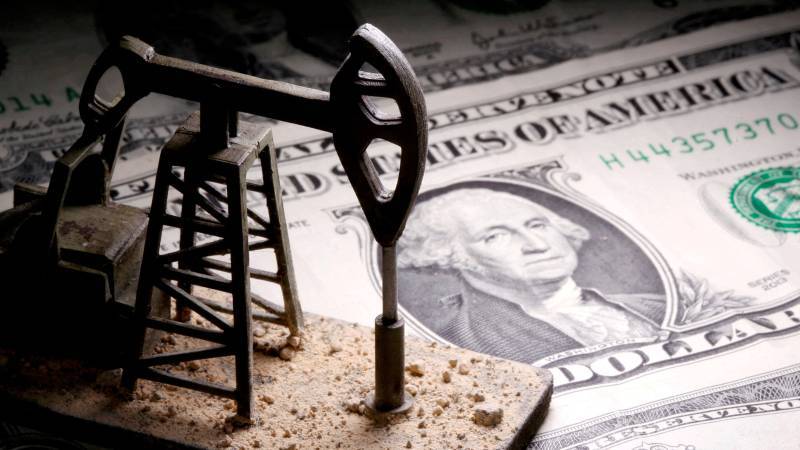
There are times in global finance when change happens not with a loud crash but with a quiet shift in language. For decades, oil has been priced, traded, and recycled in dollars. It has been part of a system that tightly linked energy markets to American financial power. That system, known as the petrodollar, did not appear overnight, nor was it built only on coercion. It was created patiently through institutions, liquidity, trust, and time.
An increasing portion of global oil trade, especially through key routes like the Strait of Hormuz, is gradually shifting towards settlements in currencies other than the US dollar, most notably China’s yuan. This change is not dramatic enough to make headlines every day, but it is significant enough to alter the structure of global finance over time. It indicates not the fall of the dollar, but the end of its unquestioned dominance.
To understand what is at stake, one must first recognise what the petrodollar system accomplished. After the breakdown of Bretton Woods and the oil shocks of the 1970s, the United States established a strategic agreement with major oil producers. Oil would be priced in dollars, and excess revenues would be reinvested in US financial markets. Over time, this system became self-sustaining. Oil importers needed dollars; exporters accumulated them; and global capital flowed back into US assets.
The result was a system that anchored global liquidity, stabilised exchange rates, and centralised monetary power in one main hub. The dollar became more than just a currency; it became the operating system of global trade.
China’s rise as the world’s largest oil importer has created a new dynamic in this system. With growing economic power and strategic goals, China has begun promoting energy trade in yuan, developing financial infrastructure such as yuan-denominated oil futures and alternative payment systems. These efforts are not just symbolic; they aim to connect trade flows to currency use and build a parallel financial ecosystem, indicating a potential long-term shift in global currency influence.
When even a small part of oil moving through the Strait of Hormuz, through which about a fifth of global supply passes, begins to be traded in yuan, the effects go well beyond energy markets. Currency rivalry shifts from desire to reality. Financial networks start to change. Liquidity, which used to flow predictably through dollar channels, begins to spread out.
The future of global finance probably will not be marked by a simple switch from the dollar to the yuan. Instead, it will be characterised by coexistence, chaos, unevenness, and constant change
This shift has significant macroeconomic effects. The petrodollar system supported global demand for dollars and allowed for a fairly stable cycle of liquidity and investment. As the oil trade spreads into other currencies, that cycle weakens. At the same time, capital may begin to concentrate more regionally. China’s financial system could absorb a greater share of global surplus, while other regions develop localised financial circuits. The result is a world where capital is no longer uniformly priced, and where financial conditions vary more sharply across regions.
Exchange rates also become more volatile. In a dollar-centric system, many currencies were implicitly tied to the dollar. A multi-currency environment loosens that tie, leading to more fluctuations, especially for emerging markets already vulnerable to external shocks.
Inflation dynamics will also grow more complex. When oil is priced in multiple currencies, the transmission of price shocks becomes less synchronised, complicating monetary policy responses across countries.
Yet perhaps the most important change lies in the area of systemic risk. A single dominant currency concentrates power, but it also consolidates stability mechanisms. A multipolar system spreads influence, but it comes with fragmentation. Multiple settlement systems, uneven liquidity pools, and weaker coordination can increase stress during crises. In other words, the world may be moving from a system of concentrated risk to one of distributed uncertainty.
A more diverse monetary system could, in theory, lessen overreliance on one country’s policies. It might give emerging economies more strategic independence and lead to a more even spread of global financial power. But diversification is not the same as stability. Without strong institutions, transparency, and coordination, a fragmented system can become more fragile.
China’s efforts to internationalise the yuan face obstacles. While its economic size and trade networks offer a strong foundation, questions remain about capital account openness, financial transparency, and institutional trustworthiness. These are not just technical issues; they are the essential factors that determine whether a global currency can sustain trust and stability over time.
The current situation is more fragile. The petrodollar system is not ending suddenly, but it is gradually losing strength. Its dominance is eroding at the edges, and those edges are slowly developing into long-term structural changes that will unfold over decades.
For policymakers, this requires a change in perspective. Bolstering regional cooperation and diversifying financial infrastructure can promote resilience and shared stability in this changing landscape. More than anything, it requires moving away from binary thinking. The future of global finance probably will not be marked by a simple switch from the dollar to the yuan. Instead, it will be characterised by coexistence, chaos, unevenness, and constant change.
The true story, then, is not about one currency falling or another rising. It is about the slow reshaping of the system itself. Oil flowing through Hormuz in yuan will not end dollar dominance tomorrow. However, it signals a more lasting shift: a world where no single currency can claim unquestioned power, and where economic influence is spread across multiple, competing, and interconnected systems.
That world is not necessarily less stable, but it is definitely more complex. And the change has already started.