

Pakistan can restore economic stability without securing lasting prosperity. Inflation can fall as demand weakens, the current account can improve as imports contract, and reserves can rise through borrowing. These gains matter, but they do not establish that the economy can sustain growth. That requires rising productivity: more real output from each hour worked. Without it, recovery risks renewed foreign-exchange pressure, wage gains can strain competitiveness, and the tax base struggles to expand. The central question is not simply whether Pakistan can restore stability, but whether it can grow without losing it.
Real GDP grows when total hours worked increase, output per hour rises, or both. Employment growth is essential, but longer shifts alone cannot sustain rising living standards. Better equipment, skills and organisation must raise output per hour. These inputs reinforce one another: machinery delivers little when power is unreliable or workers lack the skills to use it. Investment announcements are therefore no substitute for productive capacity. The World Bank’s October 2025 Pakistan Development Update makes the distinction clear. Fiscal and monetary restraint helped contain inflation and improve economic balances, while tariffs, regulatory friction and costly energy and logistics continued to constrain exports. Stabilisation buys room for recovery. Productivity determines how far that recovery can go.
International productivity comparison
Average annual growth in real GDP per hour worked (%)
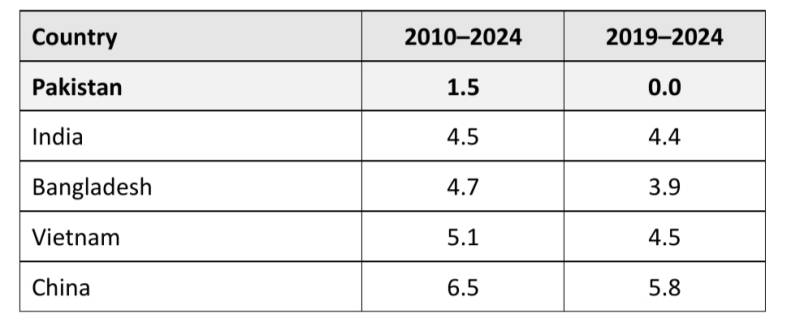
Source: Asian Productivity Organization, Productivity Databook 2026, Table 9.11 (p. 149). Economy-wide estimates; figures rounded to one decimal place.
These are growth rates, not productivity levels. On the rounded figures shown, Pakistan’s average annual improvement during 2010–2024 was one-third of India’s and less than one-third of Vietnam’s. Its 2019–2024 rate rounded to zero. That does not mean every firm stood still; it points to little or no measured economy-wide productivity growth over that period. The link to wages is direct. When hourly labour compensation rises faster than real output per hour, labour costs per unit increase, squeezing margins or pushing up prices. Rising productivity allows firms to pay more without the same cost penalty, although institutions and bargaining determine how gains are shared. Cheap labour is not necessarily competitive labour: a skilled worker with better equipment can earn more while producing at a lower unit cost.
Productivity growth can ease inflationary pressure by expanding supply and reducing unit costs. Reliable power, efficient transport and higher agricultural yields allow demand to grow with fewer bottlenecks. They cannot neutralise every food, fuel or exchange-rate shock, nor replace monetary discipline. But lower inflation achieved through stronger supply offers a firmer basis for growth than lower inflation achieved through depressed spending. The external account exposes the productivity trap most clearly. Recovery raises demand for imported fuel, machinery and inputs; if competitive exports lag, foreign-exchange pressure returns. More productive firms can lower costs, improve quality and deliver reliably, earning the foreign exchange needed to sustain expansion. A current-account surplus is not the sole test of success: restricting machinery and inputs can improve today’s balance while damaging tomorrow’s export capacity.
Depreciation alone cannot resolve this weakness. It can raise exporters’ rupee receipts, but also increases the rupee cost of imports and foreign-currency debt. Loans and rollovers provide liquidity; remittances support incomes and the external account. None is inherently undesirable. The problem begins when financing repeatedly substitutes for an export base capable of supporting growth. The fiscal connection is equally important. Productive investment can broaden the tax base and strengthen the economy’s capacity to carry debt, but cannot excuse excessive borrowing. What is missing is a clear hierarchy of spending priorities: the size of a development budget matters less than the value it creates. Productive expenditure removes barriers to growth; wasteful expenditure builds monuments to ambition and leaves those barriers intact. Fiscal discipline must protect effective investment in learning, health and essential infrastructure while cutting projects that deliver visibility rather than value.
This is an argument for better infrastructure choices, not against infrastructure. The IMF’s 2023 Public Investment Management Assessment identified weak links between national goals and investment plans, and relatively low public-investment efficiency. Every proposed project should disclose its expected economic and social benefits, full lifetime costs and the alternatives forgone. Prestige projects that fail this test should not displace maintenance, reliable power, safe water, foundational learning or nutrition. Such spending leaves productivity constraints unresolved while adding operating and maintenance costs to future budgets.
Alongside better spending choices, reform must address the risks facing a firm considering expansion. Predictable rules, security and timely contract enforcement make investment less hazardous. Digitised land records, dependable titles and effective commercial courts help firms finance equipment and enter supply relationships. When policy or ownership remains uncertain, investment is delayed and future productivity suffers. Administration should reduce friction, not manufacture it. Predictable taxes, timely refunds and transparent regulation release working capital and management time for production. Competition allows capable firms to expand instead of leaving resources trapped in protected businesses. But these policies require an administrative structure designed to deliver them. Cheap credit cannot compensate for rules that reward influence over efficiency.
That requires reform of the civil service, including the Central Superior Services (CSS) recruitment model. In Pakistan’s most expensive lottery, published in Business Recorder on November 2, 2026, Dr Nadeem ul Haque questions the economic cost of prolonged examination preparation and whether the selection process reliably identifies ability. His central estimate puts the annual economic cost of preparation and foregone earnings at roughly Rs11 billion—not an official expenditure figure. The productivity concern extends beyond recruitment: time spent pursuing scarce posts has an opportunity cost, while a general examination cannot substitute for specialist expertise. Recruitment should match knowledge to clearly defined roles and provide transparent entry routes for experienced professionals.
Stabilisation buys time; investment in people and productive capacity determines how well it is used. The test is whether Pakistan can sustain growth, raise living standards and avoid another cycle of crisis.
Recruitment reform must be matched by institutional rationalisation. Duplicated bodies, overlapping mandates and repeated approvals waste public money, delay investment and blur accountability. Reform should eliminate redundant functions, clarify responsibilities across tiers of government and set enforceable decision deadlines. Without an administration capable of implementing policy, even sound economic reforms will struggle to deliver.
International experience offers a useful test: does policy create competitive capability? South Korea combined investment, imported technology and export discipline, allowing buyers to judge price, quality and delivery. Vietnam’s trade integration attracted manufacturing, but the World Bank’s Viet Nam 2045 report highlights weak domestic supplier links. Hosting factories is a start; building local skills and retaining more value is the harder task. Pakistan’s economic zones should be judged by operating factories, supplier development and competitive orders—not land allotments or memoranda.
Energy reform connects these ambitions to factory-floor reality. Outages waste machine hours and disrupt deliveries; expensive, unpredictable supply deters modernisation. Reliable power and transparent, cost-reflective charges support investment and lower effective unit costs. Shifting utility losses onto industry weakens competitiveness, while unsustainably low tariffs create another financing gap. Losses, procurement and governance need direct remedies; vulnerable households need transparent, targeted budget support.
Business support needs discipline too. Assistance should have a disclosed cost, a review date and an exit mechanism, assessed against additional investment, productivity and competitive sales. Persistent demands for protection are not evidence of success. Withdrawing special favours must not mean withholding the reliable infrastructure and timely refunds that every lawful enterprise needs. Diversification should pursue value, not a longer list of preferred sectors. Textiles can earn more through design, technical products and dependable delivery; other tradable activities should expand where demand and competence exist. Testing, certification and technical training can help firms enter higher-value markets. Gross exports alone are insufficient: domestic value added matters, and imported technology and inputs may be essential to increase it.
Technology adoption and adaptation turn that ambition into better products and processes. Applied research, shared testing facilities and support for commercially viable prototypes should be judged by adoption, reduced waste and improved quality. Research spending raises productivity only when ideas reach production. Skills and health determine how much these investments deliver. The World Bank’s October 2024 human-capital brief reports that, in 2019, 80 per cent of Pakistani children could not read and understand a simple text by age ten. Such learning deficits constrain the use of machinery and technology. Foundational learning, employer-linked technical training and pathways into productive employment must take priority over qualifications unsupported by practical competence.
The constraint begins before school. Pakistan’s 2018 National Nutrition Survey found that 40.2 per cent of children under five were stunted. Poor nutrition and repeated infection can impair learning and future earnings, perpetuating deprivation. Maternal nutrition, early-childhood care, safe water and sanitation are therefore investments in productive capacity, not peripheral welfare measures. Accountability requires a connected dashboard. Read GDP growth alongside productivity and employment, wage growth alongside inflation and unit labour costs, and exports alongside volumes and domestic value added. Ask whether the current account improved through competitive sales or suppressed imports, and whether stronger reserves reflect durable foreign-exchange inflows or borrowing that creates future repayment obligations. Track investment through to operating capacity and public projects through to realised benefits—not merely spending totals or completion ceremonies. Otherwise, targets can reward the appearance of progress while its foundations weaken.
Turning stability into lasting prosperity requires investment in people alongside institutional and economic reform. Human development—nutrition, health, education and skills is a prerequisite for the productivity gains that support higher wages, competitive exports and a broader tax base. These capabilities must be matched by dependable institutions, a professional administration, reliable infrastructure and firms able to adopt technology and compete. Spending priorities should strengthen those foundations, not favour the visibility of prestige projects. Stabilisation buys time; investment in people and productive capacity determines how well it is used. The test is whether Pakistan can sustain growth, raise living standards and avoid another cycle of crisis.