

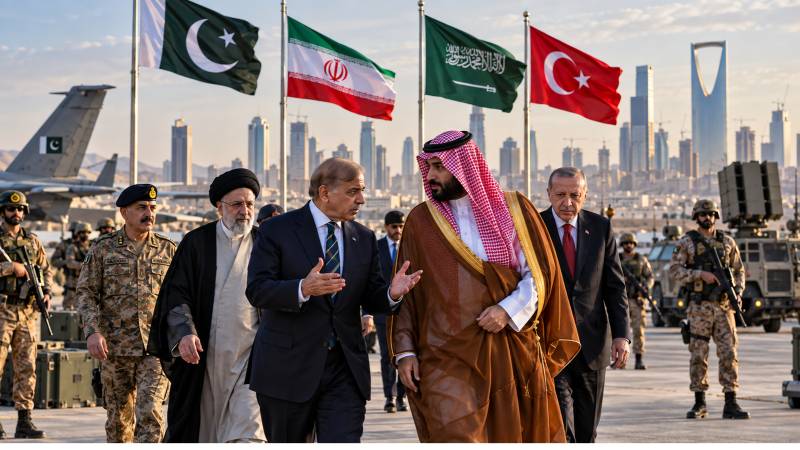
For much of the past two decades, Pakistan was discussed internationally as a source of instability rather than a contributor to regional order. Economic weakness, militancy, political volatility and strained civil-military relations reinforced that image. Recent events have complicated it. Pakistan's mediation between the United States and Iran, its defence commitments in the Gulf and its expanding security cooperation with Saudi Arabia and Türkiye point to a more active regional posture.
The change is real, but it should not be exaggerated. Pakistan has not become an indispensable security guarantor. It is better understood as a selective security provider: a state that can convene adversaries, contribute military capabilities and support collective deterrence, yet still lacks the economic strength and coercive leverage required to shape outcomes on its own.
The strongest evidence comes from the 2026 Iran conflict. Pakistan maintained channels with both Washington and Tehran and hosted intensive talks between American and Iranian delegations on 11 and 12 April. Those negotiations helped sustain a ceasefire process that culminated in the electronically signed Islamabad Memorandum of Understanding on 17 June. Pakistan subsequently joined Qatar in supporting implementation talks in Switzerland. This was serious diplomacy, conducted through the Prime Minister's Office, the Foreign Ministry and the military leadership rather than through a single personality or institution.
Pakistan was not the only mediator. Oman and Qatar had their own established channels, while China and other regional actors supported de-escalation. Islamabad's contribution nevertheless mattered because it could communicate with both sides, keep negotiations moving after setbacks and provide a venue for direct engagement. Its diplomatic value lay in access, persistence and a degree of trust from parties that had few reliable channels between them.
The limits of that role soon became clear. The Islamabad Memorandum halted the immediate fighting but did not remove the underlying disputes over Iran's nuclear programme, sanctions or the Strait of Hormuz. Renewed tensions later tested the agreement. As recently as 1 October, Pakistan's Foreign Office was still urging both sides to honour their commitments and describing the memorandum as the basic framework for a negotiated settlement. Pakistan could facilitate an agreement; it could not compel either Washington or Tehran to observe it. That distinction separates a useful mediator from a power capable of enforcing regional order.
Influence is not the same as control. Pakistan’s most credible role is that of a selective security provider whose usefulness rests on access, diplomacy and limited military support.
At the same time, Pakistan has moved more deeply into Gulf security. The Strategic Mutual Defence Agreement signed with Saudi Arabia in September 2025 states that aggression against either country will be treated as aggression against both. In August 2026, Pakistan, Saudi Arabia and Türkiye widened this architecture through the Makkah Joint Defence Agreement. The three governments committed themselves to collective deterrence and broader defence cooperation. A joint political and defence committee and a Saudi-based secretariat, initially led by a Pakistani secretary-general, were announced later that month. These are signs of institutionalisation, not merely ceremonial diplomacy.
The military dimension has also become more visible. Reuters reported in May that Pakistan had deployed 8,000 troops, combat aircraft and air-defence assets to Saudi Arabia. On 2 October, it cited a Pakistani official who put the number at between 30,000 and 40,000 troops tasked with helping defend the kingdom's borders and countering drone and missile threats. The same report said Pakistani equipment and advisers were supporting Saudi-backed forces in Yemen, while noting that the Pakistani and Turkish defence ministries had not responded to requests for comment. These reports therefore require official clarification. If accurate, however, they show that Pakistan's Gulf role has moved well beyond training exchanges and political declarations.
Nuclear claims require even greater caution. Public statements surrounding the Saudi agreement have encouraged speculation that Pakistan may be extending a nuclear umbrella to the kingdom. The published joint statements do not establish such a guarantee, identify a nuclear command arrangement or explain how extended deterrence would work. Until the governments release clearer language, the issue should be treated as strategic ambiguity rather than confirmed policy. Loose rhetoric may provide short-term signalling value, but it also creates proliferation concerns and expectations that Islamabad may not intend to meet.
Pakistan's dual role creates a difficult balance. Its credibility with Iran depends on being regarded as a fair intermediary. Its expanding commitments to Saudi Arabia and Türkiye place it more firmly inside a Gulf-centred security framework. Neutrality does not require equal distance from every partner, but mediation does require confidence that the intermediary can preserve channels and protect sensitive communications. The more operational Pakistan's Gulf commitments become, the harder it will be to reassure Tehran that those commitments will not shape its diplomatic conduct.
Domestic conditions impose a second constraint. The Global Terrorism Index 2026 ranked Pakistan as the country most affected by terrorism in 2025, recording 1,139 deaths and 1,045 incidents. Militancy in Khyber Pakhtunkhwa and Balochistan, instability along the Afghan border and limited fiscal space compete with external commitments for attention and resources. Pakistan can contribute specialised capabilities abroad, but an open-ended security role would be difficult to sustain while threats at home remain severe.
A durable policy therefore needs clear limits. The government should define the scope, command arrangements and parliamentary basis of overseas commitments; preserve institutional channels with Iran as defence cooperation with Gulf partners grows; and avoid presenting ambiguous nuclear signalling as a substitute for a declared policy. Mediation should remain anchored in the Foreign Ministry and elected government, with military channels supporting rather than overshadowing formal diplomacy. This would make Pakistan's role more predictable to partners and less dependent on personalities.
Pakistan's regional profile has undoubtedly expanded. It has helped adversaries negotiate, supported collective defence arrangements and demonstrated that it can supply capabilities valued by important partners. Yet influence is not the same as control. Pakistan's most credible role is that of a selective security provider whose usefulness rests on access, diplomacy and limited military support. Whether it can sustain that role will depend on disciplined commitments abroad and greater stability at home.