

Pakistan and India together account for around one fifth of the world’s population, with women constituting approximately 48.5% of the population in both countries. Female labour force participation, however, remains significantly different: approximately 24% in Pakistan compared with 32% in India. Women's economic participation in both countries is heavily informal and largely home based. Female educational attainment is higher at Bachelor’s level in India: 11.7% compared with 8.4% in Pakistan; at Master’s level, the figures are approximately 2.8% and 3%, respectively. So, could level of tertiary education and labor force participation be the difference between a women rights awakening or movement? No, women across the social strata’s, income and education divide are impacted by social/cultural restrictions and gender based discrimination. The political effect of education and employment depends on its ability to be translated into access to rights, confidence to occupy public spaces, voice and agency.
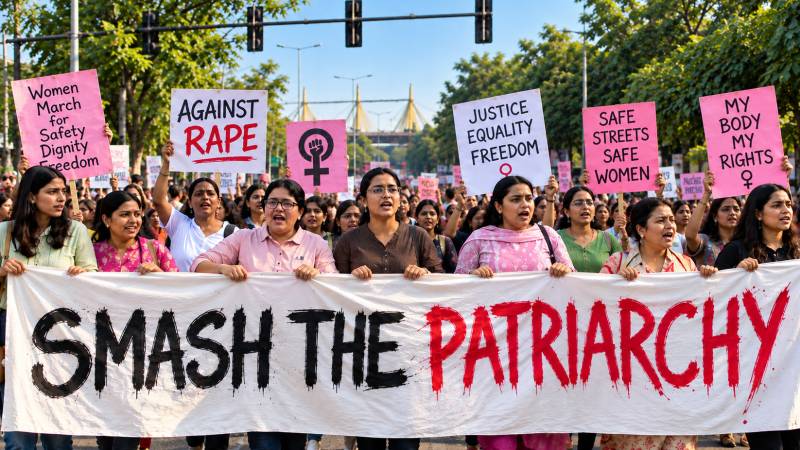
September 2026, for both Pakistan and India brought two contrasting episodes of Sexual Gender Based Violence (SGBV) and linked women’s mobilization. In Delhi, the gang rape of a 17 year old student triggered protests by women students, initially demanding safe mobility and public spaces and subsequently developing into a wider ‘Smash the Patriarchy’ discourse. In Swat, the rape and murder of a nine year old girl triggered an organic all women protest demanding justice, punishment and accountability from the police and the government.
The commonality factor between the two event is Gender Based Violence (GBV) and patriarchal impunity to cases of SGBV. In both countries, socio-cultural and socio-religious stereotypes are used to regulate women’s life, sustain discrimination and challenge the road to gender equality. Whenever women challenge this order, political and religious vested groups impact the discourse to shift attention from crime and accountability to the cultural appropriateness of women’s clothing, language, mobility and/or behavior. Their words and slogans are often scrutinized more than the violence that produced them. Women are expected to remain linguistically modest and appropriate even when expressing anger and grief over violence as heinous as rape. They are expected to take victim blaming lying down and failing to do so results in being labeled as westernized liberal and obscene.
Slogans have had triggering effect on both side of the border. The slogans used by the Delhi University have become viral. Ek kachori do Samosam: in mardon ka kya Bharosa - calling out men as not trustworthy has become earworm on social platforms. Gils are being called out for slogans like ‘Raaton par bhi haq hai hamara’ (we have a right to the night too), ‘Rapist ko andar karo, ladkiyon ko nahin’ (put rapists behind bars, not girls), and ‘Why cursing is a cultural shock, but rape is not?’ These slogans are labelled as obscene rather than expressions of anger, claiming public space, equality of rights; while rejecting the idea that women’s safety means added restrictions on women and girls. The slogans of Aurat March - “Mera Jism, Meri Marzi,” “Aurat Mangay Azaadi” and “Jaag Riasat Jaag.” in Pakistan had similar reactions. These slogans have been criticized as obscene or incompatible with religion, family, honor and social values. The real issue, however, is not whether a slogan is linguistically appropriate to a socio-religious normative framework. The issue is why female linguistic choice leads to social anxiety than male violence against women – the crime.
Whenever women challenge this order, political and religious vested groups impact the discourse to shift attention from crime and accountability to the cultural appropriateness of women’s clothing, language, mobility and/or behaviour.
Leadership in both countries, political to religious vested groups, have a sustained history of victim blaming. Bhartiya Janata Party (BJP) Member of Legislative Assembly M.P. Renukacharya (2012) said that ‘a lot of incidents of sexual assault occur due to the clothes that women wear’ as men are provoked by women’s clothing. Religious leader Asaram Bapu, commenting on Delhi rape case (2012), said the victim was ‘as guilty as her rapists’; she should have called the attackers her brothers and begged them to stop – ‘it takes two hands to clap’. Prime Minister Narendra Modi described it as a ‘cultural shock’ while referring to women protesters sloganeering and use of foul language. In Pakistan, former Prime Minister Imran Khan 2021, said that ‘If a woman is wearing very few clothes, it will have an impact on men. Unless they’re robots. Its common sense.’ The Aurat March, 2018, core slogan Mera Jism, Meri Marzi (My body My right) triggered politicians across divide, except Pakistan People’s Party (PPP).
The Jamat-e-ulema-Islam (JUI-F) leader Maulana Fazlur Rehman described it as promoting vulgarity, irreligiousness and Western values. PML-N Senator Mushahidullah Khan described the slogan as obscenity and said, ‘We will not allow this slogan. Jamaat-e-Islami (JI) Senator Mushtaq Ahmad Khan condemned it as an attempt to introduce Western culture in the name of women’s rights. In contrast, Bilawal Bhutto-Zardari Chairman PPP supported Aurat March, saying that women would march and take up professions such as doctors, lawyers and even the prime minister. In India, Rahul Gandhi, Chairman Indian National Congress, responding to Modi’s ‘cultural shock’ comment, questioned why boys could use abusive language without generating the same cultural anxiety and told protesting women: ‘Smash the patriarchy… be loud, be proud, and fight for your space in society.
Fact also remains that despite progressive legislation social vacuum exist, in both countries, that perpetuate social impunity for SGBV and enables political and religious leaders to criticize the discourse on gender equality and women protesters. The vested groups and politicians remain scared of the potential of such protest taking shape of political protest; or a subject like SGBV mainstreamed in political discourse to have a political implication. Hence the conversations on violence, perpetrators and institutional accountability, mutates or are targeted towards women’s modesty, honor, language, cultural appropriateness and acceptable social conduct.
The political discourse surrounding sexual violence in India and Pakistan also reflects two set of approaches: (a) protectionist approach, which seeks to reduce women’s vulnerability by regulating how they dress, articulate to conduct; and (b) a citizenship based approach which holds that women should be free to make life style choices and State has the responsibility for preventing violence. Constitutionally, both India and Pakistan provide substantial formal guarantees of gender equality, dignity, liberty and non-discrimination. India’s Articles 14–16, alongside Articles 19 and 21, provide a strong constitutional vocabulary of equality, liberty and public citizenship. Pakistan’s Articles 14–16 and 25–27 similarly guarantee dignity, liberty, equality and non-discrimination, while Article 34 explicitly commits the State to women’s full participation in national life. The critical issue is therefore not simply whether rights exist on paper, but how constitutional guarantees are translated into lived rights.
Gender conditioning in both countries is also critical. A woman raised/conditioned to believe, that I am entitled to study, work, travel and occupy public space, is more likely to recognize and interpret harassment to GBV as violation of rights. Whereas, a woman conditioned to believe that I am lucky to have access to education, allowed to work, and my safety depends on my family’s protection may interpret the same experience as justification for increased restrictive parameters. This is where internalised misogyny becomes relevant: women can internalize the very norms that regulate their mobility, sexuality and conduct. That is the critical shift from protection to citizenship: whether violence produces a demand for greater control over women, or a demand for greater accountability from perpetrators, institutions and the State.
Why we don’t see a protest like Delhi in Pakistan despite numerous cases of SGBV being reported in education institutions, girl child sexual abuse, domestic violence, rape and harassment on daily basis? This does not mean Pakistani women are less aggrieved or less politically conscious or do not have an organized woman collective but the social cost of public mobilization is different. For a university or college-going woman, publicly protesting sexual violence can carry personal and family consequences: reputational damage, restrictions on mobility, loss of educational opportunities, social retaliation and, in extreme cases, threats to physical safety. The same calculation affects women facing workplace harassment or domestic violence. They may call it out privately or in small groups but may not be able to afford public identification with the issue. This is why Mera Jism, Meri Marzi is socio-politically explosive: it moves a woman from being sexually objectifiable, object of regulation under the garb of protection to the subject of constitutionally guaranteed rights.
Not a day goes by when a heinous case of sexual assault is not reported against women both in India and Pakistan. The trajectories of women’s mobilisation around GBV in India and Pakistan reveal a significant difference not in the existence of violence or women’s protest, but in how individual cases convert or fail to be converted into sustained feminist political mobilization. It is between forms of mobilization and the social conditions that enable or challenge them. The protests in Delhi and Swat reveal two different stages of the politics of GBV. In Swat, women entered public space to demand justice for a violated child largely within a protection and punishment framework. In Delhi, young women transformed an individual rape into a political claim about their own citizenship: the right to occupy public space, travel at night, attend university and live without male violence or patriarchal restrictions. Smash the Patriarchy’ is a new beginning rather than simply a slogan about men and women. It represents a shift in political responsibility from controlling women to holding perpetrators, institutions and the state accountable