

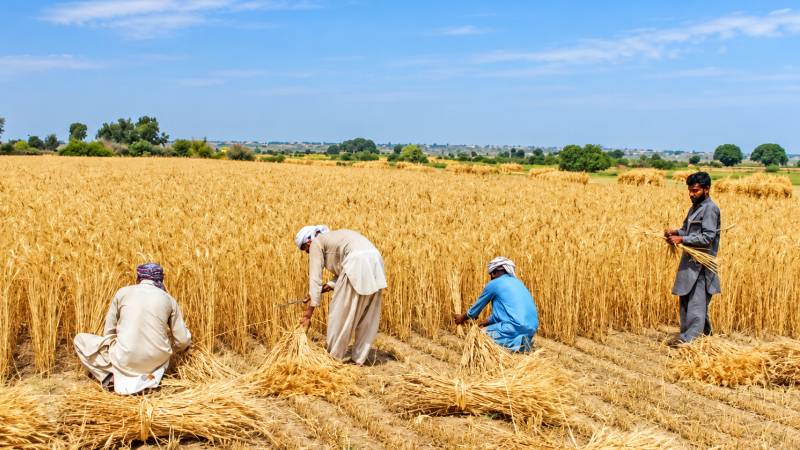
In the next few weeks, ships carrying imported wheat will begin arriving at Pakistani ports. At almost the same time, farmers across Punjab and Sindh will be putting the next crop into the ground. These two events tell the same story. Pakistan is importing wheat because the last harvest fell short. The government has ordered one million tonnes. The Trading Corporation of Pakistan has already contracted 365,000 tonnes at nearly $349 a tonne. Meanwhile, the crop meant to reduce that dependence is starting life under a 22 percent water shortage, approved by the Indus River System Authority on October 6.
The stakes are concentrated in two provinces. Last season, Punjab produced 22.04 million tonnes and Sindh contributed 4.40 million tonnes, generating the bulk of the national crop. While initial space-based forecasts projected a baseline of 27.48 million tonnes, finalized year-end estimates placed national output at 29.61 million tonnes. Even at that higher figure, it fell short against a national consumption requirement of 31.9 million tonnes.
Under the distribution formula used to manage shortages, Khyber Pakhtunkhwa and Balochistan are exempt from cuts. The deficit falls entirely on Punjab and Sindh. This means that any avoidable release or political accommodation during Kharif directly intensifies the burden on the two provinces responsible for the national wheat crop.
A Sindh or Punjab farmer does not experience the percent shortage as a statistic. He experiences it as a shortened canal turn, a delayed irrigation, a longer-running tubewell and a climbing diesel bill. The household buying flour next year will see none of this. They will only see the price of atta. The chain of consequence begins upstream.
Pakistan entered Rabi with 9.34 million acre-feet in storage, down from 13.2 million acre-feet a year earlier. The physical capacity to bridge summer river flows and winter crop demand has been steadily eroded. The cumulative designed live storage of our major reservoirs used to be 15.6 million acre-feet. Today, sedimentation has slashed that capacity. Tarbela live storage has fallen from initial 9.68 million acre-feet to 5.81 million acre-feet. That is a 40 percent loss. We are attempting to carry summer into winter with a system that has lost millions of acre-feet of its original design capacity.
This year, 10.40 million acre-feet passed downstream of Kotri during Kharif, against a minimum environmental requirement of about 8.2 million acre-feet. While the delta needs freshwater, a country entering winter with a major irrigation shortage must question why more summer water was not captured by its shrinking reservoirs.
Storage is only half the equation. Delivery is the other. Even if reservoirs were full, system inefficiencies would dilute the benefit. Between the reservoir and the field, water traverses thousands of miles of canals, distributaries and watercourses. Decades of deferred maintenance mean that canals carry significantly less. Conveyance and application losses amplify the reservoir shortage by the time water reaches the root zone. A farmer grows wheat with water at the root zone, not with a national basin balance.
Some of the 22 percent shortage comes from hydrology. Some reflects storage lost to sediment. Some was lost to system inefficiency. And some was spent in summer for political reasons. We should argue about all of this—but we must be clear about who pays: first the farmer, then the consumer, and finally the country.
Furthermore, timing matters as much as volume. Wheat requires irrigation at specific biological stages. This year, the authority approved a 21-day closure of Chashma Barrage from December 26 to January 14 for maintenance. For late-sown wheat, this window overlaps the critical crown-root-initiation stage. Administrative schedules must be synchronised with crop biology. Water that arrives after the crop needs it cannot recover lost yield.
This year, the storage deficit was compounded by operational decisions driven by the political needs of the coalition government. According to informed sources as reported by a major newspaper, over one million acre-feet of avoidable releases were made during Late Kharif.
While overall Kharif deficits were manageable, with Punjab at 11 percent and Sindh at 7 percent, the timing of specific withdrawals destroyed the Rabi carryover. Parliamentary interventions allowed Sindh to draw 1.262 million acre-feet as flood supplies under Para 4 of the 1991 Water Accord, 0.077 million acre-feet were also drawn by Punjab. These draws were made on commitments that provincial shares would be adjusted subsequently. The season ended before those adjustments materialised.
This is the core of the man-made deficit. Reservoirs were operated through political accommodations that overrode seasonal discipline. A reservoir is not a bank account from which water can be borrowed against future adjustments. Water released in August cannot be recalled in January. When those adjustments fail to materialise, the physical deficit is transferred directly to the winter wheat crop. Once seasonal allocations are fixed, the physical operation of reservoirs must follow hydrology, not the political needs of the day.
A few hundred kilograms lost on one farm mean little. Repeated across millions of acres, they become a national deficit. At that point, the provincial irrigation department file closes, and the burden shifts to the province agriculture department to federal food ministry, then the Trading Corporation and finally the State Bank dollar reserves. That is how a water problem becomes a wheat import bill.
Pakistan treats these as separate crises, but the farmer experiences them as one system. When the system fails, costs move from one ledger to another. Save less water and the irrigation ledger deteriorates. Deliver it poorly and the farmer ledger deteriorates. Produce less wheat and the food balance deteriorates. Import the difference and the foreign exchange ledger deteriorates. The country pays somewhere.
The debate over this Rabi must move past the sterile binary of building dams versus improving efficiency. Pakistan needs both, and Provincial governments must look at efficiency and Planning Commision, Finance Ministry and WAPDA must make all efforts to complete delayed storage projects at the earliest . But before both comes discipline in managing the water we already have.
The Late Kharif withdrawals demand transparent accounting. Who authorised them? On what hydrological basis? Why were the promised adjustments not made? These are not provincial grievances. They are questions about whether food security can be subjected to short-term political bargaining.
The farmer sowing today cannot manufacture water in January. The finance ministry cannot negotiate with the river once the wheat balance is set. By then, the only remedy is import. Some of the 22 percent shortage comes from hydrology. Some reflects storage lost to sediment. Some was lost to system inefficiency. And some was spent in summer for political reasons. We should argue about all of this. But we must be clear about who pays. First the farmer. Then the consumer. Finally, the country. The wheat import bill begins long before a ship enters Karachi harbour. It begins upstream.