

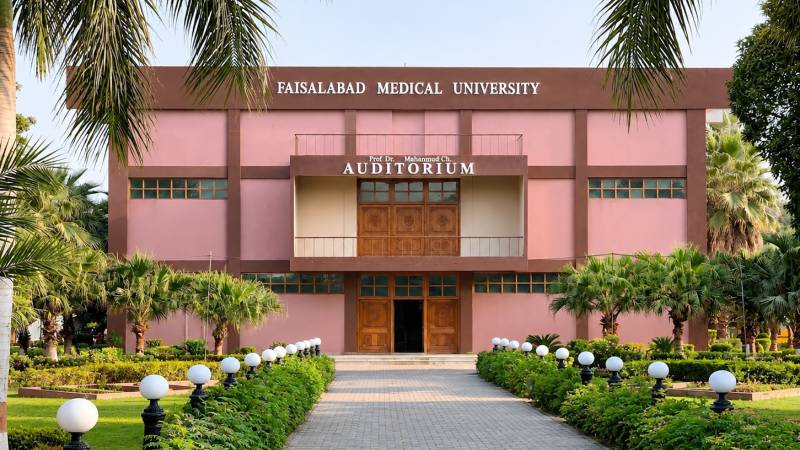
Some losses announce themselves with a thunderclap. Others arrive quietly, concealed in the unremarkable language of an official notification, signed by someone who may never have walked through the corridors of the institution. The first provokes outrage; the second is often allowed to pass unnoticed. Yet both can leave wounds that endure long after the ink has dried. On 20 October 2026, through the Public Sector Medical Universities (Second Amendment) Ordinance, the Punjab government restored several historic medical colleges as constituent institutions of their respective universities. But in Faisalabad, the restoration came with an act of erasure. Punjab Medical College was revived not under its own longstanding name, but as “Faisalabad Medical College.”
To an administrator, this is inconsequential rearrangement of words. To thousands of medical graduates scattered across continents, it is the threatened disappearance of an institution whose name has accompanied their achievements, friendships, aspirations and memories for over half a century. For some of us, it is also a painfully familiar story. In the closing years of the nineteenth century, a remarkable town arose from the dust of Punjab. Named after Sir James Lyall, the Lieutenant-Governor of Punjab, the town soon acquired a character distinctly its own; its prosperity owing to the farmers, traders, craftsmen and migrants who made it their home. Partition brought its upheavals, departures and new beginnings, yet Lyallpur absorbed the sorrows of one generation and the hopes of another, preserving an identity woven into its streets and the collective memory of its people.
Then, in 1977, somebody decided that Lyallpur required another name. Political expediency and the desire to honour the late King Faisal of Saudi Arabia converged upon a city whose inhabitants were scarcely consulted. Amid the turbulence following Zulfiqar Ali Bhutto's downfall, General Zia-ul-Haq announced the change on 1st September 1977. Lyallpur was christened Shah Faisalabad, a name that survived barely a fortnight before being shortened to Faisalabad. Thus, an identity nurtured over generations was surrendered to the expediencies of a passing political moment. Nearly half a century later, the same philosophy of administrative convenience has returned; this time to the doors of Punjab Medical College.
Punjab Medical College is not an empty signboard waiting to be redesigned. It is a living institution, established in 1973, known to generations of doctors in Pakistan and abroad by precisely that name. Its graduates carry it in their degrees, their professional histories, and their memories. It is under that name that credentials have been recognized, reputations built, and a place in medical history secured. To tamper with that identity without compelling reason is not reform; it is vandalism in legislative dress.
The matter is made more absurd by the government’s own inconsistency, under the same ordinance, other colleges were allowed the dignity of historical continuity: King Edward Medical College remains King Edward Medical College; Fatima Jinnah Medical College remains Fatima Jinnah Medical College; Rawalpindi Medical College and Nishtar Medical College retain their inherited names. Only Punjab Medical College appears to have been selected for a needless rebaptism. Why? On what principle? By whose wisdom? And after what consultation? No convincing answer has emerged.
The state often behaves as though memory were its private property: available for editing, trimming or repainting whenever convenience demands.
We are instead asked to accept the familiar Pakistani combination of official vagueness and administrative shrugging. First, it is hinted that the change may have been a mistake. Then comes the ritual assurance that the matter will be “looked into.” Then silence. Meanwhile, the altered name sits in the law, acquiring the false dignity of permanence merely because those responsible lack either the clarity to correct it or the courage to admit they were wrong. Pakistan has made a habit of small but telling acts of carelessness. The state often behaves as though memory were its private property: available for editing, trimming or repainting whenever convenience demands. That is why this episode reopens an older wound - the renaming of Lyallpur.
Lyallpur was not a random municipal label. It was the historic name of a city planned with vision and laid out with uncommon distinction: a city of the Clock Tower and the eight bazaars. It grew not merely as an urban settlement, but as a civilisation of toil, trade, migration, and rootedness. It survived Partition, demographic transformation, and the untidiness of modernity, yet retained an unmistakable selfhood. One may understand the desire to honour King Faisal. What one cannot admire is the now-familiar habit of honouring one memory by extinguishing another. The irony is painful. Lyallpur had already endured one such loss. Must Punjab Medical College now be made to endure its own lesser version of the same fate?
To tamper with that identity without compelling reason is not reform; it is vandalism in legislative dress.
The city lost its old name to political symbolism. Now the college risks losing its own name to bureaucratic languor, conceptual confusion, or some mixture of both. And confusion there certainly is. A university and a college are not the same thing. They need not bear identical names in order to belong to one another. Across Pakistan and beyond, universities encompass colleges whose distinct identities remain intact. Indeed, that is the most natural arrangement possible: Faisalabad Medical University reflects the city’s present administrative name; Punjab Medical College preserves its own established institutional identity. Harmony requires no demolition. Nor is the issue merely sentimental. There are practical implications which any serious administrator ought to foresee. Thousands of graduates have their qualifications recorded, verified, and recognised internationally under the name Punjab Medical College. Professional regulators, credentialing bodies, employers and training institutions know the college by that name. An alteration serves no evident academic purpose, yet invites unnecessary ambiguity into credential verification and professional documentation.
But here again lies the peculiarly Pakistani paradox: public authorities now profess endless concern for “systems”, while showing astonishing indifference to the historical and human realities upon which systems actually rest. Institutional identity is treated as an ornament rather than an asset. Those who draft such measures often understand control better than continuity. Yet continuity is precisely what serious institutions require. A medical college is not made by government prose alone. It is shaped by generations of teachers, students, clinicians and scholars; by cadavers studied over long nights, ward rounds survived, friendships formed, ambitions kindled; by the pride of those who entered its gates and the labour of those who taught within them. Such places acquire soul slowly. That soul cannot be renamed, nor legislated away without cost.
Many of us did not go to Punjab Medical College by accident; we went by allegiance to a city, to a tradition, and to the emotional geography of home. The college formed part of a wider civilisational landscape: Lyallpur’s landscape, however officially disguised. To strip that institution of its historic name is therefore not simply to alter nomenclature. It is to tell its alumni, its students and its city that continuity is dispensable; that heritage must bow before clerical convenience. This should not be allowed to stand. The remedy is neither difficult nor revolutionary. The Punjab government should amend the relevant provision and restore the college’s proper name: Punjab Medical College, as a constituent college of Faisalabad Medical University. That formulation is administratively sound, historically faithful, and intellectually defensible. It preserves the authority of the university while respecting the identity of the college.
More than that, it signals a principle badly needed in public life: that institutions are not disposable, and that inherited names deserve respect unless there exists an overwhelming and rational public interest for change. A people that neglects the names of its places and institutions eventually neglects the histories those names contain. And when history is treated lightly, amnesia begins to masquerade as governance. Governments may possess the authority to rename. They do not possess the right to erase what generations have learned to love. They took Lyallpur from us once. They must not take Punjab Medical College too.