

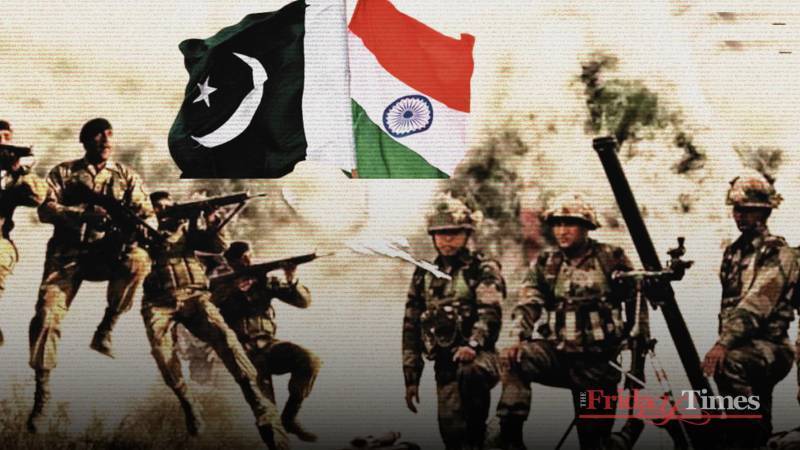
It was a false flag by all accounts, just like the earlier ones in Pulwama (2019), Mumbai (2008), and the Parliament attack (2001), each orchestrated for sinister objectives, much like Pahalgam in April 2025. The first three served their purpose well, as India successfully rode the tide of the “War on Terror” narrative and exploited it to suppress the voices of the Kashmiris, who continue to demand freedom from Indian occupation, an area internationally recognised as a disputed territory.
But if shame were an entity capable of dying, it would have perished in May 2025, when Indian aggression met with Pakistan’s decisive response. Yet it lives on, shamelessly and undeterred, now manifested in a renewed attempt to manufacture another dispute, this time over Sir Creek, a 96-kilometre (60-mile) tidal estuary lying within the marshlands of the Rann of Kutch. Opening into the Arabian Sea, Sir Creek roughly separates the Indian state of Gujarat from Pakistan’s Sindh province.
The Bombay Government Resolution of 1914 remains the most critical document determining the status of Sir Creek. Signed between the rulers of Kutch (now part of India) and the British Indian province of Sindh (now part of Pakistan), this resolution defined the boundary between the two territories. It explicitly stated that the boundary lies “east of the creek,” clearly implying that the entire western bank of the creek belongs to Sindh, now Pakistan, according to the Thalweg Principle commonly used in international river law. This interpretation grants Pakistan sovereignty extending east of the creek itself.
India, however, insists that the vague map attached to the 1914 Resolution holds overriding authority. That map shows a solid line running east of the creek, which New Delhi claims represents the eastern bank, thereby asserting that the entire creek lies within Indian territory and that the boundary runs along its western edge.
After the Partition of British India in 1947, Kutch acceded to India, while Sindh became part of Pakistan. The settled boundary from the 1914 resolution immediately became a point of contention. The poorly defined border led to several minor clashes between patrols of both nations throughout the 1950s and early 1960s. These skirmishes eventually escalated into a limited armed conflict in April 1965, only months before the larger Indo–Pakistani War of September that year. Both sides deployed infantry and armoured units in the Rann of Kutch region.
India no longer wishes to risk air combat with Pakistan after the lessons of the May 2025 engagements, where it lost seven aircraft in under an hour
To resolve the Kutch conflict, both countries agreed to international mediation.
British Prime Minister Harold Wilson facilitated a ceasefire and subsequent agreement on 30 June 1965. Following this, the Indo–Pakistani Western Boundary Case Tribunal (1966–1968) was established, comprising judges from Iran, Sweden, and Yugoslavia (the latter serving as chair). The tribunal’s verdict awarded approximately 90 per cent of the Rann of Kutch to India and 10 per cent to Pakistan. Crucially, however, the tribunal refrained from ruling on the Sir Creek issue, deeming it beyond its mandate. It only demarcated the land boundary up to the top of Sir Creek (known as Boundary Pillar 1175).
By all legal and historical interpretations, Sir Creek therefore remains part of Pakistan, as stipulated in the original 1914 document, whose wording is unequivocally clear.
The recent Indian rhetoric over this long-settled matter once again invokes the ambiguous map annexed to the 1914 Resolution, an interpretation seemingly echoed by the Indian Defence Minister, Rajnath Singh, in his latest public claim over the area.
On 2 October 2025, while addressing troops at Bhuj Military Station in Gujarat, Singh warned that any “misadventure in the Sir Creek sector will invite a decisive response.” He asserted that Pakistan’s recent expansion of military infrastructure around Sir Creek “reveals its intentions” and constitutes a cause for concern. Singh further threatened that “the road to Karachi passes through the creek,” adding that India’s response to any aggression could be so forceful that it might “alter both history and geography.”
Rajnath Singh’s false assertions and inflammatory rhetoric are in complete synchrony, both in tone and timing, with similar statements issued by the Indian Army and Air Force chiefs.
In early October 2025, Indian Army Chief General Upendra Dwivedi reportedly warned Pakistan that India “would no longer maintain the restraint exercised during Operation Sindoor 1.0” if provoked. He further insinuated existential consequences, suggesting that Pakistan’s continued support for so-called “state-sponsored terrorism” could jeopardise its very status on the map, an unmistakable veiled threat of territorial and strategic repercussions. His remarks again invoked “geography” and “history,” implying that India’s military response could fundamentally reshape regional realities.
In a similar vein, on 3 October 2025, the Indian Air Force Chief, Amar Preet Singh, reiterated his unfounded claims that during the May 2025 hostilities (Operation Sindoor), India had shot down five Pakistani fighter jets (F-16/JF-17) and destroyed significant military infrastructure. He went further, asserting that India’s “options remain open” and that it retains the capability to launch precision strikes “wherever necessary” inside Pakistani territory should actionable intelligence be available. At a lecture in Bengaluru, he went so far as to declare that India had “dreamed of the day” it could reach airbases such as Sargodha, implying a strategic depth of ambition and capability.
Since the world refused to accept India’s claims of Pakistan’s involvement in the Pahalgam incident, where New Delhi failed to provide even fabricated “proofs” as it had done in previous false flag operations like the Parliament and Mumbai attacks, the Indian leadership has chosen to reignite a settled matter for its war-mongering, the Sir Creek dispute. In doing so, they appear to have planned a strategic shift in both attention and potential theatre of conflict from the north (Kashmir) to the south (Sir Creek).
This shift is not merely rhetorical; it reveals clear strategic calculations.
India no longer wishes to risk air combat with Pakistan after the lessons of the May 2025 engagements, where it lost seven aircraft in under an hour. The four-day confrontation also exposed significant weaknesses in the Indian Army, which lost several forward posts in Kashmir to Pakistani forces. Having a larger naval fleet perhaps still gives India the self-deceptive confidence that it can engage Pakistan on the maritime front to offset its earlier losses. That is where Sir Creek enters the picture, as a symbolic and tactical alternative battleground.
The intentions are transparent; the stage is, perhaps, set for another Indian misadventure.