

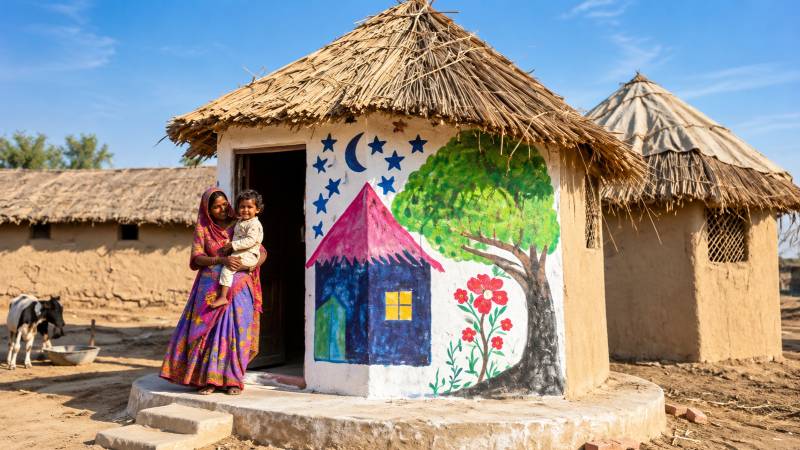
In 2022, catastrophic monsoon floods submerged a third of Pakistan, striking Sindh harder than any other province. Rainfall was more than 400 percent above the 30-year average, and 24 of Sindh’s 30 districts were declared calamity-hit, while roughly 2 million homes were damaged or destroyed. Most affected families lived in mud-and-thatch structures without formal land documentation.
Sindh government launched the Sindh People’s Housing for Flood Affectees (SPHF) initiative under the vision of Pakistan Peoples Party (PPP) Chairman Bilawal Bhutto Zardari to rebuild 2.1 million climate-resilient houses for 15 million flood-affected people across 24 districts of Sindh. SPHF is based on the core ideology of PPP’s foundational slogan and ideology of "Roti, Kapra aur Makan" (Food, Clothing, and Shelter), pledged by Shaheed Zulfikar Ali Bhutto and Shaheed Mohtarma Benazir Bhutto. The initiative has become one of the largest post-disaster housing reconstruction efforts in the world and has evolved from an emergency recovery measure into a far-reaching socio-economic transformation.
By mid-2026, the project has achieved several major benchmarks, though it has navigated operational delays relative to its ambitious early timelines. To date, field teams have validated 2.0 million beneficiaries using GIS-based surveys. Every damaged home was surveyed using GIS mapping, satellite imagery, and mobile app photos, establishing an auditable digital trail that eliminates middleman exploitation.
According to official government whole-programme figures, 1.0 million homes—representing roughly half of the total target—have been completed and are currently occupied. An additional 600,000 homes are actively under construction at various building stages, while 1.15 million constructions have successfully passed inspector verification at the foundation plinth level.
Traditional public sector recovery efforts frequently rely on large contractors—a system prone to delays, inflated budgets, and mismanagement. SPHF disrupted this framework by adopting a decentralized, owner-driven model. Rather than hiring contractors, SPHF transfers cash grants directly into bank accounts opened for verified families. Beneficiaries receive technical guidance from partner community-based organizations to build single-room, flood-resilient core units according to standardized blueprints. To ensure structural integrity and transparency, funds are released in four staged tranches; from land verification, plan assignment to complete structural verification and occupancy readiness.
SPHF demonstrates how post-disaster reconstruction can become a climate-adaptation strategy when safer housing, community ownership, women’s asset rights and political commitment are brought together at scale.
The financial and socio-economic reach of the initiative has been equally significant. Between 1.16 million and 1.65 million new bank accounts have been opened to facilitate direct tranche transfers and a significant majority belong to female beneficiaries, often for the first time. A beneficiary woman from Khairpur expressing her excitement on bank account said “I though only rich people can have bank accounts, I never thought I would be account holder one day”. On the ground, the initiative has created over 1.0 million local jobs across supply chains and labour, while training approximately 20,000 local masons in multi-hazard construction standards.
Beyond bricks and mortar, SPHF’s most enduring legacy would be its contribution to gender equity and financial inclusion in rural Sindh. Traditionally, rural women lacked formal assets or access to banking institutions. Under the SPHF policy guidelines, land ownership documents (Sanads) are issued directly in women's names or through joint household ownership wherever possible. Over 800,000 land titles have been transferred to female heads of households, securing long-term economic independence. Entrusted with managed funds to select materials and hire masons, women have actively led construction decisions within their villages.
When the land and bank account are in a woman's name, her position in the household can change. She has something of her own if she is widowed, divorced or abandoned. She has more say in family decisions, and her daughters may inherit an asset rather than nothing. Research from South Asia links women's property ownership to greater bargaining power and lower risk of domestic violence. Widows and female-headed households, among the poorest in rural Sindh, are prioritised.
For many families, this is the first time they have a legal document for the land they live on. A Sanad protects them from eviction and from disputes with neighbours or local powerful figures. It also makes it easier to claim government services and compensation in future. This matters greatly in a society where many rural poor have lived for generations without any proof of their home.
Families move from mud and thatch huts that collapse in heavy rain to homes on raised plinths, built to resist floods. They don’t have worry about losing their home, belongings and livestock, or to be displaced into camps again. Water, Sanitation, and Hygiene (WASH) with plan to provide safe drinking water, sanitation, hygiene and allied infrastructure facilities to approximately 2,000 villages across Sindh has been integrated in the initial phase.
The scale and digital execution of SPHF have attracted international attention. At the UN Climate Change Conference (COP29) in Baku, international climate leaders highlighted SPHF as a blueprint for climate adaptation. Dr. Valerie Hickey, Global Director for Environment at the World Bank, termed the programme a "miracle project," emphasizing that it combines disaster relief with localized employment and long-term climate resilience. The model’s success has spurred expansion beyond provincial borders, with similar owner-driven housing schemes now being adopted in flood-affected districts of Balochistan, such as Sohbatpur and Jaffarabad.
With the unprecedented success, it may also create hurdle that while 70% of beneficiaries resided on state-owned land eligible for direct titling, an estimated 300,000 families lived on private land. This could pose a challenge in legal title right for these households, this concern should be taken into account. SPHF demonstrates that when post-disaster recovery prioritizes community ownership, and female asset rights along with political will, it can rebuild safer homes while fundamentally lifting vulnerable populations out of poverty.