

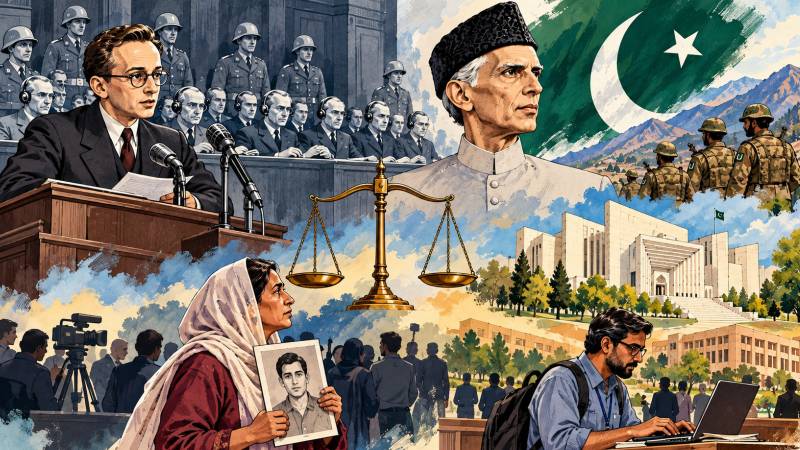
Eighty years after the Nuremberg verdicts, a young prosecutor’s modest ambition asks a large question of Pakistan. On 1 July, these pages carried my piece on Jinnah’s founding promise and the Nuremberg principle. I did not expect to return to Nuremberg so soon. Then, this week, Harvard Law School marked the eightieth anniversary of the verdicts of the International Military Tribunal by recalling one of its own, Benjamin Ferencz of the Class of 1943, and a sentence he once spoke about his work: “If I could get them to create a more humane world, using this as an example, that would be worthwhile.”
Ferencz was 27 when he rose as chief prosecutor in the Einsatzgruppen Trial, one of the twelve subsequent Nuremberg proceedings. It was his first case. Before him sat 22 defendants, six of them generals, charged in connection with the murder of more than a million people. He understood at once that no sentence could ever balance that ledger. So he set himself a different objective. He would use the case to show the world what law could be made to do. That sentence has stayed with me all week.
Let me be careful, because care is the whole point of this column. Pakistan is not Germany in 1945, and nothing I write here compares anyone in this country with those judged at Nuremberg. The comparison is of principle, not of degree. Ferencz was not only interested in the guilty. He was interested in the example: in what a society decides to make normal, and in what it decides to make unthinkable.
The quietest lesson of Nuremberg was later written down by the International Law Commission as the fourth of the Nuremberg Principles. Acting on the orders of a government or a superior does not relieve a person of responsibility, provided a moral choice was in fact possible to him. Read slowly, that is not a threat. It is a compliment. It assumes that every person who holds authority, in a police station, a secretariat, a courtroom or a cantonment, is a moral agent and not a component. It assumes that conscience survives the chain of command.
Jinnah assumed the same. Addressing officers at the Staff College in Quetta on 14 June 1948, he told them he had found that some very senior officers did not fully appreciate the implications of the oath they had taken, and he asked them to study the constitution then in force so that they understood what being faithful to it meant. Our present Constitution carries that oath in its Third Schedule. Every officer swears true faith and allegiance to Pakistan and to the Constitution, and undertakes not to engage in any political activities whatsoever. Jinnah was not lecturing them. He was honouring them.
I say this as someone who felt the same pride as every Pakistani when the country’s defenders stood firm in the hard days of May 2025. We live in a difficult neighbourhood. Those who guard the frontier, and those who lie buried in its soil in Waziristan and Balochistan, are owed the nation’s gratitude without qualification. No serious person argues that a state becomes humane by becoming weak.
A more humane Pakistan is not an abstract ideal; it is a citizen receiving due process, a journalist returning home safely, a Parliament able to scrutinise public spending, and a public office that remains subject to ordinary law.
But Ferencz, who died in 2023 at the age of 103, spent the rest of his long life making an argument that any good soldier would recognise. The strength that lasts is the strength that accepts limits. He campaigned for decades for a permanent International Criminal Court, and at 91 he delivered a closing statement in its very first trial. His creed was three words: law, not war. He never meant that a nation should not defend itself. He meant that a nation is safest when the power that defends it is answerable to law.
What would a more humane Pakistan, built by example, actually look like? It is not abstract. It is a mother outside a press club, holding a photograph, who is told within twenty-four hours, as Article 10 already requires, before which magistrate her son has been produced. It is a citizen who receives the fair trial Article 10A promises, before the courts the Constitution itself established. It is a journalist who files his story and sleeps at home that night. It is a budget whose every head of expenditure can be debated in Parliament without anyone feeling brave for having asked. It is a public office, any public office, that does not sit above the ordinary law.
None of this requires a revolution. It requires an example. There is one more thing in the Harvard announcement that a lawyer cannot pass over. Last year the Harvard Law School Library made available online the first complete, fully searchable, digitised collection in English of the official evidentiary documents and trial transcripts from all thirteen Nuremberg trials, open to anyone on its Nuremberg Trials Project website. Every order, every memorandum, every careful signature of men who believed the paperwork would protect them is now a keyword search away for a schoolchild in Lahore.
Records are patient. I have written in these pages of an archive in Bombay that I could not read. I have learnt since that archives wait. Our own files, the notifications, the detention orders, the judgments, the minutes of meetings no one expected to be read, will one day be opened by someone with no stake in who held power in 2026. Everyone in authority today is, whether he knows it or not, compiling the exhibit list of the future.
Ferencz did not set out to destroy the institutions he faced. He set out to persuade the people within them, and the world watching, to build something better from a terrible lesson. Pakistan has a happier opportunity. We need no tribunal. We need institutions confident enough to set the example before anyone asks them to: to choose the limit, to honour the oath, to let the courts be courts and the citizen be a citizen. If I could persuade even a few of those who hold power in this country to create a more humane Pakistan, using our own Constitution as the example, that would be worthwhile. Ferencz never gave up hope. Neither should we.