

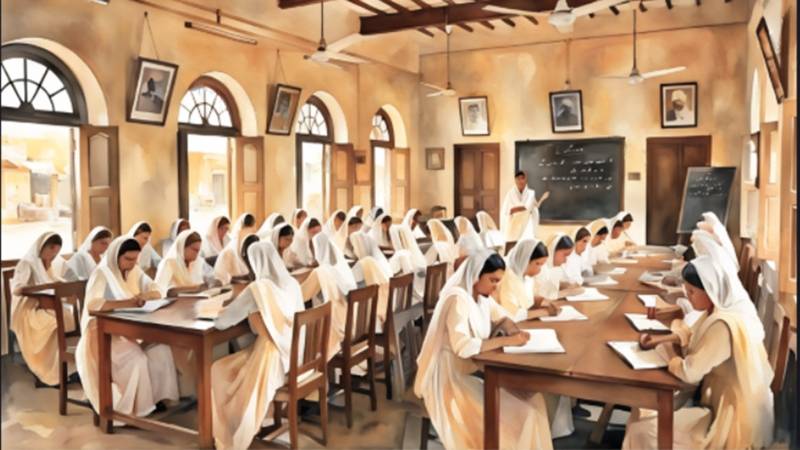
In the dusty, sun-baked streets of 1930s Hyderabad, Sindh, a prosperous diamond merchant named Dada Lekhraj experienced profound spiritual visions that led him to envision a new divine order. Beginning in 1936, he shared this divine knowledge with a close circle of devotees, emphasising purity, celibacy, and soul-consciousness through meditative practices centred on the chanting of “Om.” What began as intimate spiritual gatherings soon evolved into the Om Mandli, a revolutionary community guided by a trust of young women, with the charismatic Om Radhe emerging as its prominent leader.
This quiet spiritual awakening rapidly attracted followers but also provoked intense opposition from conservative elements within the local Sindhi community. Patriarchal leaders, alarmed by the group's emphasis on female autonomy and celibacy—even within marriage—formed the Anti-Om Mandli Committee, which spearheaded a vehement campaign against it. The controversy escalated into violent protests, picketing, attempted arson, legal challenges, and even a reported assassination plot against Dada Lekhraj (later revered as Brahma Baba) in 1938–39. Undeterred, the devoted members persisted in their practices, eventually relocating to Karachi for safety.
News of the Om Mandli's activities spread widely, appearing in both European and vernacular newspapers of the British India and the United Kingdom. However, ten newspapers based in England, Northen Ireland and Scotland are selected. The newspapers were selected on the basis their English medium, publication office in the United Kingdom, carried Om Mandli news, and covered period from 1938-1945. However, some newspapers such as Edinburgh Evening News, (Edinburgh, Scotland) carried two items on the same date, it was so, because some newspapers published the late edition. Another, observation was that one of the newspapers expect, The Scotsman, Midlothian, Scotland had its own corresponded, but it not sure that its journalist was based in Calcutta, Delhi or Karachi.
To conduct a historical analysis of the British media’s portrayal of the Om Mandli, it is essential to first understand the journalistic landscape of the United Kingdom. The newspapers that carried these reports were not a monolith; they represented a diverse cross-section of the British Isles, ranging from venerable 18th-century titles to 20th-century tabloids. By situating these publications in the order of their establishment, we can observe how the story of a localised spiritual movement in Hyderabad, Sindh, was filtered through nearly two centuries of varying journalistic traditions.
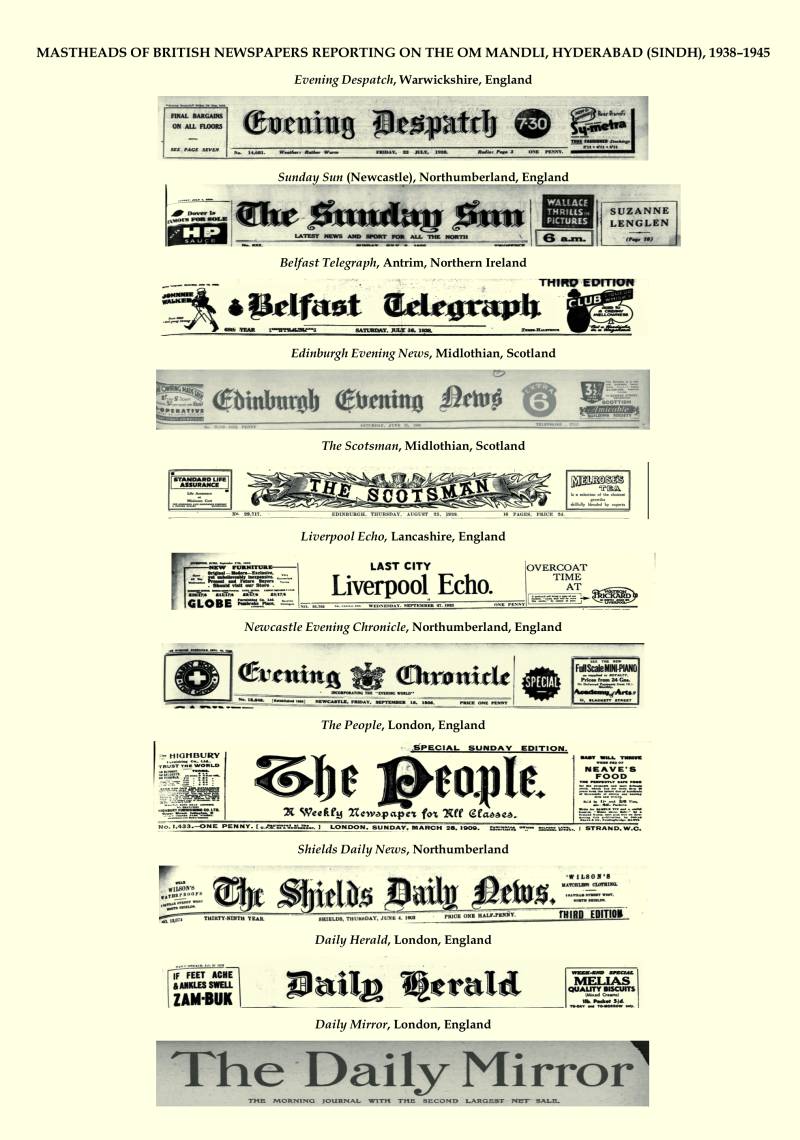
The lineage of the Newcastle Evening Chronicle, one of the primary newspapers covering the Om Mandli, stretches back to the mid-18th century. While it traces its origins to 1764, it adopted its modern evening format in 1885 to serve the industrial Northeast. Following it is The Scotsman, founded in 1817 as a liberal weekly that eventually became a pillar of the Scottish press. The mid-19th century brought the Shields Daily News, which grew out of a precursor founded in 1849 to serve the coastal Tyneside communities. As the Victorian era progressed, the thirst for evening news grew, leading to the establishment of the Belfast Telegraph in 1870 and the Edinburgh Evening News in 1873. These titles focused on their respective capitals, providing a bridge between local community interests and broader international affairs.
British editors utilized ‘headline engineering’ to craft sensationalist titles like "Temple of Kisses" – designed to get visceral reactions rather than inform the public
By the late 19th century, the press began targeting broader, more diverse demographics. The Liverpool Echo was launched in 1879 as an affordable evening sister to the Daily Post, while The People was established in 1881 as a national Sunday paper aimed at the working class. The turn of the century saw the birth of the Evening Despatch in 1902, serving the Birmingham area, and the Daily Mirror in 1903, which relaunched in 1904 as an illustrated tabloid. The national reach of the "Om Mandli" scandal was further amplified by the Daily Herald, which emerged as a labour-movement daily in 1912, and the Sunday Sun (Newcastle), founded in 1919 as a dedicated Sunday voice for the Northeast and Scottish Borders.
Collectively, these newspapers translated the events in Sindh into a variety of cultural "languages"—from the unionist perspectives of Northern Ireland and the liberal sensibilities of Scotland to the sensationalism of London’s national dailies.
Between 1938 and 1945, United Kingdom-based newspapers reported on the Om Mandli with diverse and often conflicting perceptions. While some outlets framed the movement as a breach of the social order, the burgeoning tabloids of the era frequently stripped away the nuances of Sindh’s cultural context, creating a moral panic that resonated across the British Isles.
To understand this phenomenon, it is essential to analyse the news through the lens of framing biases. Although framing as a discipline emerged from sociology in the 1970s and became more precise in the 1990s, its core function remains the journalistic practice of selecting and highlighting specific aspects of a story to influence audience interpretation. It functions as a "mental window" that guides public attention toward a particular meaning while excluding alternative perspectives.
Women of the Om Mandli were almost entirely stripped of their agency – described not as individuals making a choice, but as 'lured away' or 'stolen objects'
The portrayal of the Om Mandli was a carefully constructed narrative shaped by specific techniques that range from broad story structures to the subtle choice of grammar. One primary technique is “Narrative and Editorial Selection,” or "Gatekeeping," where facts are intentionally filtered to highlight scandals while ignoring a group’s actual beliefs. By treating conflicts as isolated, sensational events rather than exploring their social foundations, the media creates a narrative of suspicion, often reinforced by “Loaded Rhetoric" that casts a movement as a danger to the established order. Furthermore, “Ideological Bias and Conflict Centricity” ensured that reports aligned with colonial interests, prioritising legal disputes and social friction over peaceful activities to keep the story attention-grabbing.
The power of these reports often lay in “Headline Engineering and Syntax”. Headlines were frequently crafted for maximum emotional impact, using hyperbole and speculative framing to imply guilt before any evidence was presented. Even the smallest grammatical choices, known as “Syntactic Responsibility,” played a major role in shaping perception. Through the active voice, journalists could place direct blame on a leader, whereas the passive voice was often used to distance preferred social actors from their roles in a conflict. These subtle shifts in sentence structure served to either assign or deflect accountability, ultimately defining the “truth” in the mind of the public. Consequently, the published items regarding the Om Mandli are analysed through the four pillars: 1. Narrative Structuring, 2. Ideological and Tone Bias, 3. Headline Engineering, and 4. Syntactic Responsibility, as illustrated in the following figure titled: A Portrayal of Om Mandli, Hyderabad (Sindh), in the British Print Media, 1938–1945.
The data presented in the table above, categorised under four frequently applied framing techniques, provides the foundation for a comprehensive conclusion.
The synthesised analysis compels that the “Architecture of a Colonial Moral and Emotional Panic" would be a suitable title for the conclusion of this article. It could be so, because the analysis of British press coverage regarding the Om Mandli between 1938 and 1945 reveals a sophisticated, multi-layered apparatus of media framing that served to delegitimise a burgeoning spiritual movement. The careful examination of the four pillars of biases - Narrative Structuring, Ideological Tone, Headline Engineering, and Syntactic Responsibility – is needed across a diverse array of UK-based newspapers.
The minute examination reveals that the Narrative Structuring of these reports was characterised by “Episodic Framing” and “Decontextualisation.” Rather than engaging with the theological or sociological motivations of the Om Mandli—particularly its emphasis on female celibacy and spiritual autonomy—newspapers like the Evening Despatch and Sunday Sun reduced the movement to domestic "shocks" and "family strife." By stripping away the cultural and spiritual context of Sindh, the media utilised "Gatekeeping" to ensure that the voices of the women involved were systematically silenced. In their place, the narrative was populated by "shocked grandfathers," "irate husbands," and "mercantile communities." This structured the story as a crisis of property and patriarchy rather than a pursuit of spiritual liberation. The recurring use of the "Adamless Eden" metaphor further trivialised the movement, framing a serious spiritual retreat as a whimsical, childish fantasy—a "Comedy of Wives Strike" as the Liverpool Echo so dismissively put it.
Likewise, the Ideological Tone across these publications was overwhelmingly “Pro-State/Government” and “Patriarchal.” There is a visible alignment between the British press and the traditional Indian social hierarchies that viewed the Om Mandli as a threat. The media’s celebration of the “Solution of Solomon”—which forced women back under the “guardianship” of their husbands—reflects a deep-seated colonial anxiety regarding the breakdown of the traditional family unit. To the colonial mind, a woman who refused her husband was not just a domestic rebel; she was a threat to the orderly, predictable social structure upon which colonial governance relied. This led to "Medicalised Bias" in papers like the Shields Daily News, which labelled the group's beliefs as “psychological perversion.” By pathologising the movement, the press justified the state’s eventual intervention and the banning of the group, framing state-government sponsored suppression as a necessary “cure” for social disorder.
Similarly, Headline Engineering functioned as the primary tool for generating moral panic. The headline analysed—ranging from the sexually provocative (“wives who wouldn’t sleep with husbands”) to the militantly alarmist (“irate husbands on the warpath”)—were designed to elicit an immediate visceral reaction from the British public. These titles functioned as “Click-bait” of the early 20th century, utilising “Hyperbole” and “Graphic Imagery” (such as the entirely fabricated “Temple of Kisses”) to ensure the Om Mandli was synonymous with scandal. This “Headline Engineering” ensured that even if a reader did not consume the full article, the "engineered" impression of vice, seduction, and “mesmeric powers” would remain. It was a strategy of “guilt by association,” where the movement was linked to “orgies” and “kidnapping” long before any legal evidence was substantiated.
Perhaps the most subtle yet damaging technique discovered in this analysis is Syntactic Responsibility. The shift between active and passive voice served to strategically assign or deflect agency. When discussing the “failings” of the movement, the active voice was used to place direct blame on the founder, Lekhraj. Conversely, the aggression of the husbands or the police was often obscured through the passive voice or framed as “timely intervention.” Most strikingly, the women of the Om Mandli were almost entirely stripped of their agency through “Passive Victimhood.” They were rarely described as individuals making a choice; they were “lured away, “infatuated followers,” or “stolen objects.” This linguistic choice reinforced the patriarchal view that women lack the capacity for independent spiritual or social decision-making, thereby validating the “heroic” efforts of husbands and magistrates to “rescue” them.
Let me conclude, the portrayal of the Om Mandli in the British print media from 1938 to 1945 is a textbook case of how media framing can be used to marginalise a minority group. Through the selective filtering of facts, the engineering of inflammatory headlines, and the tactical use of syntax, the UK press successfully transformed a localised spiritual movement into a global symbol of moral decay. This analysis proves that the “truth” presented to the British public was a carefully curated narrative—one that prioritised the preservation of colonial and patriarchal power over the nuanced reality of Sindh’s cultural and spiritual evolution. The legacy of these reports reminds us that the media does not just mirror society; it actively constructs the lenses through which we view the “other.”