

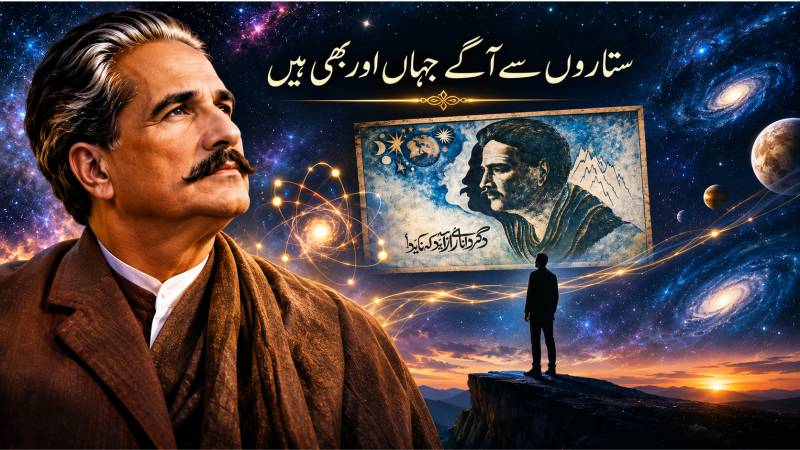
To a physicist, the stars are celestial bodies governed by natural laws; to a poet, they symbolize hope, mystery and human aspiration. Yet both perspectives originate in wonder. Beyond his celebrated philosophy of Khudi and spiritual awakening, Allama Iqbal's poetry reveals a fascinating engagement with atoms, stars, energy, motion, time and space. Although Iqbal was not a scientist, his philosophical imagination developed during an era of revolutionary discoveries in physics and astronomy. His verses offer an intriguing meeting point between scientific inquiry and poetic imagination, revealing different but complementary ways of understanding the universe. Perhaps no couplet captures this relationship more strikingly than the following lines:
Haqeeqat aik hai har shay ki, khaaki ho ke noori ho
Lahoo khursheed ka tapkay agar zarray ka dil cheerain.
The underlying reality of everything, whether earthly or luminous, is one; open the heart of a tiny particle, and even the Sun's blood might flow from it. The imagery is extraordinary. Iqbal places the microscopic zarra beside the immense khursheed, bringing together the smallest and the greatest within a single poetic vision. For the modern reader, the comparison acquires an intriguing significance. Einstein's mass–energy relationship established a profound connection between mass and energy. Nuclear physics subsequently demonstrated how changes in the binding energy of atomic nuclei can release enormous amounts of energy. The Sun itself shines through nuclear fusion, a process in which hydrogen nuclei ultimately combine to form helium. However, splitting an atom and the fusion processes responsible for solar radiation are not identical phenomena. Nor can Iqbal's couplet be considered a scientific prediction of nuclear energy. Its real beauty lies in the intuition that apparently different forms of existence may share underlying principles. Interestingly, the verse can also introduce a philosophical discussion of wave–particle duality, through which quantum mechanics challenged the classical distinction between particles and waves. In one poem he writes:
Betaab hai is jahaan ki har shay
Kehtay hain jisay sukoon, nahin hai
And elsewhere:
Junbish se hai zindagi jahaan ki
Yeh rasm-e-qadeem hai yahaan ki.
Everything in existence seems restless; what appears to be stillness conceals movement. Modern physics offers many illustrations of a dynamic natural world. A book resting on a table appears stationary, yet its constituent particles participate in microscopic motion and interactions. Earth rotates on its axis and revolves around the Sun. Our solar system moves through the Milky Way, while galaxies themselves evolve within an expanding universe. Iqbal presents the same philosophical idea in another memorable couplet:
Faraib-e-nazar hai sukoon-o-sabaat
Tarapta hai har zarra-e-kaainaat.
Stillness and permanence may be deceptive; every particle seems restless. Strictly speaking, physics also recognizes equilibrium, stability and reference frames in which an object can legitimately be described as stationary. Iqbal was not formulating a universal physical law. His concern was philosophical: existence is characterized by change, development and renewal. For him, stagnation is not merely a physical condition but an intellectual and civilizational danger. The connection with scientific inquiry is compelling. Science advances because established explanations are questioned, experiments are repeated and new evidence continually challenges what we believe we know. Iqbal extends this philosophy of movement into an extraordinary conception of cosmic existence:
Theharta nahin kaarwaan-e-wujood
Ke har lehza hai taaza shaan-e-wujood.
The caravan of existence never stops; every moment reveals existence in a new form.
Yeh kaainaat abhi na-tamaam hai shaayad
Ke aa rahi hai damadam sada-e-Kun Fayakoon.
Perhaps the universe remains unfinished, while the command of creation continues to resound. These lines invite reflection upon modern cosmology. We now understand that the universe possesses an evolutionary history extending over billions of years. Stars form within enormous clouds of gas, undergo nuclear processes, and eventually reach different final stages according to their masses. Galaxies evolve, planetary systems emerge and matter is continually reorganized through physical processes. Astronomical observations also establish that the universe has expanded over cosmic time. Yet the religious and philosophical meaning of Kun Fayakoon cannot be equated with the mathematical description of cosmic expansion. Iqbal's verse is concerned with creation as an enduring philosophical reality; cosmology investigates the observable history and physical behaviour of the universe. This openness becomes almost irresistible in Iqbal's celebrated declaration:
Sitaaron se aagay jahaan aur bhi hain
Abhi ishq ke imtihaan aur bhi hain.
Beyond the stars lie other worlds; beyond present achievements lie further challenges. A century ago, humanity possessed limited observational knowledge of the wider universe. Today, telescopes reveal galaxies at immense distances, while astronomers have confirmed thousands of planets orbiting stars beyond our solar system. The Milky Way alone contains enormous numbers of stars, and the observable universe extends far beyond our galaxy. Iqbal continues:
Tahi zindagi se nahin yeh fazaaein
Yahaan saikron kaarwaan aur bhi hain.
These expanses are not empty of possibility; other caravans may exist beyond our familiar horizon. The verse is sometimes interpreted as anticipating extraterrestrial life. Such a claim would be scientifically unjustified, since life beyond Earth has not yet been conclusively established. Iqbal was exploring spiritual and intellectual possibilities rather than announcing an astronomical discovery. Nevertheless, his poetry refuses to imprison humanity within a narrow conception of existence. Iqbal's engagement with time and space deserves particular attention. He writes:
Isi roz-o-shab mein ulajh kar na reh ja
Ke tere zamaan-o-makaan aur bhi hain
Iqbal’s concept of zamaan-o-makaan (time and space) offers a philosophical parallel to Einstein’s theory of relativity, which transformed the classical understanding of time, space and gravity. Although Iqbal was not describing relativity mathematically, both perspectives challenge the assumption that reality is limited to ordinary human experience. Iqbal’s central message is that the limits of human perception should never be mistaken for the limits of existence. One of the most striking illustrations of Iqbal's rational temperament appears in his rejection of astrological fatalism:
Sitara kya meri taqdeer ki khabar dega
Woh khud faraakhi-e-aflaak mein hai khwaar-o-zaboon.
Iqbal challenges the belief that stars determine human destiny, distinguishing scientific astronomy from unsupported astrological predictions. Through his philosophy of Khudi, he emphasizes human independence, rational inquiry and personal responsibility rather than submission to celestial influences. While science can accurately predict planetary movements, it cannot use them to determine individual fortunes. Iqbal's message remains relevant: scientific advancement is incomplete if human thinking remains imprisoned by superstition. Iqbal's conception of human potential is equally powerful:
Urooj-e-Aadam-e-khaaki se anjum sehmey jaatay hain
Ke yeh toota hua taara mah-e-kaamil na ban jaaye.
The stars seem apprehensive at the rise of earthly humanity, fearing that this fallen star might become a radiant full moon. Human history gives this poetic image a remarkable contemporary resonance. A species that once observed celestial bodies with the naked eye developed telescopes, rockets and spacecraft capable of investigating other worlds. Humans walked upon the Moon, robotic explorers reached Mars, and instruments now observe radiation that began its journey billions of years ago. Yet these accomplishments did not emerge from imagination alone. They required mathematical understanding, careful experimentation, engineering precision and sustained international effort. Iqbal's human being is khaaki, made of earth, yet capable of extraordinary intellectual achievements. The philosophical message should not be reduced to technological conquest. Human development also involves ethical responsibility. A civilization capable of exploring distant planets while failing to provide clean drinking water, basic education or dignity to its own people has reason to reconsider its priorities. Scientific power is an achievement, but its responsible application is a test of civilization. The search for unity beneath diversity appears again and again. For instance:
Yeh wahdat hai kasrat mein har dam aseer
Magar har kahin be-chugoon, be-nazeer
Iqbal's poetry offers a fascinating meeting point between scientific inquiry and poetic imagination, revealing different but complementary ways of understanding the universe.
The scientific imagination of Allama Iqbal finds one of its most beautiful expressions in Bazm-e-Anjum (The Assembly of Stars), included in Bang-e-Dra. Describing the transition from sunset to evening, Iqbal writes:
Sooraj ne jaate jaate shaam-e-siyah-qaba ko
Tasht-e-ufuq se le kar laalay ke phool maaray.
Pehna diya shafaq ne sonay ka saara zevar
Qudrat ne apne gehnay chaandi ke sab utaaray.
In these exquisite verses, Iqbal transforms the setting Sun into an artist scattering crimson tulips across the darkening sky, while twilight adorns the horizon with golden ornaments. Behind this poetic spectacle lies the fascinating physics of atmospheric light scattering. Sunlight contains different wavelengths, and as it travels through Earth's atmosphere, shorter wavelengths, particularly blue light, are scattered more strongly than longer red wavelengths. At sunset, sunlight passes through a greater thickness of atmosphere, leaving the direct light enriched in orange and red, producing the magnificent colours of twilight. This phenomenon is primarily explained by Rayleigh scattering, with atmospheric particles and clouds contributing to the changing shades. Iqbal was not explaining optical physics; he was capturing nature's beauty through imagination. The physicist explains why the evening sky turns crimson and golden, while the poet transforms those same colours into flowers and ornaments. Science reveals the mechanism; poetry preserves the wonder. Iqbal's invitation to observe nature appears in another beautiful couplet:
Khool aankh, zameen dekh, falak dekh, faza dekh
Mashriq se ubhartay huay sooraj ko zara dekh.
Open your eyes and observe Earth, the heavens, the atmosphere and the rising Sun. Observation is the beginning of scientific inquiry, although observation alone is never sufficient. Human beings watched the apparent movement of the Sun for thousands of years before developing an accurate understanding of Earth's rotation and orbital motion. They saw lightning long before explaining electrical discharge, and observed falling objects long before constructing mathematical theories of gravitation. Science advances when familiar phenomena become subjects of disciplined questioning. Why is the sky blue? Why does the Moon change its apparent shape? Why do stars have different colours? The answers demand evidence, measurement, experimentation and reasoning. Iqbal's call to open one's eyes can therefore become a useful metaphor for scientific education. The challenge is to develop the ability to observe intelligently rather than merely admire familiar appearances. Iqbal's short but powerful poem Talib-e-Ilm (The Student) offers a profound lesson for modern education:
Khuda tujhe kisi toofan se aashna kar de
Ke tere bahr ki maujon mein iztirab nahin.
Tujhe kitaab se mumkin nahin faraagh ke tu
Kitaab-khwaan hai magar sahib-e-kitaab nahin.
Science and literature are often treated as separate disciplines, yet both emerge from humanity's curiosity about the universe. Science explains natural phenomena through evidence and reason, while poetry explores their beauty, meaning and emotional significance. Iqbal's verses beautifully connect these worlds, inspiring reflection on atoms, stars, motion and time without claiming to establish scientific laws. His poetic imagination should never be mistaken for a prediction of modern physics; his greatness requires no such exaggeration. For Pakistan's universities, his poetry offers an opportunity to connect scientific inquiry with literary creativity, encouraging students to question, explore and think beyond textbooks. The greatest tribute to Iqbal is not merely to recite his verses but to cultivate the curiosity they inspire. He taught us to imagine worlds beyond the stars; science has given us the means to investigate them. Our greatest failure would be not the inability to reach the stars, but the loss of curiosity that first inspired us to look towards them.