

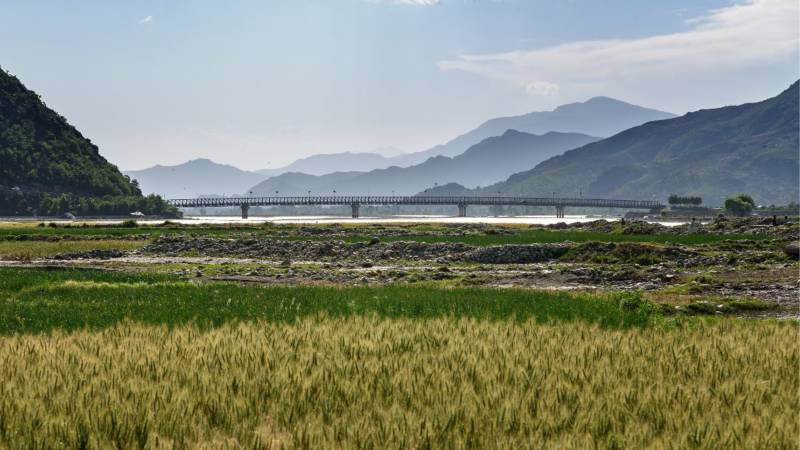
The mountains of Swat have long echoed with stories of beauty, resilience and resistance. Once celebrated for their breathtaking landscapes and cultural richness, these highlands are now the site of an emerging collective awakening, a struggle not merely for identity, but for survival and justice. This awakening was powerfully expressed in the Swat Kohistan Qomi Jirga, held in Kalam under the aegis of the Aman Jirga.
The jirga brought together representatives from across Tehsil Bahrain, home to the Torwali, Gawri, Gujari, Pashto, Ushujo and Khowar-speaking communities. Participants included elders, youth activists, educators, environmentalists and cultural scholars. Despite their linguistic and ethnic diversity, all voiced a common concern: the systematic exclusion of mountain communities from decision-making processes concerning their own land, water and natural resources.
Locally known as Swat-Kohistan, this mountainous region constitutes almost sixty per cent of the total area of Swat District. It is the source of the River Swat, the reservoir of the valley’s forests, glaciers and biodiversity, and the foundation of Swat’s tourism and hydropower economy. Yet paradoxically, this very region remains marginalised in development policies, governance structures and institutional representation.
For centuries, the inhabitants of Swat-Kohistan have served as the custodians of these mountains, protecting their forests, rivers and valleys through indigenous systems of stewardship. Today, however, they find themselves in a continuous struggle to defend their land, their river and their languages from state-led and corporate encroachments. Over the past two decades alone, three catastrophic floods have devastated the area, yet reconstruction and rehabilitation projects have consistently bypassed these communities.
A central theme of the jirga was administrative marginalisation. When the government announced the creation of the new Upper Swat District, the people of Bahrain Tehsil, who form its geographic and ecological core, were not consulted. The jirga participants expressed deep concern that this exclusion reflects a larger pattern of bureaucratic centralisation, where decisions affecting mountain populations are made in distant offices without local participation.
The jirga called for the formation of community-based forest protection committees, and for government investment in alternative energy sources such as solar, biogas and micro-hydel systems to reduce dependence on wood fuel
The jirga demanded that the district headquarters be established in Madyan, Bagh Dheri or Bahrain, making administrative institutions more accessible to residents of remote valleys. They warned that continuing to impose top-down decisions without consultation would further erode public trust and deepen regional inequalities.
Educational deprivation in Swat-Kohistan remains one of the region’s most enduring injustices. Union Councils such as Mankial, Balakot, Bishigram and Utror suffer from severe shortages of schools, teachers and infrastructure. In upper areas beyond Madyan, girls’ education is virtually non-existent.
Speakers at the jirga emphasised that education is not merely a social service; it is a tool for empowerment, leadership and critical awareness. They demanded the immediate establishment of a University of Swat campus in Kalam, along with the recruitment of qualified teachers in every school. The absence of secondary and higher education, they noted, perpetuates poverty and leaves young people without the skills to participate in the emerging regional economy.
The River Swat, which originates in these very mountains, has become the focal point of intense and random hydropower development. Projects such as Daral, Gorkin-Matiltan, Gabral–Kalam, Asrit–Kedam and the Madyan Hydropower Project are presented by the government as symbols of “green energy” and national progress. Yet for local communities, they represent unconsulted interventions and ecological threats.
Speakers described these projects as forms of environmental colonialism, where the state and private investors extract energy and revenue from mountain regions while excluding local people from benefits and decision-making.
The jirga particularly commended the Darya-e-Swat Bachao Tehreek (Save the Swat River) movement, a 14-month-long non-violent campaign led by the indigenous Torwali community against the Madyan Hydropower Project. This movement, they argued, stands as a model of indigenous environmental resistance and a demand for climate justice within Pakistan.
Once renowned for their majestic deodar, fir and pine forests, the upper valleys of Swat are now witnessing alarming rates of deforestation. Illegal logging, timber smuggling and land grabbing, often in collusion with local elites, have eroded the ecological balance.
Participants pointed out that new forestry laws have stripped indigenous communities of their customary ownership and management rights, undermining centuries-old systems of sustainable forest governance. The jirga called for the formation of community-based forest protection committees, and for government investment in alternative energy sources such as solar, biogas and micro-hydel systems to reduce dependence on wood fuel.
Tourism, while often hailed as a vehicle of development, has become a double-edged sword for Tehsil Bahrain. The region’s natural beauty attracts millions of visitors annually, yet the economic benefits rarely reach local populations.
The jirga condemned the government’s use of Section 4 of the Land Acquisition Act, which allows land to be seized in the name of “public interest”, often for tourism infrastructure. In areas such as Kalam, Mankial Jabba and Biyun, locals have been forcibly displaced without compensation. Participants demanded that all tourism projects be undertaken with prior informed consent, local participation and environmental safeguards.
They cited the Upper Swat Development Authority as a clear example of exclusion, noting that no resident of Bahrain or Kalam had been hired or appointed to its board. Tourism development, they argued, must not replicate patterns of internal colonialism but instead empower host communities through training, co-management and profit-sharing.
The voices rising from the highlands are not merely local grievances but a global call for environmental justice, indigenous rights and pluralistic governance
The jirga also addressed the dire state of health and infrastructure. The Bahrain–Kalam Road, the main artery connecting upper Swat to the rest of the district, remains broken since the floods of 2010. Dozens of bridges have not been rebuilt, severely affecting mobility, tourism and trade.
In the health sector, the situation is equally grim. Hospitals in Bahrain, Madyan and Kalam lack doctors, equipment and basic facilities, forcing patients to travel to Saidu Sharif, a journey of several hours. The jirga demanded the establishment of a fully equipped district hospital and the immediate rehabilitation of all major roads by the National Highway Authority.
Swat-Kohistan, that is, Tehsil Bahrain in Swat, is a mosaic of languages: Torwali, Gawri, Gujari, Pashto, Ushujo and Khowar. The jirga celebrated the 2023 legal victory in the Peshawar High Court, which recognised Torwali, Gawri and Gujari as languages eligible for inclusion in Pakistan’s national census. However, participants stressed that recognition alone is insufficient.
They urged the provincial government to introduce these languages as mediums or subjects of instruction at the primary level, in line with UNESCO’s advocacy for mother-tongue education. The jirga also called for the establishment of a Centre for Language and Cultural Research at the University of Swat, and the activation of the long-delayed Khyber Pakhtunkhwa Regional Languages Promotion Authority.
Experts at the jirga issued grave warnings about the region’s vulnerability to climate change. The glaciers feeding the Swat River are melting rapidly, threatening both local ecosystems and national water security. Unpredictable rainfall patterns, recurrent floods and accelerated soil erosion are reshaping the livelihoods of mountain communities.
Participants urged that climate adaptation funds be directly channelled to local community organisations rather than filtered through bureaucratic intermediaries. They emphasised that local ecological knowledge and participatory planning are key to sustainable resilience.
The Swat Kohistan Qomi Jirga represents not a protest against development, but a collective assertion of the right to participatory, sustainable and culturally rooted development.
As one elder poignantly stated in the concluding session:
“We are not against progress. We only demand that progress should not devour our rivers, our forests and the future of our children; it should live in harmony with them.”
The jirga thus stands as a landmark in Pakistan’s mountain politics, a reminder that the voices rising from the highlands are not merely local grievances but a global call for environmental justice, indigenous rights and pluralistic governance.
Sustained resistance, the participants concluded, is essential. An isolated protest or symbolic meeting cannot yield transformation unless it evolves into a continuous, organised struggle for autonomy, recognition and ecological balance. The mountains of Swat, once silent witnesses, are now speaking and their message is both local and universal: justice for the land, dignity for its people and balance for the Earth.