

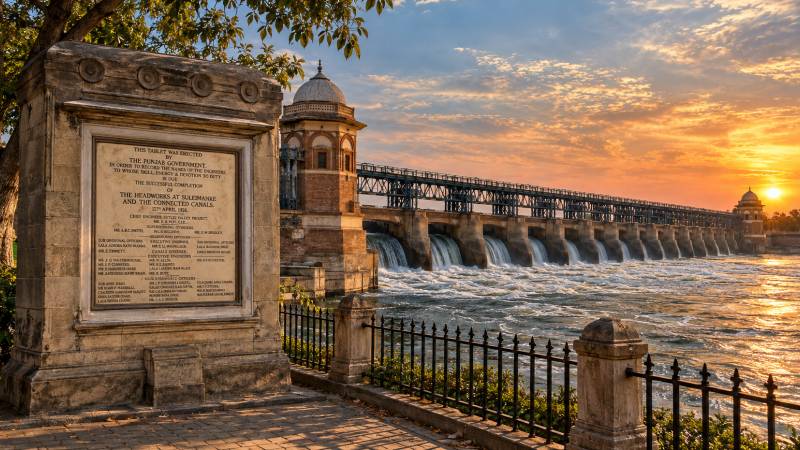
On 12 April 1926, a gathering assembled on the banks of the Sutlej to witness the opening of Sulemanki Headworks. Sir Malcolm Hailey, Governor of Punjab, was there, as was Nawab Sir Sadiq Muhammad Khan V of Bahawalpur. There were officials, engineers and men who had spent years working on the river. Beyond the ceremony lay a countryside whose future was about to change. A hundred years later, the anniversary passed in silence. No ceremony worth mentioning, at the headworks, no public remembrance of those who built the system. Yet Sulemanki remains at work, its canals carrying water through lands transformed by their construction. Villages have grown, markets have prospered, and generations have farmed the land. The names of those who made much of it possible have faded from public memory. Not all have disappeared. At Sulemanki, there is a stone that remembers.
Its inscription attributes the successful completion of the headworks and connected canals to the engineers' "skill, energy and devotion to duty". At the head of the list stands E. R. Foy, Chief Engineer of the Sutlej Valley Project, alongside Nicholson, Executive Engineer of the headworks division. Below them are Waterhouse, Rose and Menzies; Khosla, Kanwar Sen and Labhu Ram; Raghbir Singh and Bakhshi Singh Sidhu; Sheikh Muhammad Niaz, Chaudhri Amar Chand and Mian Muhammad Abdul Rahim.
British and Indian names, belonging to men who worked together on a river that cared little for the distinctions between them. Behind those names were years of surveys, calculations, drawings and long days spent beside the Sutlej. It is a remarkable memorial, not because the men were famous, but because someone thought it important that the people who built the works should be remembered.
Sulemanki belonged to the Sutlej Valley Project, approved in 1921 after years of surveys and negotiation. Four headworks and eleven canals were planned to serve British Punjab, Bahawalpur and Bikaner. Ferozepur, Sulemanki and Islam stood across the Sutlej, while Panjnad was built below its confluence with the Chenab. Together, they formed an ambitious undertaking intended to extend irrigation across vast stretches of country.
Bahawalpur was not an empty wilderness awaiting the engineers. Its rulers and farmers had irrigated land from the Sutlej for generations. There were established towns, cultivated fields and old inundation canals that came alive when the river rose. But the river gave according to its seasons, and much of the land beyond its immediate reach remained difficult to cultivate.
Sulemanki changed what was possible. The Upper Pakpattan Canal carried water towards the Nili Bar in British Punjab. On the Bahawalpur side, Eastern Sadiqia provided perennial irrigation, while Fordwah, developed from an older inundation channel, remained seasonal. Further downstream, canals from Islam and Panjnad extended irrigation into other parts of the princely state.
Historical research estimates that the project opened roughly a million acres of new colony land in Bahawalpur to agricultural settlement and development. Land was surveyed, villages laid out and markets established. Haroonabad and Chishtian grew as canal-colony centres, Bahawalnagar gained a grain market, and Fort Abbas developed facilities serving the surrounding countryside. Families settled on newly irrigated land, farmers prepared fields, and children grew up in villages that had scarcely existed a generation earlier. What began as lines on engineers' drawings gradually became the geography of ordinary lives. It is easy, looking at a canal today, to forget how uncertain the undertaking once was.
A hundred years later, the anniversary passed in silence. No ceremony worth mentioning, at the headworks, no public remembrance of those who built the system. Yet Sulemanki remains at work, its canals carrying water through lands transformed by their construction.
The Sutlej on a survey map was a blue line. The Sutlej at the bank was a living river, with shifting currents, rising floods, unstable banks and, always, silt. Sulemanki presented a particular challenge because canals had to draw water from both banks. Foy described still-pond and silt-trap arrangements that allowed sediment to settle and be flushed back towards the river. The task was not simply to divert water, but to manage what came with it.
Foy directed the project while Nicholson supervised construction. Before the headworks could rise, the site needed a railway connection, power, pumping equipment and building materials. Machinery had to arrive, labour had to be organised, and construction proceeded according to the river's seasons. The finished masonry tells only part of that story. The rest lies in the organisation, patience and ingenuity that brought it into existence. Then history intervened in a way the builders could scarcely have imagined.
Partition left Sulemanki in Pakistan but placed associated river-training works across the border in India. At Hussainiwala, the reverse difficulty arose, with its right-bank marginal bund falling in Pakistan. Engineers had designed these works as parts of a single hydraulic system. The new boundary divided them between two countries. A marginal bund did not become less necessary because it now stood across an international frontier, and floodwater recognised no border.
An agreement signed in Delhi in January 1960, with territorial adjustments implemented the following year, helped resolve the difficulties. Land near Sulemanki passed to Pakistan and the Hussainiwala area to India. The agreement was signed by diplomats, but its technical provisions carried the signatures of two Chief Engineers of Irrigation, S. N. Ravikant and M. Mahboob. Its schedules concerned river surveys, inspections and maintenance of marginal bunds. Even the border, at Sulemanki, was an engineering document.
The story did not end with its builders. Generations of Pakistani engineers and staff have since watched floods, operated gates, managed sediment and repaired structures upon which farmers depend. Some spent entire careers at such works, acquiring an intimate knowledge of the river's behaviour. That understanding passed from senior officers to younger colleagues, from experienced operators to new recruits, sometimes within families whose lives became inseparable from the canal system. Their work was less visible than construction, but no less important. A headworks does not remain useful for a century merely because it was well designed. It survives through attention, repair and the judgment accumulated over years of service.
Yet the surviving stone records those who built Sulemanki. No comparable public record tells visitors who sustained and adapted it over the decades that followed. Today, inauguration plaques readily commemorate ministers, dignitaries and executing agencies. The names of engineers and those who spent their working lives keeping the structures operational are seldom accorded the same honour.
The difference is not competence but custody. An irrigation department inherits more than gates, canals and masonry. It inherits drawings, observations, maintenance histories and knowledge accumulated through experience. Lose these records, and the next generation must rediscover what its predecessors already knew. This is what a centenary is for. Not ceremony, but custody. The Punjab Irrigation Department could preserve Sulemanki's surviving plans, photographs, technical papers and maintenance records, together with the names and contributions of those who built and operated it. A permanent display at the headworks could tell visitors how it was built, the problems its engineers solved, and the countryside its canals helped create.
The department's motto, Crescat e Fluviis, "let it grow from the rivers", found tangible expression here. Follow the canals away from Sulemanki and the achievement is visible in the fields, villages and markets that grew around the water. A century has passed. The men who built Sulemanki are gone, as are many of the farmers who first received water from its canals. Their descendants inherited a landscape those earlier generations helped create. The Sutlej still flows past Sulemanki. The canals continue on their way. And on the old stone, the names remain. They ask for nothing more elaborate than to be read, and for the work behind them not to be forgotten.