

A student who wins a place at a foreign university should not need a well-connected agent to prove that a Pakistani degree is genuine. A worker with a job offer abroad should not have to pay a middleman to authenticate a certificate the state itself issued. Yet for many Pakistanis, that is still how document attestation works. The reason has less to do with technology than with who profits from the queue.
The past month made this hard to ignore. On 18 September, Deputy Prime Minister and Foreign Minister Ishaq Dar ordered a three-member committee to investigate irregularities in the apostille and attestation system, including the role of courier services and whether Foreign Ministry officials were involved. It was given two weeks to report. Two days later, the Federal Investigation Agency said it had booked 22 suspects, six of them ministry officials, after raiding consultancy and courier offices in Islamabad's Aabpara over forged apostille stickers and stamps. Applicants had allegedly paid heavily for promises of faster service. These are allegations, not findings of guilt. They still show what cumbersome public service invites. I find this especially frustrating, because a better design was on the table four years ago.
Pakistan deposited its instrument of accession to the Hague Apostille Convention on 8 July 2022, becoming its 123rd contracting party. The Convention took effect for Pakistan on 9 March 2023. It replaced a long chain of legalization stamps with a single apostille, issued by a designated authority and recognized by other member states. Before he left office in April 2022, Prime Minister Imran Khan wanted the new service to be fully digital, and I was approached to propose how. I was then chairman of NADRA. I took a design for an electronic apostille to the Ministry of Foreign Affairs and met then Foreign Secretary Sohail Mahmood and his colleagues, who were receptive.
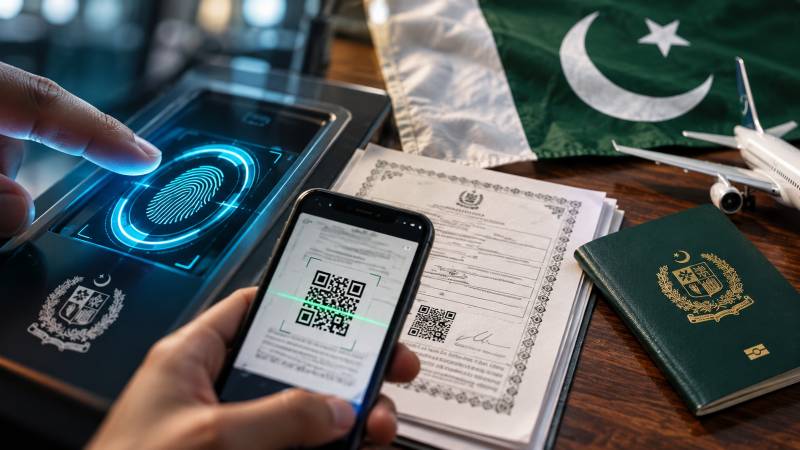
The design was simple. Citizens would be onboarded and verified through NADRA, with the CNIC as the key linking every record. Issuing bodies would connect directly, and each document would carry a secure, verifiable QR code. The principle was that the state should check its own records instead of making citizens carry paper from counter to counter.
NADRA's engineers had also built an AI-assisted document recognition system. It could tell at once whether a document was a degree, a certificate, a civil registration record such as a birth, death, marriage, divorce or adoption certificate, or a power of attorney. We wanted each of these documents to carry a verifiable unique identifier linked to the smart national identity card, so that citizens could prove their credentials anywhere in the world. I met Dr Mukhtar Ahmed, then chairman of the Higher Education Commission, to make the case for connecting degree records. He agreed.
Then the government changed. In early 2023 I met Foreign Minister Bilawal Bhutto Zardari, who was keen for NADRA to take on the work. His reasoning was practical: NADRA already verified identity, so the job fitted. He had also seen what our digital power of attorney service had done for overseas Pakistanis. Thousands of them had their powers of attorney processed within a few months without visiting a mission, and the load on embassies fell. The apostille proposal now had support from two governments. Yet the ministry preferred to hand the work to the National Information Technology Board. I resigned from NADRA in June 2023, and elections followed in February 2024.
That choice worried me. It put the question of which agency would own the project ahead of how the service should work. NADRA already ran identity verification at national scale. The sensible question was how to combine that with the ministry's legal authority and the records held by universities, examination boards and other issuers. I could see the conditions for failure forming: enthusiasm at the top, competing preferences below, and nobody committed to the integrated service. That was my judgment at the time. Whatever was built afterwards should be judged on its performance. But the episode shows how a reform can lose its way even with ministers behind it.
Pakistan has a habit of announcing back-end integration once pressure builds. The harder question is why it took more than three years after the Convention came into force.
Pakistan's reform debates often blame citizens for low digital literacy or resistance to change. Those concerns are real. We spend far less time on the people who gain from a slow service. The citizen in the queue wants it shorter. The intermediary selling a place in it does not. A hard state should not be hard on its own citizens.
A digital service would make requirements clear, fees visible, every verification traceable and every decision auditable. It would cut repeat visits and the openings to sell favors. People who need help with digital services would still get it. What should disappear is the need to buy access to something you are already entitled to.
The money is not small. On 12 January 2026, the Senate Standing Committee on Foreign Affairs heard that the ministry had earned about Rs2 billion from apostille attestation in the previous year. That is lawful government revenue, not illicit earnings. But a service at that scale needs strong oversight. The committee's chairman, Senator Agha Shahzaib Durrani, called for complete digitization, less human intervention and integration with NADRA, the Higher Education Commission and other institutions. We had proposed much the same in 2022.
Some things have improved, I assume. Pakistan now runs an electronic apostille register, so a recipient abroad can check an apostille online or by scanning a QR code. The Hague Conference's implementation chart lists that register. It does not list Pakistan as issuing e-Apostilles, which are created and signed electronically from the start. Checking a paper apostille online helps. Issuing it digitally is the bigger step.
On 30 July, officials told the Prime Minister that the attestation system was now linked to the databases of NADRA, the HEC, the Inter Boards Coordination Commission and the National Police Bureau. Full digitization, they said, was next, and a mobile app was being built with NITB. These are official claims, not measured outcomes. Pakistan has a habit of announcing back-end integration once pressure builds. The harder question is why it took more than three years after the Convention came into force. The hybrid regime must answer that.
Those announcements deserve credit, and they create a duty to show results. Which documents can now be processed without a visit? How long does verification take? How often must applicants still go back to the issuing body themselves? Can a citizen finish the process at the published fee without an agent? What happens when the portal goes down? Reform should be judged on those answers. Reliable records, cybersecurity, budgets and trained staff all matter. They deliver little while institutions keep reasons to preserve discretion. That is why this debate cannot end with a portal and a QR code.
A QR code is only a route to a record. Its worth depends on the record behind it, the security of issuance and the ability to spot tampering. Identity and authenticity are also separate questions. NADRA can confirm who the applicant is, but only the issuing body can vouch for where a document came from. And an apostille certifies the signature, the signatory's capacity and any seal or stamp. It says nothing about whether the document's contents are true.
The international framework already exists. The Hague Conference's electronic Apostille Programme covers both e-Apostilles and e-Registers, and an e-Apostille cannot be refused simply because it is electronic. Had we been allowed to built the system then, integrated e-Apostille with our PAK-ID app as per international standards, it would have raised Pakistan's standing abroad and narrowed the trust deficit between state and citizen, at home and internationally. When verifiers can authenticate a document at its source instead of relying on stamps and signatures on paper, trust returns.
Pakistan should build on it with a clear division of labor. The Foreign Ministry exercises its legal authority to issue apostilles. NADRA verifies identity. Issuing bodies authenticate their own records through secure links. Every role should be explicit, and every action should leave an audit trail. The next step is a published roadmap that starts with documents whose source records are already reliable and digital. Citizens need one schedule of official fees, firm processing times and a way to track their applications. Any refusal or request for further checks should come with a reason.
Couriers save people travel and money, and assisted counters matter for those without smartphones or reliable internet. Both should work under published rules and charges, with a clear route for complaints. Data access should be limited to what the service needs; checking a certificate is no excuse to expose unrelated personal information. Secure access, accountable staff and independent audits belong to the reform itself.
The Dar inquiry should look beyond individual wrongdoing. It should name the procedural gaps that make forgery, overcharging and queue-jumping possible, publish its findings within legal limits, and give someone responsibility for closing each one. Otherwise, Pakistan faces another round of allegations, inquiries and recommendations, while the citizen goes back to guessing. My 2022 proposal would need updating. Technology, law and institutions have moved on. Its core still holds: the state should verify its own records, and citizens should get a lawful service without paying for influence.
Apostilles are a small matter beside Pakistan's larger governance problems. That is what makes them a good test. The service has a defined purpose, known institutions and an international rulebook, and its performance can be measured. If the state cannot make this reliable, affordable and transparent, citizens have every reason to doubt grander promises of digital transformation. Pakistan has set up a string of digital authorities and spent heavily on data centers, firewalls and equipment, staging a kind of digital theater. Its delegations tour the world touting digital transformation, while the ordinary citizen is still asking: what's in it for me? Better systems are only half of reform. The other half is removing the incentives that keep bad ones alive. The person waiting for an apostille needs a service that works, and institutions willing to make it work.