

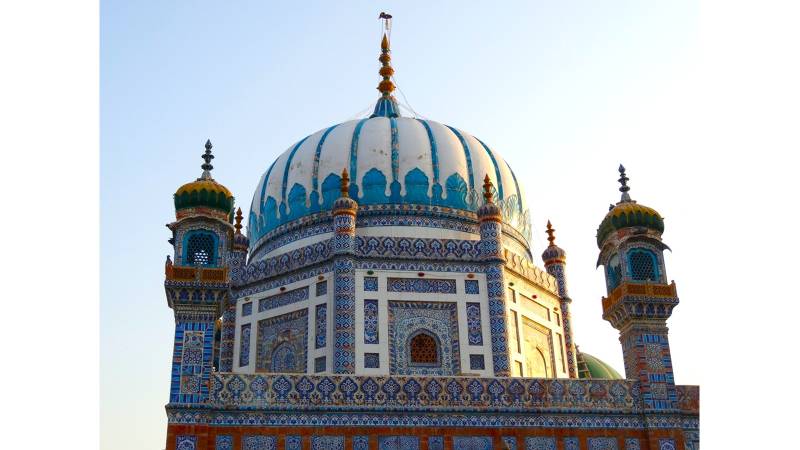
Sindhi tombs have a charm and beauty of their own. Rising from otherwise desolate surroundings, they often break the monotony of the landscape and draw the eye from a considerable distance. Many occupy prominent locations, while those built on higher ground offer panoramic views of the surrounding countryside. Visibility is therefore an important aspect of how these monuments are experienced. The choice of such prominent locations may not always have been accidental. In some cases, it may also have helped keep the tomb, and the memory of the person buried there, visible in the landscape.
The visual appeal of these tombs is not limited to their setting. Many were richly decorated with mural paintings, glazed tiles, or a combination of both. Their painted interiors contain a wide range of secular and sacred themes. Folk romances, hunting and battle scenes, and floral and geometric designs frequently appear on their walls. Sindhi artisans worked with an established repertoire of subjects and designs, but their art was not isolated from influences beyond the region. Through interaction with other artistic traditions, they encountered new forms and motifs, which they sometimes adopted and adapted to their own artistic practices.
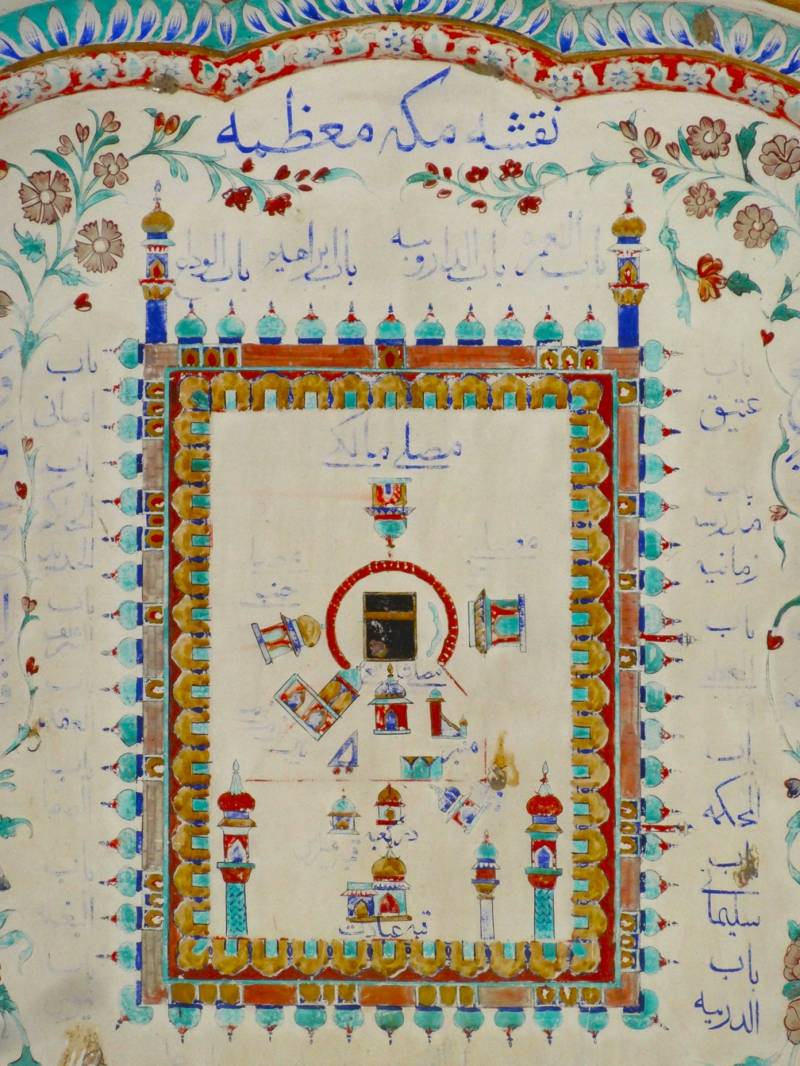
Painted tombs in Dadu, Larkana, Kamber-Shahdadkot, Sanghar, and other districts of Sindh preserve many examples of these themes. Their murals provide a rich visual record of local stories, social life, costumes, weapons, animals, architecture, and the artistic imagination of the communities that produced them.
Depicting the Holy Sanctuaries
Among the sacred themes found in Sindhi funerary art are paintings of Makkah and Madinah. These depictions appear in a few Sufi tombs in Tando Allahyar and other districts of Sindh, where artists represented the holy sites of Islam on interior walls. These paintings are a distinctive feature of Sindh's funerary art, visually linking local Sufi spaces with the sacred centres of Islam. At the same time, they offer an interesting insight into how Sindhi artists imagined and portrayed distant sacred places through their own artistic traditions.
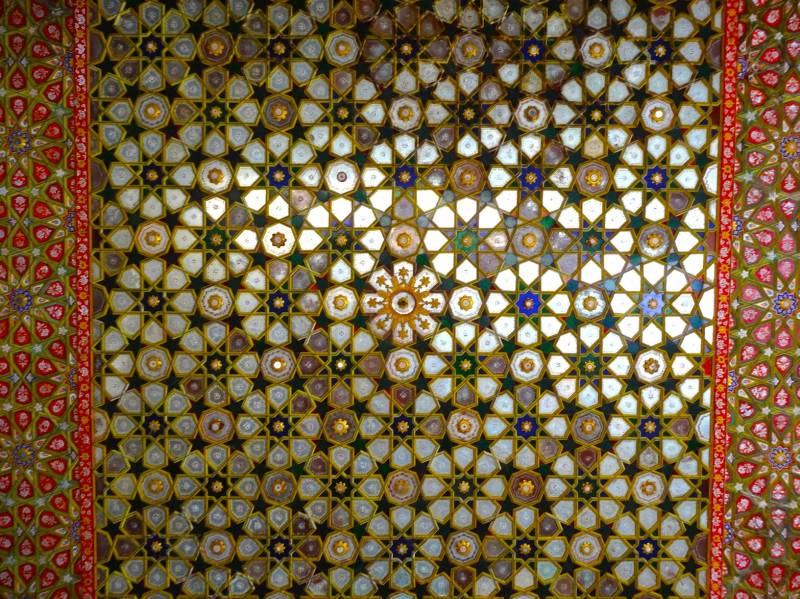
Islamic art frequently depicts the Holy Ka'ba, the Masjid al-Haram that surrounds it, and the Mosque of the Holy Prophet Muhammad (PBUH). Both Makkah and Madinah, the pilgrimage sites, appear in tombs and mosques in Sindh. Most tombs, built during the Talpur period (1783–1843) and the colonial era, depict maps of Makkah and Madinah.
The earliest representation of the Holy Ka’aba is found in the mosque of Jam Nindo at Qubo Shahdad necropolis in Sanghar district. This mosque was built during the Kalhora period (1700–1783). Near the depiction of the Holy Ka’aba are paintings of the shrines.
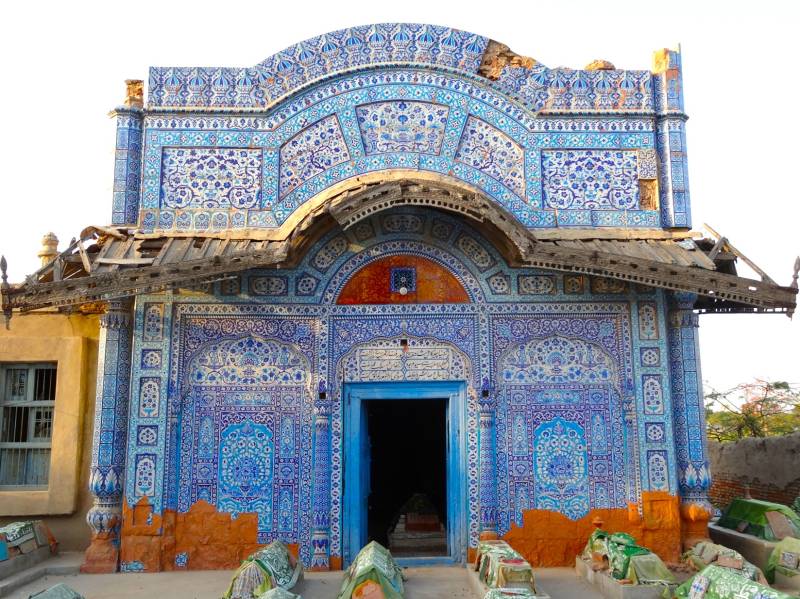
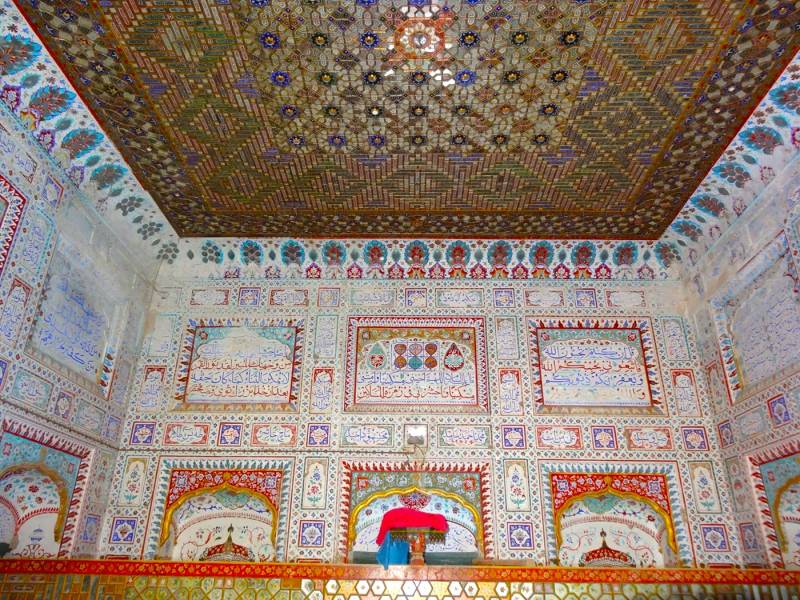
The tomb of Pir Noor Muhammad Shah Jilani is one of the most magnificent in terms of painting, glazed tiles, and mirror work on a painted wooden ceiling
Apart from the mosque of Jam Nindo, the most splendid tomb of Syed Hasan Ali Shah, built in 1829, is decorated with paintings of the Holy Ka'aba and the Mosque of the Prophet Muhammad (PBUH). The tomb of Syed Hasan Ali, locally known as Mahawali, is located near 70 Mori in the district of Tando Muhammad Khan. Two panels on the tomb's eastern wall depict the Holy Ka'aba and the Mosque of the Prophet Muhammad (PBUH), respectively.
The Splendour of Sangaro Sharif
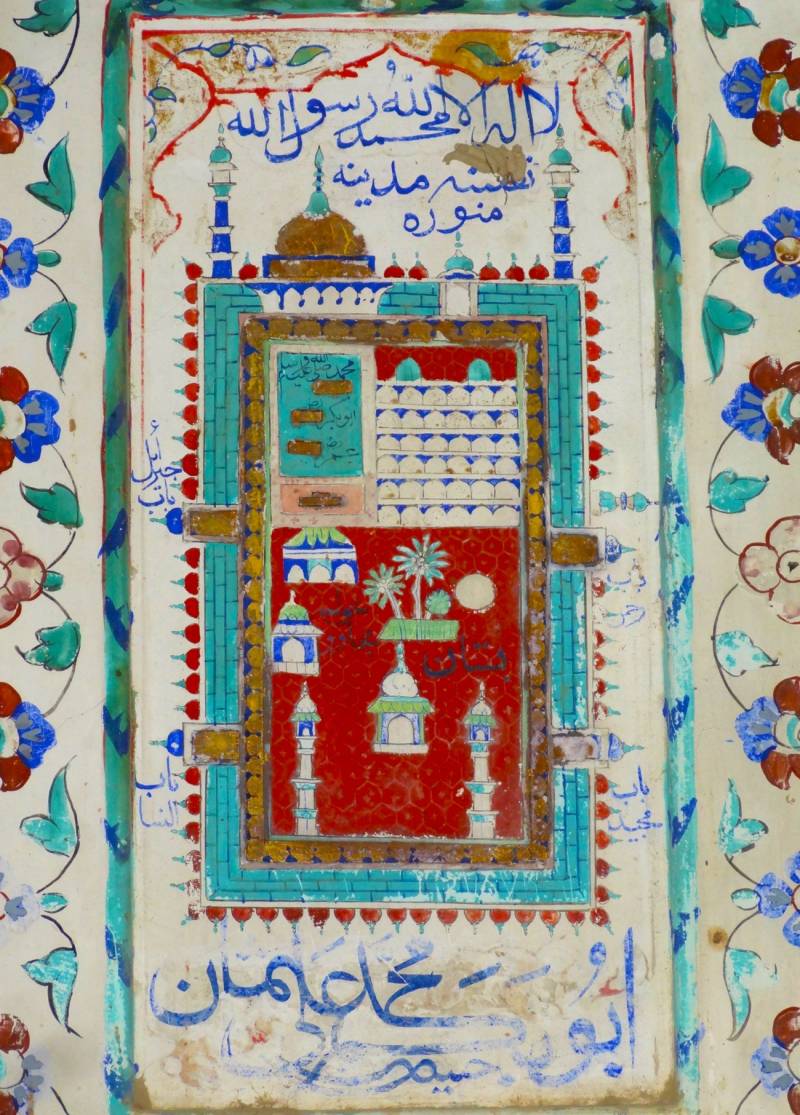
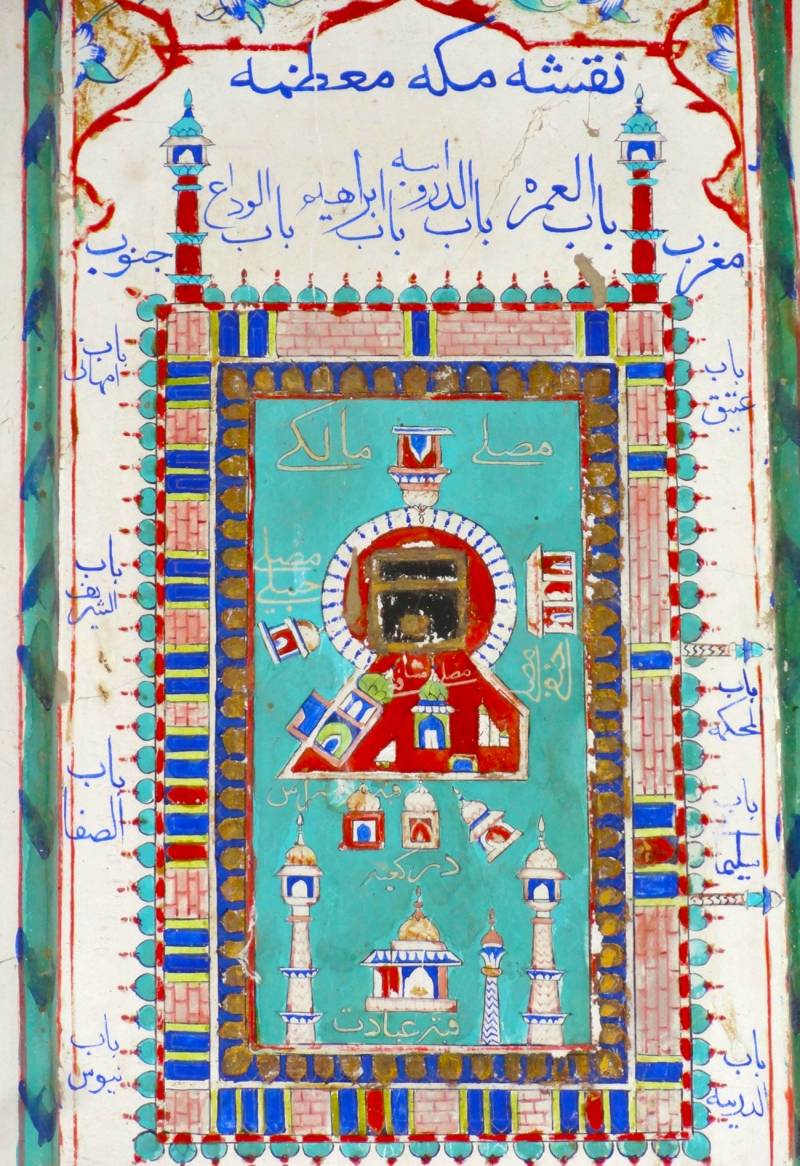
However, the Jilani tombs at Sangaro Sharif feature the most impressive paintings of Makkah and Madinah. Sangaro Sharif is located about 6 km east of Tando Allahyar town. Two prominent tombs at Sangaro Sharif belong to Pir Noor Muhammad Shah Jilani and Pir Bachal Shah Jilani, respectively. Both tombs depict paintings of Makkah and Madinah. The tomb of Pir Noor Muhammad Shah Jilani has two panels that show the Holy Ka'aba and the Masjid al-Nabawi. The panel shows the Holy Ka'aba in the centre, depicting key annotated monuments. At the top of the panel is written "Naqsha" (map) of Makkah.
The second panel shows the mosque of the Prophet Muhammad (PBUH) at Madinah. It is depicted as a large courtyard surrounded by arcades and with four minarets. The painting also identifies the tomb of the Holy Prophet Muhammad (PBUH). Two other tombs belong to Hazrat Umar (RA) and Hazrat Abu Bakr (RA).
The tomb of Pir Noor Muhammad Shah Jilani is one of the most magnificent in terms of painting, glazed tiles, and mirror work on a painted wooden ceiling. Such refined work is rare to see in the Tando Allahyar district. Although the Jamia Mosque of Kamaro Sharif also features glazed tilework and mirror work on a painted wooden ceiling, it is not painted as impressively as the tomb of Pir Noor Muhammad Shah Jilani.
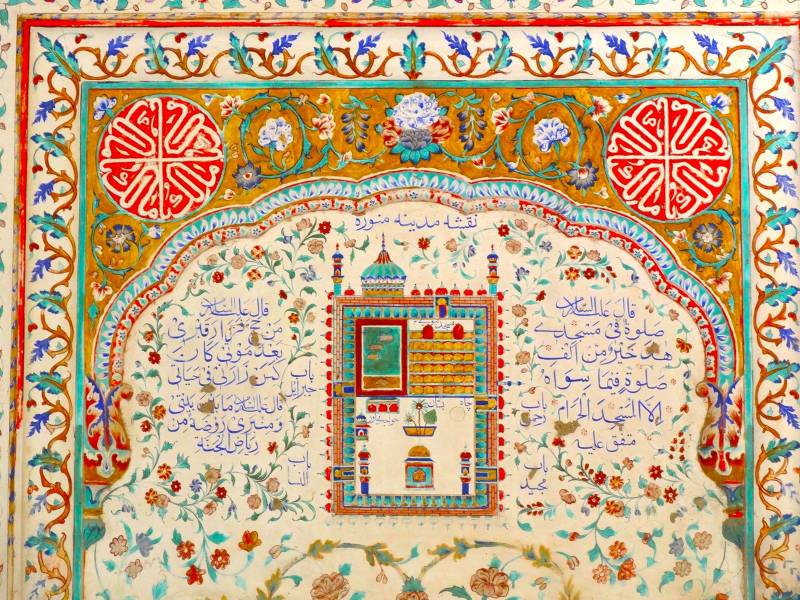
Another architectural gem of Sangaro Sharif is the tomb of Pir Bachal Shah Jilani, which is located north of the tomb of Pir Noor Muhammad Shah Jilani. It also contains the grave of Pir Mehar Shah Jilani.
Standards of Representation
The tomb of Pir Bachal Shah Jilani depicts two panels representing two holy sanctuaries at Makkah and Madinah. Both sanctuaries share the same elements and representations. A two-dimensional view of the sanctuaries at Makkah and Madinah became the standard in the tombs and mosques in Sindh. As M A S Abdel Haleem (2012: 39) notes in his article "The Importance of Hajj: Spirit and Rituals,” published in Hajj: Journey to the Heart of Islam, edited by Venetia Porter et al and published by the British Museum Press, the two-dimensional view of the sanctuary became a standard form of representation on Hajj certificates and in manuscripts such as the Dala’il al-Khayrat and Futuh al-Haramayn.
Holy sanctuaries of Makkah and Madinah also appeared on tiles. The tiles depicting the holy sanctuaries of Makkah and Madinah were made between the mid-17th and early 18th centuries at Turkish ceramic centres in Kutahya, Iznik, and Tekfur in Istanbul. They made tiles in various forms, from small portable individual tiles to large panels.
Robert Irwin (2012), in his article "Journey to Mecca: A History” in Hajj: Journey to the Heart of Islam, edited by Venetia Porter et al and published by the British Museum Press, notes that the earliest surviving example of a tiled depiction of Makkah is on the eastern wall of the Aya Sofia in Istanbul, dated 1642 and with an inscription bearing the name of Tabazade Mehmed Beg. I saw this tile when I visited the Aya Sofia in 2017. I also saw three large panels depicting Makkah, Madinah, and Mount Arafat in the mosque of the Black Eunuchs in Topkapi Palace in Istanbul.
Colonial Era and Beyond
The holy sanctuaries of Makkah and Madinah continued to appear in the tombs and mosques in colonial Sindh. Some mosques built in the 1950s and 1960s also depicted the holy sanctuaries of Makkah and Madinah. One such mosque, known as Gulzar-e-Madinah mosque in Dadu town, was decorated with paintings of the Holy Ka'aba and the mosque of the Prophet Muhammad (PBUH). These paintings depict holy sanctuaries of Makkah and Madinah, and other key monuments. In addition to the two sanctuaries of Makkah and Madinah, the painters depicted Baytul Muqaddas, the third holiest place for Muslims. This mosque has been rebuilt, and we also lost many precious paintings during the rebuilding.
The tomb of Shadi Shaheed in Khairpur district also depicts the holy sanctuaries of Makkah and Madinah. Many holy pilgrimage sites are painted in the transition zone and on the tomb's domed ceiling. The tomb's domed ceiling depicts eight holy sanctuaries, including the Holy Ka'aba, the mosque of the Holy Prophet Muhammad (PBUH), the mosque of Al Ghamama, etc. The transition zone also includes many pilgrimage sites, including the sanctuaries of Makkah and Madinah. It also depicts Ghar-e-Hira, the shrine of Hazrat Imam Ali (AS). The mosque of Fatima al-Zahra (RA) is also painted in the transition zone of the tomb of Shadi Shaheed. The shrines of Sufi saints are also depicted in the tomb. Prominent among these are representations of the shrines of Shaikh Abdul Qadir Jilani, Data Ganj Bakhsh, and many others.