

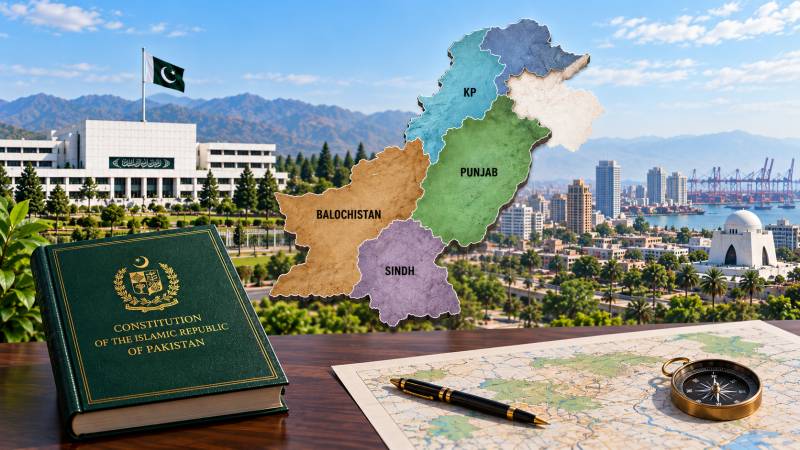
Pakistan’s debate over new provinces is back, with a familiar argument: our provinces are simply too large to govern effectively. Supporters believe smaller provinces would bring government closer to the people, improve representation, and give neglected regions a stronger political voice. Opponents fear that new provinces could deepen ethnic and political divisions without fixing the problems that prompted the demand. Both concerns are legitimate. But perhaps we are asking the wrong question. The issue is not simply how many provinces Pakistan should have. It is how close government is to the people and how much power people actually have over the government that affects their daily lives.
Pakistan has already taken an important step towards decentralisation. The 18th Amendment shifted substantial powers from Islamabad to the provinces, while the 7th National Finance Commission Award increased their share of federally collected revenues. But power moved from Islamabad to provincial capitals and often stopped there. It did not consistently move from provincial capitals to cities, districts, and neighbourhoods. That is one of the great unfinished tasks of Pakistan’s federal system.
Provinces understandably fought for autonomy from the federation. But they have often been far less willing to give comparable authority to elected local governments. Article 140A requires provinces to establish local governments and devolve political, administrative, and financial authority to elected representatives. Yet, in much of Pakistan, local governments remain weak, short-lived, and dependent on provincial governments for money and authority. This matters because citizens do not experience the state through constitutional amendments. They experience it when the water does not arrive, the road is broken, the hospital has no medicines, the garbage is not collected, or a police complaint goes nowhere. For them, the question is simple: Who is responsible and can I hold that person accountable?
A Smaller Province Is Not Automatically Better Government
There is a legitimate case for asking whether four provinces remain the most effective administrative structure for a country of more than 240 million people. Punjab alone is larger than many countries. Sindh combines Karachi with vast rural areas whose economic and administrative needs are very different. Smaller regions have long complained about political marginalisation and the distance from provincial capitals. These concerns deserve consideration. But making a province smaller does not guarantee better government. A new province can mean a new capital, assembly, and bureaucracy without necessarily producing better schools, hospitals, roads, water systems, or municipal services. That is the danger of confusing redrawing boundaries with reforming government. Indonesia’s sweeping decentralisation after 2001 showed that transferring responsibility to subnational governments is not enough without local capacity and accountability.
South Africa offers another lesson. Its post-apartheid system gave substantial responsibilities to metropolitan municipalities such as Johannesburg, Cape Town, and Durban. The aim was not to turn every major city into a separate province, but to give local governments authority over problems that are fundamentally local. The lesson is straightforward: Decentralisation works when authority, responsibility, money, and accountability move together. Without them, another province may simply mean another layer of government.
The answer is devolution. Because division changes the map. Devolution changes who has power. Pakistan has spent decades debating the first while neglecting the second.
Sindh: Protecting a Province or Improving Government?
Recent reactions in the Sindh Assembly to discussions about administrative division show how quickly a governance question can become an existential political argument. Talk of “breaking Sindh” or “going to the last limit of Pakistan” suggests that administrative reform is sometimes treated as an attack on provincial identity itself. But Sindh is more than a political slogan. It is home to people from different linguistic, economic, and geographic backgrounds, with different needs. The question should be simple:
Would a more decentralised system make government work better?
If creating or strengthening administrative units could improve public services, strengthen tax collection, reduce crime and corruption, bring decisions closer to citizens, and make politicians more accountable, why should the idea automatically be treated as an attack on Sindh? The objective should not be to “break” Sindh or any other province. It should be to make government work. A province can retain its history and identity while giving more authority to cities, districts, and local communities. The real choice is not necessarily between preserving Sindh and dividing Sindh. It is between keeping power concentrated and bringing government closer to the people.
Karachi Shows What Is Really at Stake
Karachi perhaps illustrates the problem better than anywhere else. The city is too important and too large to be governed through a system where responsibility is scattered among municipal institutions, provincial departments, cantonments, and federal agencies. Land, planning, transport, water, policing, and infrastructure often fall under different authorities. When something goes wrong, it can be difficult to know who is responsible. But turning Karachi into a new province would not automatically solve that problem. A city can have a new provincial government and still have a weak mayor. It can have another assembly and still lack adequate municipal finances. The better question is: Who has the authority, the money, and the accountability to govern Karachi? That question should be asked across Pakistan.
Start with the People, Not the Map
Pakistan does not have to wait for another constitutional amendment to begin fixing its governance problem. Provincial governments can strengthen elected local governments, provide predictable financial transfers, and give them greater authority over genuinely local priorities. The federal government should handle matters requiring national coordination. Provinces should manage regional issues. Cities and local governments should control services that are fundamentally local. Each level should have clearly defined responsibilities, adequate resources, and accountability for results. That would also make the debate over new provinces more rational.
Instead of asking first, “How many provinces should Pakistan have?”, we should ask: “Who should be responsible for what?” If existing provincial boundaries genuinely prevent effective administration, representation, or development, changing them should remain an option. But if the real problem is that too much power is concentrated in provincial capitals, creating another province may simply move the problem somewhere else.
The answer is devolution. Because division changes the map. Devolution changes who has power. Pakistan has spent decades debating the first while neglecting the second. The country may eventually need new provinces. It may not. But it certainly needs government that people can see, reach, and hold accountable. Pakistan does not need more capitals simply for the sake of having them. It needs more government where people actually live and more power in the hands of those they can hold responsible.