

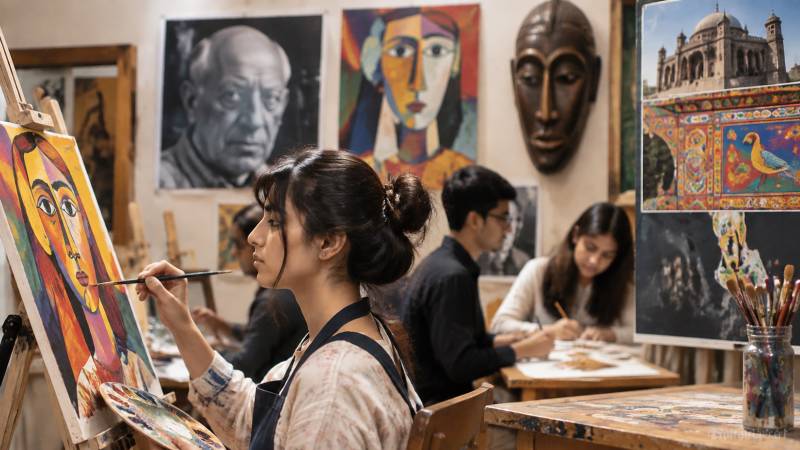
In Pakistan, Pablo Picasso is perhaps one of the most recognizable artists taught in classrooms and art studios. You may also be familiar with Cubism – the art movement he helped pioneer. But did you know that Picasso drew inspiration from African masks and sculptures? These were artistic traditions that Europeans often dismissed as “primitive.” Yet Picasso and fellow artist Georges Braque borrowed from these traditions and helped transform modern art, while the African artists and cultures behind that influence received no recognition.
Picasso is hardly an exception. Think of the most celebrated artists in history: Leonardo da Vinci, Michelangelo, Rembrandt, Monet, Van Gogh, Warhol, Duchamp. The list is overwhelmingly European and male. Literary critic Harold Bloom referred to a similar collection of celebrated writers and thinkers as the “Western Canon” – a body of work treated as the pinnacle of human achievement and therefore worthy of study. Variations of this canon have found their way into classrooms across the world, including our own. As a result, generations of students in Pakistan have learned far more about European artists and movements than about Sadequain, Shahzia Sikander, Rashid Rana, or Faiza Butt. The problem is not that students learn about Picasso or European art history. They should. The problem is that these figures are often presented as universal benchmarks of artistic excellence, without examining the social, political, and colonial contexts that shaped them or the traditions that were marginalized along the way.
I grew up in Islamabad and attended the city’s most prestigious schools. Like many Pakistani students, my experience of art education was limited to drawing landscapes, sketching still lifes, and experimenting with coloured pencils, watercolours, and oil pastels. Art was treated as a discrete subject rather than a broad field encompassing music, theatre, photography, sculpture, performance, and other forms of creative expression. I formally encountered the Western Canon in my undergraduate studies at the Pakistan Institute of Fashion and Design in Lahore. Our course, History of Art and Culture, was dominated by European artists, movements, and institutions. We memorised names, dates, objects, and stylistic characteristics, but rarely engaged critically with the social and political conditions that produced them. We learned to celebrate Bauhaus as a revolutionary model of modern art and design education, but rarely discussed its contradictions. It took me another ten years after graduation to learn that, while Bauhaus championed innovation and experimentation, women at the school were frequently funnelled into weaving workshops rather than architecture or industrial design. We were taught its achievements without examining its exclusions. Critical engagement was replaced with admiration.
Today, one of the most significant developments in Pakistani arts education has been the adoption of Art, Model Drawing and Fine Arts as a National Curriculum, beginning in the 2022-23 academic year. The curriculum is noteworthy not only because it establishes the first national framework for arts education, but also because it reflects a growing recognition for the arts. The curriculum has an interesting history. It was originally developed in 2015 by Zindagi Trust, a nonprofit organisation working to reform public education in Sindh, and was later adopted at the national level. The curriculum attempts to broaden students’ horizons by introducing them to world heritage sites, internationally recognised artists, and diverse artistic traditions. Pakistani students deserve opportunities to engage with global artistic histories. Yet exposure alone is not enough.
A closer reading of the national curriculum and the revised curriculum released by Zindagi Trust in 2024 reveals a familiar pedagogical pattern. Students are introduced to artists and then asked to recreate their work. Activities include replicating Paul Klee’s Castle and Sun and producing Picasso-inspired collages. Studying artists is important, but why does engagement so often begin with reproduction? Why are students invited to imitate masterpieces before investigating their own experiences, communities, and cultural worlds?
Decolonial pedagogy views learners not as passive recipients of expertise but as active knowledge-makers. When children are asked primarily to reproduce existing artworks, they learn that artistic value resides elsewhere – in museums, textbooks, and the work of celebrated figures.
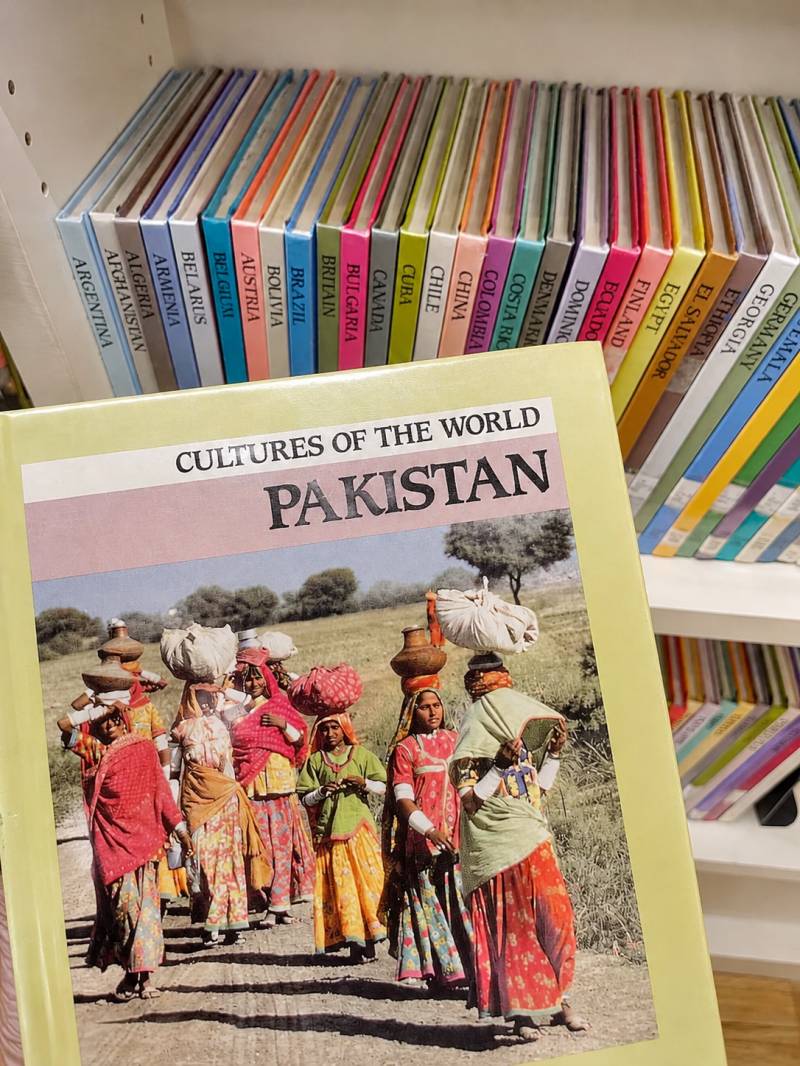
I encountered a different approach while working as a Graduate Teaching Artist at the Rhode Island School of Design in 2024. In a community-based elementary arts programme, lessons rarely began with a famous artist whose work students were expected to emulate. Instead, we would start with a children’s storybook that invited students to draw on their own experiences and imaginations. Students would then be introduced to artists whose visual strategies related to the activity, helping them experiment with materials and techniques while developing their own artistic responses.
This seemingly small shift had important implications. Artists were presented not as models to imitate but as examples of the many ways creative ideas can be communicated. The result was a classroom filled with artworks that reflected each student’s perspective, choices, and experiences. A similar approach could be adopted in Pakistan. Imagine a lesson beginning with a folktale from Gilgit-Baltistan, a Sindhi folk story, or even family stories shared by students. Children might first create visual interpretations of these narratives before being introduced to artists whose work explores similar themes or forms of storytelling. In such a model, students’ cultural worlds become the starting point of artistic inquiry rather than an afterthought.
This distinction is significant because it concerns who is authorised to produce knowledge. Decolonial pedagogy views learners not as passive recipients of expertise but as active knowledge-makers. When children are asked primarily to reproduce existing artworks, they learn that artistic value resides elsewhere – in museums, textbooks, and the work of celebrated figures. Beginning with their own stories and observations teaches them that their experiences are worthy of artistic exploration. To be fair, the national curriculum is not devoid of creativity. It encourages divergent thinking, original ideas, engagement with contemporary issues, and the development of students’ own artistic voices. It is also culturally grounded. Students encounter Pakistani art history, regional crafts, Ajrak and textile traditions, architecture, folk narratives, oral histories, and contemporary artists such as Shahzia Sikander. These are important developments, but they also reveal the limits of simply diversifying content. Much of the curriculum treats culture as something to be identified, documented, preserved, or appreciated. Students are less frequently asked to reinterpret those traditions, critique them, or connect them to contemporary social realities. Culture appears as content to be learned rather than as a living process in which students actively participate.
Take, for example, the inclusion of Shahzia Sikander. Introducing students to one of Pakistan’s most internationally influential artists is commendable. Yet her work extends beyond formal analysis or aesthetic appreciation. It engages with questions of gender, power, identity, migration, and colonial history, while reimagining South Asian visual traditions for contemporary contexts. Whether students encounter these dimensions depends largely on the teacher, because the curriculum offers limited guidance on critical engagement. Will students simply learn that Sikander is an important Pakistani artist, or will they discuss how artists use their work to question social norms and reshape cultural narratives?
Decolonizing arts education does not mean rejecting Western artistic traditions or replacing one canon with another. It requires studying them more deeply and critically. Students should learn not only what Picasso painted, but also how Cubism emerged through encounters with African artistic traditions. They should learn not only that Bauhaus transformed art and design education, but also how gender shaped opportunities within the institution. They should learn to celebrate artistic achievements while investigating the historical, political, and cultural conditions that made them possible. Decolonisation asks students to move beyond admiration towards analysis.
The revised curriculum released by Zindagi Trust in 2024 appears to be moving in this direction. Compared to the earlier version, it is more engaging and activity-based, offers more accessible guidance for teachers, incorporates stronger Pakistani references, and moves away from the rigid bureaucratic language of outcomes-based frameworks. Despite these improvements, it continues to treat culture primarily as something students study rather than something they actively create, question, and transform. Formal elements of art remain heavily emphasised, student agency remains limited, and opportunities for critical engagement are often underdeveloped. Culture appears frequently, but is often presented as a backdrop rather than a site of inquiry. This raises a fundamental question: why does arts education so often begin with the Mona Lisa, Picasso, or Paul Klee rather than with truck art, neighbourhood murals, family photographs, local craftspeople, or community histories? Why do students learn first to reproduce existing cultural artefacts rather than investigate the cultural worlds they already inhabit?
Pakistan gained political independence in 1947, but political independence alone does not dismantle colonial ways of thinking. If we are serious about cultivating a confident cultural identity, we must examine how colonial assumptions continue to shape our educational institutions, curricula, and understandings of art. A decolonised arts education would not reject global artistic traditions or abandon established artists. Rather, it would rebalance the relationship between global and local knowledge. It would teach students that artistic expertise exists not only in galleries and textbooks but also in communities, families, streets, and everyday life. Most importantly, it would position young people as creators of culture rather than inheritors of it. In a country as culturally diverse and artistically rich as Pakistan, this shift may be one of the most important educational reforms still waiting to happen.