

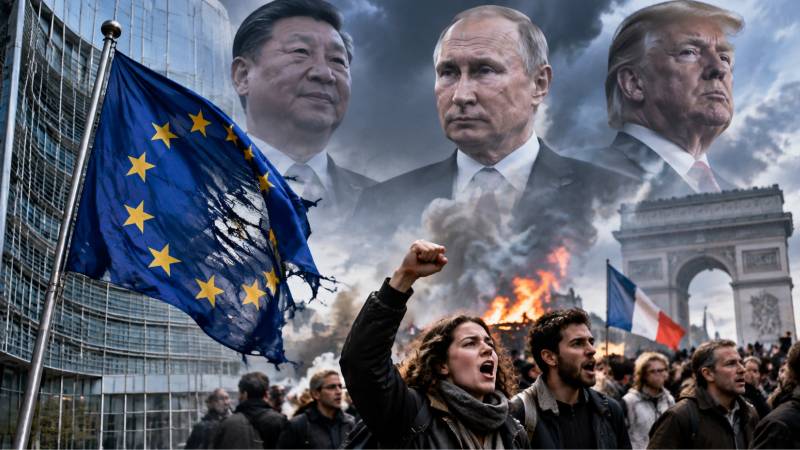
A spectre is haunting Europe. This time however, it is not communism. Europe is facing a challenge on three fronts and each threatens the prosperity and political influence it has enjoyed for much of the past century. For a long time, Europe was at the forefront of industrial and technological development. That position is now being challenged by China. From electric vehicles and batteries to renewable energy and telecommunications, Chinese companies are competing with and in some fields overtaking their European counterparts. The shift in economic power towards Asia is no longer a distant possibility. It is happening before our eyes.
Europe's ambitions in the east have also run into serious trouble. Following the collapse of the Soviet Union, the European Union and NATO expanded their influence across Eastern Europe. Russia viewed this expansion with growing hostility and Ukraine eventually became the principal battleground. The war has dragged on far longer than many anticipated with enormous human suffering and serious economic consequences for Europe itself. For decades, European industries had relied on relatively cheap Russian gas and oil. The war disrupted these supplies and forced Europe to seek more expensive alternatives. Energy prices soared, inflation followed and industries already struggling to compete internationally found themselves under further pressure. Europe may have reduced its dependence on Russia, but it has paid a considerable economic price.
The third challenge comes from an unexpected quarter: the United States, Europe's closest ally since the Second World War. The relationship that once provided Europe with security and access to a vast market is becoming increasingly strained. American tariffs threaten European exports, while Washington's insistence that European countries shoulder a much larger share of their defence expenditure is adding to their financial burdens. Europe is discovering that even its oldest alliance can no longer be taken for granted. All this is happening at a time when European economies are already struggling with slow growth, ageing populations and mounting public debt.
The European welfare state was built during decades of remarkable economic expansion. It promised ordinary citizens access to healthcare, education, pensions, unemployment benefits and a degree of economic security that earlier generations could scarcely have imagined. It was one of the great achievements of postwar Europe. But maintaining that system is becoming increasingly difficult. They are caught between raising taxes, borrowing more, cutting expenditure or reforming benefits. None of these choices is politically easy.
The burden is not shared equally. Those with wealth, property and secure employment are better placed to protect themselves. For many working-class families and young people, life has become more uncertain. Housing is increasingly unaffordable, employment is less secure, and the cost of living has risen. It is against this background that we need to understand the growing discontent on the streets of Europe. France provides a particularly interesting example. In May 1968, students took to the streets of Paris, soon joined by millions of industrial workers. They were rebelling against the political and social order of a country that was enjoying extraordinary economic prosperity. The establishment saw the spectre of communism behind the protests, although the movement was far more complex than that.
Europe’s decline is not simply the consequence of China’s economic rise, Russia’s war in Ukraine or an increasingly strained relationship with the United States. It is also the result of a changing global order that is exposing the vulnerabilities of its economic model, placing its welfare state under unprecedented pressure and deepening social divisions.
I remember those days vividly. In 1968, at the height of the movement against Ayub Khan, Tariq Ali visited Lyallpur. He was drawing a parallel between the young people confronting a military dictator in Pakistan and their counterparts in France challenging the authority of Charles de Gaulle. For our generation, the student rebellions of Europe were not distant events. They were part of a wider wave of youthful defiance against established authority.
More than half a century later, France is once again witnessing recurring protests and episodes of violent unrest. But the circumstances have changed. The country is no longer enjoying the economic expansion of the 1960s. Its industries face intense international competition, its public finances are under strain and many of its younger citizens see fewer opportunities for themselves. The identity of the protesters has also changed. In the urban riots of recent decades, many participants have been young people from impoverished suburbs, often the children or grandchildren of immigrants from France's former colonies. Most are French citizens, yet many feel excluded from the prosperity and opportunities that French citizenship is supposed to guarantee.
Sections of the political right increasingly attribute such unrest to immigration and the failure of integration. But blaming immigrants alone does little to explain why so many French citizens feel alienated from their own society. And it is not just the European right wing. Some former left-wing activists in Pakistan, once champions of progressive causes, have also moved towards the political right, embracing Zionism and joining the chorus against immigration and cultural integration in the West.
There is an irony here. In 1968, the French establishment feared that communists were threatening its social order. Today, sections of the right see immigrants and their descendants as the principal source of disorder. The perceived enemy has changed, but real underlying economic and social tensions remain. Europe's troubles are not simply the result of immigration, nor can they be blamed entirely on China, Russia or the United States. The world in which Europe built its prosperity and welfare state has changed profoundly, and its political leaders are struggling to adjust to these new realities. Europe needs to reconsider its ambitions of eastward expansion, reshape its geopolitical and economic relationships through greater cooperation with Russia and China, end its support for imperial wars in the Middle East, and redefine its relationship with the United States on more independent and balanced terms.