

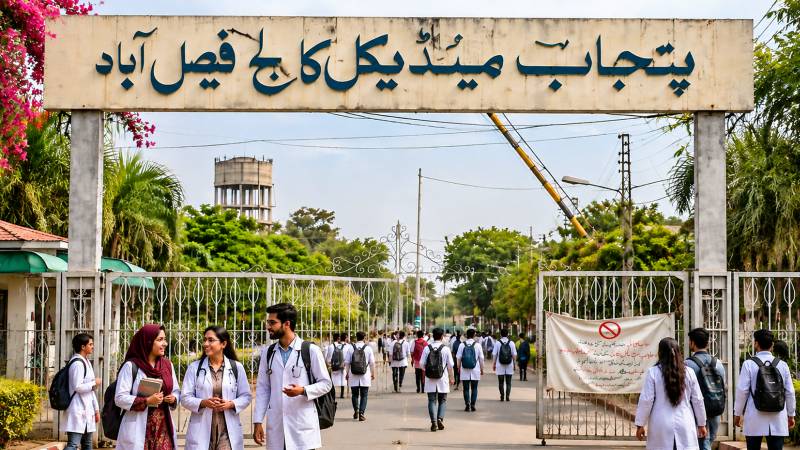
Some decisions may seem straightforward administratively but carry consequences beyond official paperwork. The proposed renaming of Punjab Medical College (PMC), Faisalabad, as Faisalabad Medical College is one such decision. I write as an alumna to explain why the existing name should be retained.
I have read Dr M Aamer Sarfraz’s piece in The Friday Times as well as The Express Tribune report on alumni opposition. I appreciate the historical and emotional connection to Lyallpur informing Dr Sarfraz’s argument. My contention, however, is different. This is not a debate about Faisalabad versus Lyallpur, nor am I advocating restoration of the city’s former name. Lyallpur was itself a colonial-era name. One could ask why not Sandalabad? But that would take us away from the actual issue: Punjab Medical College.
A medical college does not necessarily have to carry the name of the city in which it is located. Nor must a constituent college surrender its established identity when its administrative affiliation changes. The institutional history matters. Under the Faisalabad Medical University Act 2017, Punjab Medical College was reconstituted and upgraded as Faisalabad Medical University. The October 2026 Public Sector Medical Universities (Second Amendment) Ordinance subsequently restored the college as a constituent institution of FMU, but assigned it the name Faisalabad Medical College. It is this change of name not the college’s constituent status or its relationship with the university that alumni are contesting.
There is no inherent administrative contradiction in retaining Punjab Medical College as the name of a constituent college of Faisalabad Medical University. The university’s administrative authority and the college’s historical identity are distinct matters. The question is not whether the college belongs within FMU’s structure, but why its established name must be relinquished in the process. There is also a practical dimension. Thousands of graduates have Punjab Medical College recorded on their degrees, transcripts, CVs and professional profiles. Many have built careers in Pakistan and abroad under this name. Job applications, immigration procedures, professional registration and international credential assessments depend on consistency in educational documentation. Graduates should not have to explain repeatedly why the name on their degree differs from the institution’s current designation. Any change would require a credible mechanism guaranteeing documentary continuity and international recognition. Why create this complication when the existing identity can be retained?
Institutional attachment should not automatically be dismissed as sentimentality. Names acquire meaning through generations of students, teachers and graduates who carry them into their professional and personal lives.
This is not simply my personal apprehension. In my personal capacity, I contacted a good number of PMC alumni in Pakistan to understand their feelings about the proposed change. The responses were remarkably consistent: people are disturbed and saddened. Their reactions reflect attachment to an institution whose name remains part of their professional and personal identities. I do not claim to speak for every alumnus, but these conversations have reinforced my conviction that their concerns deserve to be heard. My association with PMC goes back to 1985–86, when securing admission to a medical college involved considerable competition. I eventually found myself at Punjab Medical College, and what followed was an education extending well beyond medicine.
I came from Islamabad. PMC introduced me to a Pakistan I had not known closely before. I learnt Punjabi and encountered its different dialects, discovered the wit and spontaneity of jugat baazi, and became familiar with everyday lives and social realities quite different from my experience of the capital. I encountered inequalities and contradictions, but also warmth, humour, generosity and resilience. Those years became an important part of my social education. As a young woman arriving from Islamabad, I encountered realities that formal education rarely captures. I did not simply study medicine in Faisalabad; I learnt to see Pakistan differently.
There is another academic distinction worth making. I graduated from Punjab Medical College when it was affiliated with the University of the Punjab. Our academic experience belonged to that wider university framework, alongside students from King Edward Medical College, Allama Iqbal Medical College, Fatima Jinnah Medical College and Rawalpindi Medical College. These institutions have traditionally enjoyed considerable prestige, yet PMC graduates competed in the same academic environment, and many performed exceptionally well. I did not graduate from a university established in Faisalabad; I graduated from Punjab Medical College, affiliated with Punjab University. This is part of the academic history under which I received my qualification.
I am not entering into a debate about medical college admission policies, reserved seats or quotas, or comparing graduates according to their admission pathways. Those are separate discussions. My concern is that an established institution should not lose its name without compelling reason, particularly when that name carries extensive academic and professional recognition. Institutional attachment should not automatically be dismissed as sentimentality. Names acquire meaning through generations of students, teachers and graduates who carry them into their professional and personal lives. This is especially true of professional institutions whose qualifications are recognised across borders.
I urge the Punjab government and relevant university authorities to reconsider the decision. Retaining Punjab Medical College as a constituent college of Faisalabad Medical University is a workable arrangement. It would preserve administrative coherence without compromising the college’s established identity or creating unnecessary uncertainty for graduates. PMC gave me much more than a medical education. It gave me a different understanding of Pakistan, its languages, people and social realities. I am proud to say that I studied and graduated from Punjab Medical College, Faisalabad. Thousands of others carry the same name in their professional and personal histories. Please do not take that name away from us. Punjab Medical College should remain Punjab Medical College.