

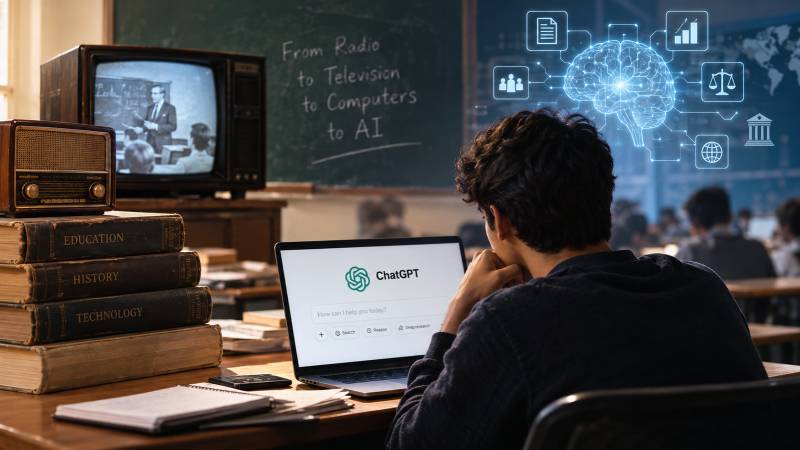
One evening, I was sitting on my sofa and scrolling through LinkedIn when a professor's post caught my eye. The message was clear and harsh: do not use AI in my class, and if I catch you, you will fail. At first, I understood the concern. Artificial intelligence can be misused. A student can ask a machine to write a full assignment, hand it in as their own work and learn nothing. A researcher can accept AI answers without checking them. A policymaker can trust a computer more than it deserves. These are real risks, and we should not ignore them. But the more I thought about that post, the more familiar it sounded. It was not really about artificial intelligence. It was the same argument we hear every time a new technology enters the classroom.
When radio came to schools, teachers worried it would weaken real teaching. When television spread, critics said students would only watch and stop thinking. In 1913, Thomas Edison went the other way and predicted that films would soon replace books in schools. Neither the fears nor the hopes came fully true. Each new technology found its place, and education adjusted. The machine changed every time, but the fear stayed the same.
Journalism has lived through the same story. When digital media arrived, many senior journalists rejected it. They said online news was shallow and unreliable, and some believed real journalism could only live on the printed page. Their worries were not baseless, because digital media did bring new problems. Yet journalism did not survive by rejecting the change. It survived by adapting to it. Today, you are reading this very article on The Friday Times' online platform. That is the reality. Change does not wait for our permission. We can resist it and fall behind, or accept it and use it for good. Telling students and new users to simply stop is not a solution. It only delays the inevitable.
AI is just the newest chapter in this old story. So the real problem may not be the technology. It may be that we are facing a new tool with an old way of thinking. We keep asking whether students should use AI. A better question is what students should be able to do when AI is always available. These two questions lead to very different classrooms. A student who uses AI to avoid thinking is not learning. But a student who uses it to test an idea, find the other side of an argument, compare policy options or improve a research question may be building useful new skills.
History gives us some comfort. Calculators did not make mathematics useless. Search engines did not close our libraries. Computers did not end writing. Each tool changed what people needed to do themselves, and AI will likely do the same. This matters a great deal for universities, because they cannot prepare students for a world without AI. That world is already gone. A public policy student who graduates today will join a government where AI is increasingly used to study data, handle documents, predict needs and sort public feedback. International bodies such as the OECD have recorded this shift, while also warning about bias, lack of transparency, privacy concerns and too much dependence on machines.
Now imagine a policy classroom that teaches students never to touch AI. They graduate, join government and are suddenly asked to manage a system that reviews public complaints or identifies poor households. What have we prepared them for? Banning the tool will not make the challenge go away. It will only leave our graduates unprepared when they face it.
The policymaker of the future, then, is neither the one who refuses AI nor the one who follows it blindly. It is the one who knows when to use it, how to question it and when not to trust it.
Instead, universities should teach AI literacy alongside normal research skills. Students should learn to question every answer a machine gives. What data is it based on? What assumptions are built into it? What evidence supports it, and what might be missing? Could it repeat the unfairness found in its data? Can its claims be checked? Asking these questions does not make students lazy. In fact, it makes them more careful and responsible thinkers.
The same idea matters even more in public policy. Governments have always had more information than any person can read, from reports and statistics to public opinions and past reviews. AI can help with this load. It can sort thousands of public comments on a draft law into clear themes. It can spot unusual trends across hundreds of districts in a development programme. It can help predict climate risks so that help reaches people before disaster strikes.
Still, one line must stay clear. AI should support policymaking; it should not replace human judgement. A computer can find a pattern, but it cannot decide what a society should value. It can compare options, but it cannot decide which choice is fair. It can summarise public opinion, but it cannot replace talking to the public. And it can predict an outcome, but it cannot decide whose needs come first. The policymaker of the future, then, is neither the one who refuses AI nor the one who follows it blindly. It is the one who knows when to use it, how to question it and when not to trust it.
This brings us back to the classroom and to how we test students. If an assignment can be finished by typing a question into a chatbot and copying the answer, perhaps the student is not the only problem. Perhaps the assignment needs to change. Instead of a general 2,000-word essay, a professor could ask students to write a policy proposal, explain their thinking, review an AI-written analysis, check its sources and defend their final answer in person. This would make cheating harder and thinking more important. Students would be judged not on how much text they produce, but on their judgement, which is exactly what a machine cannot provide alone.
None of this means allowing AI without rules. Universities need clear policies on plagiarism, fake references, data privacy, private information and honest disclosure of AI use. UNESCO has already issued guidance for AI in education, with a strong focus on ethics, fairness and human control. The answer, in short, is neither AI everywhere nor AI nowhere. It is responsible use.
The professor on my screen was trying to protect honesty in learning, and that goal deserves respect. But failing every student who uses AI mixes up the misuse of a tool with the tool itself. A student should never be rewarded for handing in machine-made work they do not understand. At the same time, a student should not be punished for using AI as a research helper, a thinking partner or a language editor, as long as the rules allow it and the student takes full responsibility for the final work.
In the end, every new technology makes us ask what real skill means. When information was rare, a good memory was power. When information became easy to find, the skill of finding and judging it mattered more. Now that machines can produce information in seconds, judgement, checking facts, original thinking and ethical reasoning have become the most valuable skills of all. Our task, therefore, is not to train young people to compete with machines at what machines do best. It is to teach them to question machines, guide them and use them wisely.
Radio did not kill education. Television did not empty the classroom. Digital media did not kill journalism, and the internet did not end research. AI does not have to destroy universities or policymaking either. But it may show us an uncomfortable truth. If our systems of learning and governance can be defeated by the arrival of one new tool, then perhaps it is the systems, not the tool, that need to change.