

Recent research by the United Nations Environment Programme (UNEP) shows that caring about the environment is more than just caring about our planet. It also involves saving lives, reducing medical expenditures, and building stronger modern-day economies. Climate change and air pollution are often addressed as separate issues, one of which is considered a global challenge, while the other is treated like a public health issue. However, both of these concerns are interrelated and can derive from the same sources, such as the burning of fossil fuels. Furthermore, both of these issues cause serious damages to people’s health and the world economy. For years, different governments worldwide have been discussing possible expenditures that would be necessary to deal with emissions and alternative energy sources. Nevertheless, a new global assessment indicates that the most important issue is not how much money might be needed, but how much is being lost due to inaction.
UNEP has published a significant report, Hidden Assets: The Economic and Health Case for Climate and Clean Air Action, through its Climate and Clean Air Coalition (CCAC). The report was published in 2026, and it investigates the economic and health advantages of taking action against climate change and air pollution at the same time. Its results are astounding. According to the report, not acting on time costs at least $1.5 trillion annually in economic and health benefits lost for the global economy approximately ten years later. These losses come from higher medical expenses, lower productivity, and other damages. In other words, the authors of the research prove that taking care of the environment cannot be treated only as an expense; it can be one of the best business investments made by governmental authorities.
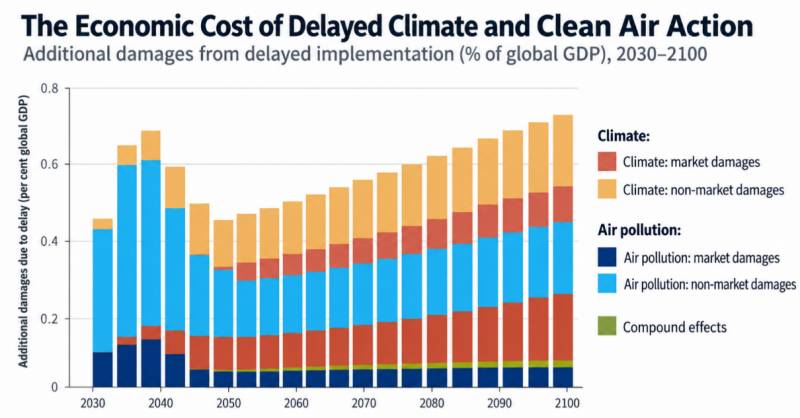
The Economic Cost of Waiting
The report brings to light several crucial findings, one of which is that actions to improve air quality and climate can lead to substantial financial benefits. UNEP has considered 25 methods that help to combat greenhouse gas emissions, improve the situation with dirty air, and slow down processes of global warming. These methods include the improvement of energy production technologies and energy consumption, shaping modern means of transport, and the introduction of sustainable practices in heavy industry, cooking, and waste management. The report finds that one invested dollar in these methods could generate about 15 dollars of economic profit during the study period.
This alters the perspective on climate action. Governments tend to postpone projects that benefit the environment because of their high costs. Making energy cleaner, improving transportation services, and decreasing industrial pollution all require a financial investment. In developing countries with tight budgets, these costs may seem unmanageable. However, as indicated by the UNEP study, delaying such investments will lead to even more costly consequences. The report shows that designing all 25 solutions will require a tremendous financial effort of $1.5 trillion yearly in the next ten years.
Governments do not have to wait decades to see a return on investment; economic and health benefits from reduced pollution are projected to exceed implementation costs by 2035
While this is a large number, the economic benefit each of these investments brings to the global economy is expected to be much bigger. This is because the assessment estimates that by 2035, the benefits will roughly equal about 2.8 per cent of global GDP, rising to 4.5 per cent by 2050 and then about 11.4 per cent by 2100. These are modelled estimates, not guaranteed returns. They will depend on how fully and quickly countries implement the proposed solutions.
The report also makes clear that time is important. Every year that action is delayed allows pollution to continue, increases the damage done by climate change, and lessens the benefits gained from earlier action. Therefore, simply postponing the investment does not constitute a savings of any kind: in many cases, it transfers the burden to future generations. This is a finding that should not go unnoticed by governments faced with burgeoning public debt, rising healthcare costs, and increasing climate risks.
Dirty Air Is Damaging Human Health and Economic Growth
The argument for clean air is even more persuasive when human health is taken into account. Air pollution goes beyond an environmental problem. It hinders people's work, study, and healthy living. It puts a burden on hospitals, forces the increase of medical payments, and lowers productivity. As stated by UNEP, as of 2025, exposure to outdoor fine particulate matter and ground-level ozone caused an estimated 6.4 million premature deaths globally. Indoor air pollution caused by dirty cooking by means of solid fuels accounted for about 2 million more deaths.
These numbers demonstrate the high human costs of air pollution. However, deaths represent only a part of the problem. Millions of people live with illness caused by air pollution. According to the report, the exposure to fine particulate matter PM2.5 causes approximately 5.5 million cases of childhood asthma and 4.2 million heart attacks a year. The evidence suggests that air pollution contributes to strokes, lung cancer, diabetes, dementia, and other diseases.
For families affected by these diseases, the consequences can include years of medical care, decreased profitability, and economic hardship. For governments, the impact could be higher demands for health systems or public spending. However, the economic consequences are not restricted to hospitals. When people are sick, they could be absent from work or even lose their jobs. Children with serious illnesses might be deprived of education. Families have to spend their money on healthcare instead of food, housing, or education. These expenses are usually ignored in traditional discussions about economic growth and progress. The report states that taking care of the population by improving air quality increases productivity and minimises losses to the economy. It establishes that the benefits of environmental activities could be received in a relatively short timeframe.
Governments do not need to wait until the 22nd century to reap the benefits of investing in the environment. Some benefits can already flow within a very short period. The UNEP calculates that the economic benefits arising from decreased illnesses and increased productivity will exceed the costs of implementing the necessary measures by the year 2035. The evaluation also indicates that the full implementation of the 25 measures proposed by the UNEP will save around 200 million premature deaths from air pollution and climate change by 2050, compared to the baseline modelled scenario. Although this projection is based on global-scale modelling, it serves to illustrate the human benefits that can arise from coordinated action. The main conclusion is that improving air quality coincides with economic development.
Why Developing Countries Have the Most to Gain
One of the relevant conclusions is connected with developing states. The majority of low- and middle-income states experience serious problems. The number of their people is growing, the demand for energy is rising, and industrial activity increases. Simultaneously, many of these countries lack financial resources and the necessary institutional abilities to regulate pollution effectively. Thus, the problem appears.
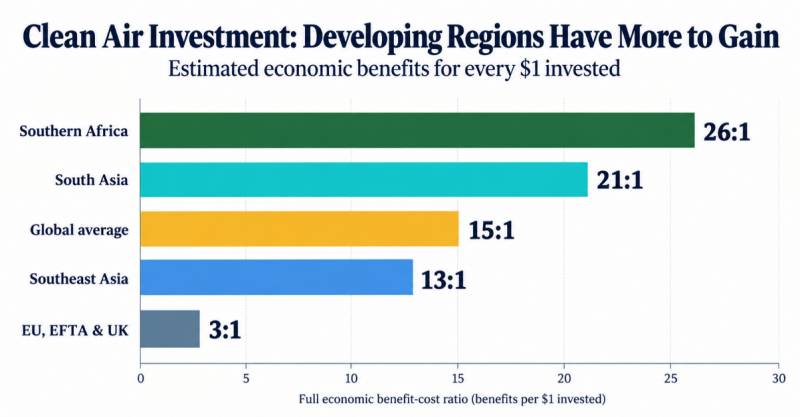
Economic development is vital, but pollution impedes realising all the advantages of development. According to the report released by UNEP, developing countries can generate considerable economic benefits by reducing pollution. It is believed that the benefit-cost ratio can be about 26 to 1 in Southern Africa and 21 to 1 in South Asia. It is nearly 3 to 1 in the EU, the EU member countries, and the UK. Regional differences reflect the health and environmental problems experienced by the developing regions. The results for South Asia are of particular importance.
Countries like Pakistan, India, and Bangladesh deal with a series of challenges like air pollution, energy demands, urbanisation, and climate change issues. These challenges have adverse effects on human health as well as economies. The report's estimate for South Asia cannot be perceived as an accurate prediction for Pakistan. But it has good reasons for the countries of the region to analyse how renewable energies and effective pollution management push growth. Pakistan is a case where increasing interest in solar energy and cleaner technologies can be observed. However, energy transition is not the only way to tackle all environmental problems. Many other factors must be taken into account, such as transport emissions, industrial emissions, waste management, and household energy use.
The primary impediments are often not technological. Rather, they are financial or institutional. Inadequate coordination among various governmental departments, a shortage of affordable financing, ineffective implementation, as well as the absence of long-term planning can hinder the progress in the field of ecological programmes. According to the authors of the report, barriers to implementation may sometimes lead to delays approximating 7.5 to 8 years in the whole world. The share of institutional obstacles is responsible for the number of these delays. This is very significant for developing countries because it can entail a rise in health and environmental costs and the loss of economic opportunities.
Therefore, the report emphasises the need for better institutions, planning, pollution monitoring, and cooperation. Furthermore, it stresses the importance of public awareness. Scientific research cannot help in solving ecological issues unless its results are communicated to industrial enterprises, governments, and communities clearly and usefully. Here, researchers, journalists, educators, and civil society can find ways to illustrate the impact of pollution.
Environmental action for developing countries should not be underpinned by an alternate combination of economic growth or a clean future. Rather, the evidence indicates that the two can indeed support one another—determined by how effectively the policies have been designed and implemented.
There is an overriding message from UNEP's assessment. The world already has much of the technology and policies needed to reduce pollution and moderate climate damage. It is unknown whether the governments will act rapidly enough to capitalise on the benefits. The cost of every year of delay is not just financial: it includes lost lives, lost opportunities, and pressure on coming generations. The question is no longer whether we can afford to invest in clean air and climate action, but whether we can afford to keep waiting.