

First we had the Strategic Mutual Defence Agreement (SMDA) between Pakistan and Saudi Arabia. Much fanfare followed it. Thinner than a reed, it nonetheless had one line that got tongues wagging: any armed attack on either country is considered an attack on both. Much airtime was wasted on what it meant.
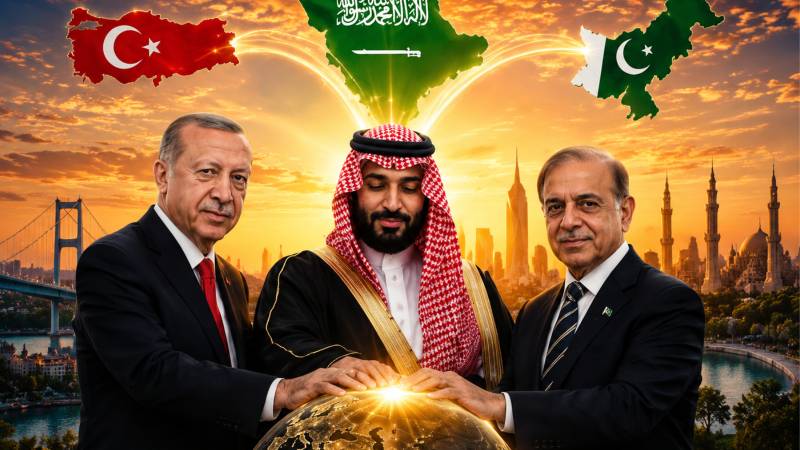
Now we have the trilateral Makkah Joint Defence Agreement (MJDA) between Saudi Arabia, Pakistan and Turkiye. Domestic drumbeating has a higher decibel level this time round. That is to be expected in an environment where the disconnect between internal disarray and external validation is growing and the dysfunction of the system has already been announced by the managers of the system themselves.
In a short assessment for Dawn published on October 5, 2025, I had made two basic points about the SMDA: one, “there’s more assuredness here in words than there’s likely to be in action” and two, “the government must begin a debate in parliament on both the SMDA and the Trump [Gaza] plan to rid the policy of its opacity and avoid…[making] Pakistan complicit in the US-Zionist genocide.” Mercifully, we didn’t hear much about the SMDA after the initial hyperventilation. Meanwhile, the United States in collusion with and on the goading of its Zionist master, attacked Iran on February 28 this year. That inflection point has changed the foundations on which the Gulf states had raised their security edifices. That process has not ended and its endpoint remains largely unknown.
What is currently known, as things stand, are two facts: the US-Zionist war has so far failed to achieve its strategic objectives; the premise on which the Gulf states had built their security and development model — the US will protect them — lies dead in the waters of the Gulf. In the backdrop of this on-again, off-again war we now have the MJDA. Like the SMDA, this one too represents a structural paradox. While its language is vague and details unavailable, it nonetheless headlines itself by declaring that an armed attack against any one of the three states shall be regarded as an attack against them all. This wording, predictably, has triggered immediate, widespread comparisons to NATO’s Article 5. That comparison is wrong as headline hype generally is since Article 5 is more nuanced in its collective defence obligations and is not grounded in automaticity. Our purpose here is to figure out, as best as one can in the absence of specifics and transparency, what to make of MJDA. How should this bird be drawn.
Legally and operationally, as it stands, it lacks the institutional depth, unified command structures, joint military planning, and integrated logistics required of a functional collective-defence alliance.
Theory is generally a good starting point and we have at least two models against which to test the MJDA: Glenn Snyder’s concept of alliances and Stephen Walt’s balance of threat theory. Snyder distinguishes clearly between different gradations of security cooperation: Alignments and Ententes, which are informal commonalities of interest or general diplomatic understandings; Agreements or Pacts, which are issues-based, transactional frameworks; Alliances, which are highly institutionalised, legally-binding treaties with explicit military triggers. This is how Snyder defines an alliance: Alliances are formal associations of states for the use (or nonuse) of military force, in specified circumstances, against states outside their own membership. He also stresses that “Alliances are associations with a military or security purpose.” So there’s an “‘other’ orientation” to alliances and they are different “from tacit ‘alignments' based solely on common interests.”
Alliances, under Snyder’s model, formalise “elements of specificity, legal and moral obligation, and reciprocity that are usually lacking in informal alignments.” In other words: The contract specifies, with varying explicitness, the identity of the opponent, what acts by the opponent will call for an alliance response, and what that response will be. Going by this, the MJDA introduces a paradox. Legally and operationally, as it stands, it lacks the institutional depth, unified command structures, joint military planning, and integrated logistics required of a functional collective-defence alliance. Yet, it deliberately borrows the absolute, high-commitment language of an alliance by using the “attack on one is an attack on all” clause.
If I were to take a charitable view of this paradox, I would call it deliberate ambiguity, almost a textbook resolution of what Snyder calls the alliance dilemma, the perpetual trade-off between the risk of abandonment (being deserted by your partner) and the risk of entrapment (being dragged into a war over your partner’s local interests).
Let me explain: By keeping the operational execution vague and omitting a mechanism for an automatic military response, the three states seek to maximise the deterrent image to minimise abandonment, while legally retaining the autonomy to decide their level of involvement and by so doing trying to mitigate the risk of entrapment. But before I take a less charitable view by raising the question — which should be the most obvious one — of who is this pact targeting or signalling to target, let’s bring in Walt.
Stephen Walt’s balance of threat theory further illuminates the fragile foundation of this trilateral arrangement. Walt argues that states form alliances not merely to balance against raw power, but to balance against perceived threats based on aggregate power, offensive capabilities, aggressive intentions, and geographic proximity (localised threats). He also speaks about bandwagoning, appeasing a much-stronger rival by aligning with it, but that is outside the scope of our discussion here. From the balancing perspective, the structural problem of the MJDA should be obvious. Its signatories face fundamentally different primary threats: Pakistan’s primary security matrix is South Asia (rivalry with India); Saudi Arabia perceives threats from Iran and its regional allies, especially Ansar Allah in Yemen; Turkiye’s security priorities are divided between NATO obligations, Kurdish insurgency, eastern Mediterranean geopolitics and increasingly its interests in Africa. Because their threat perceptions do not naturally overlap, the binding language of a military alliance would be strategically inappropriate for each participant — i.e., deliberate operational vagueness becomes a structural necessity.
Defenders and celebrators of the agreement argue that the trilateral configuration is a rational pooling of complementary capabilities. Okay! Let’s see. Saudi Arabia provides immense financial muscle, energy leverage, and strategic depth; Turkiye brings to the table an advanced, rapidly-growing defence-industrial complex and combat-tested technology (drone warfare systems); Pakistan contributes a battle-hardened conventional standing military and presumably a strategic (nuclear) deterrent. The simple question would be: why did the pooling of resources and capabilities require a sweeping, collective-defence clause? Exchange of technologies, joint exercises and strategic funding could have been executed through an agreement focusing on systems integration, technology sharing, and resource pooling without invoking a rhetorical collective security trigger. Upgrading the wording to simulate an alliance creates a dangerous expectation of mutual defence that none of the three states is structurally or politically prepared to fulfil.
But there’s also a deeper structural problem and it is grounded in alliance theory’s historical reliance on a dominant state to ensure durability. Successful military alliances have been woven around a hegemon: NATO relies on the overwhelming structural, nuclear, and economic dominance of the US; the Warsaw Pact was driven by the dictates of the Soviet Union. This is not new. Athens led the Delian League; Sparta the Peloponnesian League. The dominant state acts as the ultimate guarantor, establishing baseline rules, absorbing the primary costs of deterrence and enforcing compliance among junior partner states.
MJDA has no such hegemon. It is an arrangement among three independent, autonomous regional states. None of the three possesses a combination of economic heft, power projection capabilities, or geopolitical authority to dictate terms or underwrite the security of the other two even as each has something to offer. Without a central, dominant power to enforce obligations, the agreement remains vulnerable to fragmenting whenever the national interests of the states diverge during a crisis. The physical and domestic constraints of the three partners further erode the plausibility of a functioning alliance. Geographically, the MJDA spans three largely disconnected regions: the Eastern Mediterranean/Europe, the Arabian Peninsula and South Asia. Power projection across these vast distances requires strategic logistics capabilities. Unlike NATO’s contiguous European landmass or shared Atlantic maritime space, these three states cannot easily move hardware, personnel, or logistics to reinforce one another in a rapid-onset crisis. Doing so requires massive amounts of money but not just that; it also requires strategic airlift capabilities, air-refuelers and aircraft carriers.
Domestically, the political structures and vulnerabilities of each country create competing incentives that actively work against the alliance’s cohesion. Saudi Arabia is an absolute monarchy focused on perpetuating that system and making it work through economic transformation (Vision 2030). It views regional stability as an absolute prerequisite and is deeply embedded in the US security architecture precisely for this reason, to offset its perceived threat from Iran, the Axis of Resistance and internal challenges (a potential Arab spring). Recent violent disruptions caused by that policy is precisely the paradox Riyadh thinks it can address through the current arrangement. Equally, it cannot get dragged into a remote Pakistani or Turkish conflict because that would derail the very purpose of what it hopes to achieve through this arrangement. The contradiction inheres in how it approaches the MJDA.
Turkey is a highly polarised constitutional republic. Its foreign policy, especially under President Recep Tayyip Erdoğan, is tightly bound to domestic electoral calculations: Erdoğan’s War… by Gonul Tol explains in detail how Erdoğan uses external threats for domestic political legitimacy. Ankara also has its broader legal, institutional commitments to NATO. It cannot easily commit its military forces to non-NATO conflicts without undermining its own interests and even triggering a legal gridlock. Its primary focus is the Kurdish problem and resources in Eastern Mediterranean. It is also seeking to make major inroads into Africa.
Pakistan is a parliamentary democracy in form dealing with persistent domestic economic and political instability and internal and external security challenges. It already faces a three-front situation. The state is structurally incapable of absorbing the financial or military costs of an external conflict even as it has honed the art of rent-seeking from conflicts. Pakistan’s military establishment, which also sets the domestic political agenda, has historically prioritised its eastern border, rendering the deployment of troops to defend Turkish or Saudi borders politically and logistically unviable.
Much of this is theoretical. None of the three is going to get dragged into another’s conflict. That is precisely the point of this critique of MJDA’s language and all the razzmatazz. But there’s one more point that I did not bring up deliberately so far. It is also the central and the most critical question: who is the “other” in this alliance? An alliance, by definition, requires an adversary to justify its existence. Yet, this trilateral alignment cannot be directed against the US or the Zionist entity. All three signatories of the MJDA are embedded within the global US security and economic architecture in varying degrees. None is about to break free of that entanglement. Turkey is a NATO member and needs the US; Saudi Arabia relies on the US-Saudi Strategic Defense Agreement and remains anchored to Washington’s security umbrella and US/Western financial investments; Pakistan relies heavily on Western financial institutions for economic survival and maintains deep, historical institutional ties with the US military apparatus.
From the balancing perspective, the structural problem of the MJDA should be obvious. Its signatories face fundamentally different primary threats: Pakistan’s primary security matrix is South Asia (rivalry with India); Saudi Arabia perceives threats from Iran and its regional allies. Turkiye’s security priorities are divided between NATO obligations, Kurdish insurgency, eastern Mediterranean geopolitics and increasingly its interests in Africa.
Using the process of elimination, the unspoken target of this arrangement, particularly from the Saudi perspective, is Iran and the Axis of Resistance. Saudi analysts continue to dance around this question but that fact is undeniable. Driven by escalating regional conflicts that have threatened Saudi oil exports and infrastructure, Riyadh views the pact as a necessary mechanism to counterbalance Iran. If the alliance is fundamentally aimed at containing Iran, it sets up a major strategic conflict of interest with Tehran’s grand strategy. For decades, Iran’s overarching objective has been to force the US out of its geographic proximity and by so doing establish a regional order free of US-led power projection. To that extent, the MJDA emerges as an adversary to this Iranian vision, but through a distinctly different method. The trilateral pact appears to signal to Tehran that even if the US security guarantees begin to dwindle, Iran will not inherit a power vacuum. It will face a coordinated wall of regional (Sunni) powers possessing nuclear deterrence, advanced drone technology, and financial capital.
This vision, specifically Saudi, creates (should) a strategic problem for Pakistan, a fact those celebrating and touting this agreement seem to ignore, wittingly or unwittingly. Pakistan shares a direct land border with Iran, hosts the largest Shia minority embedded in the country’s power structure, and has historically maintained a strict policy of neutrality in the Saudi-Iran rivalry to prevent domestic sectarian spillover. Committing to an alliance that could potentially act as a containment wall against Iran is not strategically viable for Islamabad.
It is actually good that the MJDA has more bark than bite. If it has to be celebrated, let’s celebrate it as strategic hedging than a meaningful military pact. Its “attack on one is an attack on all” language is a rhetorical tool meant to project deterrence while deliberately remaining vague to prevent entrapment. Put another way, just like the bilateral SMDA, it functions more as a flexible political signal and potential economic-military exchange than a rigid, integrated security regime. It utilises calculated ambiguity to satisfy distinct national interests rather than following strict alliance theory models. It is good that Pakistan has read Iran into what this pact means for Islamabad, and Tehran, for its part, has chosen to ignore the Saudi perspective and described it as replacing “reliance on [the] US.” Iran has also updated Islamabad on progress in its dialogue with Oman over arrangements for navigation through the Strait of Hormuz. Pakistan, meanwhile, persists in mediating the conflict.
Here’s the gist: by analysing the structural requirements of alliances, the necessity of a dominant state, the divergence of threat perceptions and the constraints of domestic political structures, it becomes evident that the MJDA is a paradoxical instrument. It projects a facade of collective security while managing, by design, entrapment risks and operates strictly within, rather than as a substitute for, the prevailing US security architecture. For Pakistan, there’s a lesson here and it is grim, not celebratory. The country is basically Jack in search of the beanstalk, constantly looking for money because it can’t generate enough at home. Regardless of the narrative of external victories, if it can’t generate money through its own resource management, it will remain fragile and pander to interests other than strictly its own.