


It would, however, be misleading to attribute the poor performance of the property tax system principally to the behaviour of tax collection staff. There is considerable evidence that the low-level equilibrium that we observe stems in large part from the relative lack of interest of various levels of government in property tax revenue, and the priority they give to keeping the levels of government below them dependent or disempowered — Understanding Low-Level State Capacity: Property Tax Collection in Pakistan, Mujtaba Piracha & Mick Moore.
Policy flaws in sub-national property tax collection include outdated property valuation tables; taxation based on rental value instead of the capital value of properties; and multiple exemptions and preferential treatments within the property tax regime — Pakistan Fiscal Crisis, Naghma-e-Tehniat Jerral.
Property tax collection in the Punjab is roughly a fifth of the level of comparable countries both in terms of the proportion of total local revenues and as share of GDP. It is estimated that with comprehensive reform, property tax revenue for Punjab can increase to almost 25 billion — Reforming the Urban Property Tax in Pakistan’s Punjab, International Growth Centre.
Pakistan, since its inception, has been facing significant challenges in balancing the distribution of power and fiscal responsibilities between its federal and provincial governments. The Constitution (Eighteenth Amendment) Act, 2010 [18th Amendment], effective from 19 April 2010, was aimed at decentralising governance by devolving more powers to provincial governments. It sought to promote provincial autonomy, enhance democratic governance, and allow establishment of local governments with political, administrative and financial powers for addressing residents’ socio-economic needs at grass-root level.
While the devolution of power was an important step towards empowering provinces, its financial implications have drawn substantial criticism as provinces have miserably failed to mobilise the revenues as per their actual potential and devolve powers in terms of Article 140A of the Constitution of Islamic Republic of Pakistan. The municipal governments in big urban centres, if empowered, can meet the basic needs of residents from collection of property and other related taxes.
The legitimate expectation behind the 18th Amendment was that provinces would gradually reduce their financial dependency on the federal government by strengthening their local revenue sources. The idea was that with greater autonomy, provinces would be able to generate enough revenue to cover their expenses without relying on the federal government’s contributions.
However, even after a little more than 15 years, this goal remains unfulfilled. Instead of reducing their reliance on federal transfers, the provinces continue to depend heavily on funds allocated through the Seventh National Finance Commission (NFC) Award. The NFC, a body to ensure an equitable distribution of fiscal resources, has failed to deliver a new award after 2009.
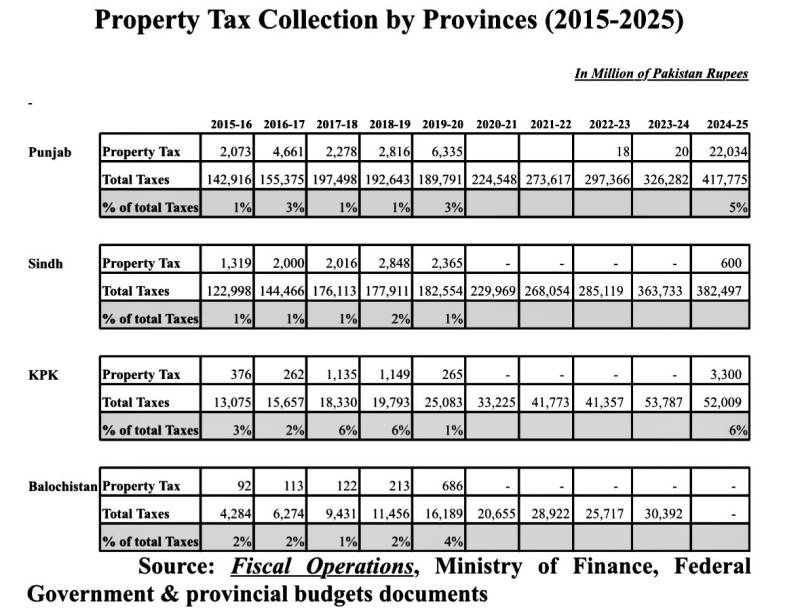
The Federal Government in Budget 2025–26 has not declared any income from property tax but has shown total administrative receipts of ICT at Rs. 16.775 million for the fiscal year 2024–25
The above situation has left the federal government with insufficient resources to meet its obligations, leading to enormous borrowing and an unsustainable fiscal path. The provinces, on the other hand, are collecting taxes as little as 0.7 per cent of total GDP of the country.
The collection of property tax on urban immovable property by all the provinces and the Federal Government in Islamabad Capital Territory (ICT) is pathetically low, as evident from the table below in respect of provinces. The Federal Government in Budget 2025–26 has not declared any income from property tax but has shown total administrative receipts of ICT at Rs. 16.775 million for the fiscal year 2024–25.
The growing financial disparity between the federal and provincial governments has sparked a wider debate on the need for comprehensive institutional and structural reforms. As the current distribution of fiscal powers and responsibilities remains lopsided, there is an urgent need to recalibrate the system to ensure a fairer, more sustainable arrangement.
To address these issues, the Government of Pakistan is currently implementing a National Fiscal Pact (NFP), a framework developed in accordance with the International Monetary Fund's (IMF) guidelines to reform the fiscal relationship between the federal and provincial governments.
The aim of the NFP is to create clearer guidelines for fiscal responsibility, revenue sharing, and resource allocation, ultimately improving the provinces’ ability to mobilise revenue and contribute to fiscal consolidation efforts.
Under the terms of Pakistan’s US$7 billion, 37-month Extended Fund Facility (EFF) agreement with the IMF, the government has made several commitments. One key aspect of the NFP is the redistribution of fiscal responsibilities between the federal and provincial governments.
The federal government has agreed to devolve certain spending responsibilities to the provinces, in line with the allocations set out in the 18th Amendment. This includes additional contributions to areas such as higher education, health, social protection, and regional infrastructure investments. At the same time, the provinces have pledged to increase their efforts to collect taxes, particularly agricultural income, property taxes, and sales tax on services.
By implementing a more comprehensive and standardised system of agricultural taxation, provinces can ensure that tax policies reflect the economic value of agricultural production
The NFP has two broad objectives: improving revenue generation and rationalising spending. On the revenue side, provinces are expected to reform taxation on property, sales tax on services, and the much-neglected income tax collection from agriculture. This is expected to boost provincial revenues and help meet fiscal consolidation targets.
By implementing a more comprehensive and standardised system of agricultural taxation, provinces can ensure that tax policies reflect the economic value of agricultural production. While there may be concerns that such reforms could place an undue burden on small farmers, the aim is to ensure that the tax system is fair and does not allow for exploitation or tax evasion.
On the expenditure side, the NFP encourages provinces to increase their contributions to federally supported programmes, such as the Higher Education Commission (HEC). It also envisions a gradual increase in spending on health and education, which would require both the federal and provincial governments to work together to align resources more effectively.
Furthermore, the NFP advocates for a review of social protection programmes to identify and eliminate redundancies, ensuring that public funds are used efficiently to address the needs of vulnerable populations. As part of these fiscal reforms, both the federal and provincial governments will need to ensure that spending aligns with broader fiscal objectives and resources are allocated in a way that maximises social welfare.
The NFP requires strong political commitment to succeed. The process is not easy, as it requires overcoming entrenched political interests and building consensus across various levels of government. There is an urgent need to pay attention to the political economy of fiscal decentralisation, especially in provinces where political instability or poor governance are hindering effective revenue mobilisation and public spending.
Pakistan’s fiscal and digital reforms represent vital steps towards modernising the country’s economic and financial systems. While the NFP offers the potential for improved fiscal management and revenue generation, it faces political and logistical hurdles that must be overcome.
As elaborated in detail by Naghma-e-Tehniat Jerral in Pakistan Fiscal Crisis, the provinces can raise considerable revenues from big urban centres by reforming the property tax regime on the following lines:
"The reform of property taxation policies and administration could generate significant tax revenues at the sub-national level. This can be achieved by aligning property valuation tables to current market values on a bi-annual basis (currently even the gain within four to five years remains untaxed due to the non-revision of valuation tables). Government could prioritise revaluation of annual rental values and proceed later to using capital value instead of rental value for taxation. The focus could be on improving the policy and legal framework to ensure that growing peri-urban settlements outside current notified municipal boundaries are also subject to appropriate land taxation."
Besides fundamental structural reforms, promoting digital literacy is an extremely critical step. Comprehensive training programmes and public awareness campaigns are a prerequisite to help businesses and individuals understand and utilise digital tools effectively. Alongside this, investing in digital infrastructure is paramount. Expanding reliable internet access and upgrading IT infrastructure, such as data centres and cybersecurity measures, will support seamless digital transactions and monitoring. The federation and its federating units will have to coordinate swiftly and closely to achieve these goals.
Digitisation can transform the overall financial environment, benefitting the smaller provinces in a big way. It, however, requires careful planning and regulation to mitigate associated risks. Ultimately, the success of these reforms will depend on the collective ability of federal and provincial governments to navigate complex political, economic, and technological challenges, ensuring that both fiscal and digital innovations contribute to the long-term stability and prosperity of Pakistan.