

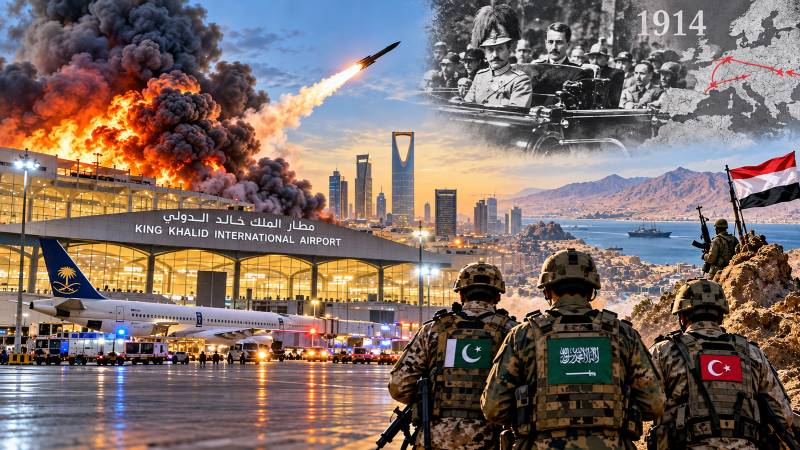
In July 1914 the average European believed the interlocking alliances that bound the continent were a source of stability. Trade was global, the royal houses were related, and every capital assumed that the threat of wider war would keep the others in check. Then Gavrilo Princip shot Archduke Franz Ferdinand in Sarajevo. Austria-Hungary received its blank cheque from Berlin, issued an ultimatum to Serbia, and watched Russia mobilise. Germany’s Schlieffen Plan, designed for speed, dragged France and Britain into a war none of the original decision-makers had wanted. Local violence in a peripheral theatre became continental catastrophe because the alliances left no room for partial response.
The Middle East today is assembling the same machinery. The Makkah Defence Alliance: Saudi Arabia, Turkey and Pakistan - has written into its structure the principle that an attack on one is an attack on all. Opposite it sits a looser UAE-Israel alignment with Indian economic weight and residual American security ties. Between the two blocs operates a non-state actor, the Houthis, backed by Iran and holding the Red Sea coast, the port of Mocha, and the ability to strike deep into Saudi territory. Like the Black Hand, they are not a great power. They are, however, capable of an act that forces the larger states to choose between the credibility of their commitments and the costs of honouring them.
The missile strike on King Khalid International Airport on 10 October 2026 is that act. Twelve or more dead, including foreigners, and more than three hundred wounded is not a border skirmish. It is an attack on the capital of the alliance’s financial centre and on the civilian infrastructure that underpins the kingdom’s economic transformation. A second projectile the following day confirmed the pattern. The Houthis have already shown they can hit energy facilities and airports. They have now shown they can do so with lethal effect in the capital itself. Saudi Arabia has responded by activating the alliance; Pakistani and Turkish forces are being deployed. This is the logic the pact was written to enforce.
It is also the logic that makes escalation difficult to contain. Pakistan maintains a long-standing military presence in the Kingdom and has received Saudi financial support for decades; it has every incentive to demonstrate solidarity. Turkey brings industrial capacity and NATO-compatible formations. Neither, however, possesses a vital national interest in occupying northern Yemen. Estimates put Houthi forces near 350,000, operating in mountainous terrain with underground facilities. Conventional military arithmetic suggests an attacker needs a substantial force ratio - often cited as three-to-one, higher still in mountains - to seize and hold such ground. The combined manpower of the three allies, plus the internationally recognised Yemeni government, does not comfortably meet that threshold. Air campaigns and blockades have been underway since 2015; they have not dislodged the Houthis from the areas that control Bab el-Mandeb. Egypt learned a similar lesson between 1962 and 1970, when Nasser committed roughly 70,000 troops to Yemen, suffered heavy casualties, and emerged weaker for the 1967 war with Israel. The terrain and the defender’s advantages have not changed.
The question is whether the next lines are drawn by deliberate restraint or by the same interlocking logic that turned a Balkan spark into a continental war.
The parallel with 1914 is structural rather than identical. Austria-Hungary did not want a general European war when it moved against Serbia; it wanted a limited victory that would restore prestige. The blank cheque and the rigidity of the alliance system removed the limited option. In the same way, Saudi Arabia does not need a ground invasion of Yemen to protect its airports and energy infrastructure. It needs the attacks to stop. Yet once the alliance is activated and forces are deployed, domestic and external pressure will favour visible action. Further Houthi strikes become more likely. Iranian support for the Houthis is instrumental rather than absolute, but Tehran retains the capacity to encourage or restrain them.
If the Makkah partners commit ground forces and Iran treats that commitment as a threat to its remaining regional leverage, the conflict can widen. Pakistan already manages a difficult border with Iran. Turkey has interests in Syria and the Eastern Mediterranean. India closely watches any Pakistani entanglement that touches the UAE-Israel alignment. The United States, which has so far limited its direct role, faces pressure from the simple fact that American citizens were among the dead and from the reality that simultaneous pressure on Hormuz and Bab el-Mandeb would transmit effects into the global economy within days.
Nuclear weapons raise the cost of the final step, but they do not eliminate the intermediate ones. In 1914 the powers possessed no nuclear deterrent yet they still managed to produce a war that destroyed the European order. Today the risk is not automatic general war. It is a sequence of limited but cascading commitments - proxy reinforcement, maritime interdiction, limited strikes - that become harder to reverse once the alliances have been invoked. Geography retains its veto. The Houthis control or threaten the southern approaches that matter for Red Sea traffic. Saudi Arabia cannot indefinitely absorb strikes on its capital while its partners debate the terms of mutual defence. The only realistic exit remains negotiation: a settlement that limits Houthi attacks on Saudi territory in exchange for reduced air campaigns and some recognition of facts on the ground. The United States demonstrated in 2023 that talks could pause shipping attacks once the costs rose high enough. The same calculation applies now.
The map of the region has already been redrawn by the Iran war. The question is whether the next lines are drawn by deliberate restraint or by the same interlocking logic that turned a Balkan spark into a continental war. The Riyadh Airport attack is not yet that spark. It is, however, the clearest demonstration yet that the conditions for one exist. These are: rigid commitments, an asymmetric actor capable of forcing a response, and chokepoints that transmit local violence into global costs.