

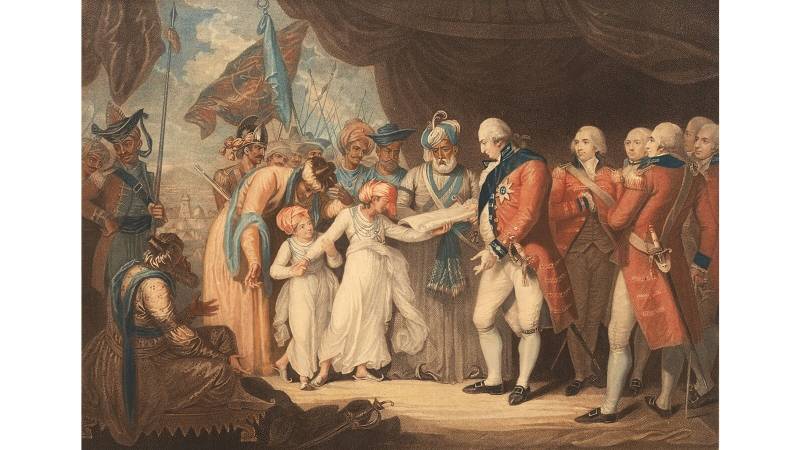
Usually, a commander who surrendered his troops in battle and ceded his country’s territory to the enemy is captured and imprisoned by the enemy. If he is freed or ransomed, he returns to face humiliation at home, is put on trial and possibly court-martialled, and his image is forever tarnished in history. Charles Cornwallis may be the only exception to that rule.
In the late 1980s, I found myself standing on hallowed ground in colonial Williamsburg, Virginia. What I saw there was so riveting that I returned to stand on that ground at least thrice in the decades that followed.
The landscape is dotted with wooden fences, cannons, tents, trenches, and stakes to prevent the adversary from invading. The timber palisades, earthworks, redoubts, and batteries hearken back to another era.
When I began traversing the walkways that crossed the battlefield, I felt like I was travelling back in time. At some point, I arrived at that juncture in history when Generals Washington and Cornwallis faced each other in an epic battle that would lead to the birth of the United States of America.
The setting was pastoral, calm, and serene, punctuated only by the sight and sounds of the waters of the York River. The setting belied the fact that upon a fateful date in history, the green landscape had turned red. That thought sent shivers down my spine, endowing the scene with pathos and depth.
Nearby was the Moore House, where the terms of surrender were dictated by the Americans and French to the Redcoats. The air must have been pregnant with emotion when that took place.
The battle, which began on the 28th of September 1781, culminated on the 19th of October 1781. Earl Charles Cornwallis, Lieutenant General of the British Army, surrendered to American Continental Army troops led by General George Washington and French Army troops led by Comte de Rochambeau. That ignominious defeat forced the once-invincible British Empire to negotiate an end to the conflict and to depart from the 13 British colonies along the Atlantic Ocean, giving birth to the United States of America.
More than 7,000 British soldiers were taken prisoner by a ragtag army of American rebels or patriots, depending on your point of view. The surrender of America led to serious negotiations between the fledgling United States and the long-established British Empire, resulting in the Treaty of Paris on the 3rd of September 1783, through which the US was granted its long-sought independence, seven years after the Declaration of Independence.
In a prisoner swap, Cornwallis was returned to Great Britain as a prisoner on parole. He had served in America for roughly five and a half years from 1776 to 1781, but was probably expecting a wretched homecoming.
Instead, as one analyst put it, “the church bells began to ring to celebrate his safe return, bystanders cheered him all the way, he was chaired shoulder high through the streets of Exeter, in London his uncle Frederick Cornwallis, who happened to be the Archbishop of Canterbury, rang the bells of Lambeth Palace. As the future Admiral Jervis remarked, 'no person was ever so popular in misfortune as he.' Charles Cornwallis may have lost America, but he had not lost his fan base.”
He had to endure public inquiries in Parliament but emerged unscathed. In 1786, he was knighted and appointed Governor-General of India. The house in which Cornwallis lived as Governor-General of India was far more spacious and grand than the modest Governor’s Palace in Williamsburg, home to the Royal Governors of the Colony of Virginia.
War of Pamphlets and Political Survival
How did this amazing transformation come about? The story of Lord Charles Cornwallis after Yorktown seems counterintuitive at first glance, but his warm reception, knighthood, and high-profile appointment to India can be traced to three factors: political scapegoating, his personal reputation, and royal favour.
In a remarkable reversal of fortunes, Cornwallis wasn’t blamed for the defeat. In Britain, the loss at Yorktown was not attributed to Cornwallis’s incompetence, but rather to the failures of the broader military command and naval isolation. Public and political blame largely fell on his superior officer, General Sir Henry Clinton, and the First Lord of the Admiralty, Lord Sandwich, for failing to coordinate and resupply him via the Royal Navy.
The church bells began to ring to celebrate his safe return, bystanders cheered him all the way: Charles Cornwallis may have lost America, but he had not lost his fan base
The surrender at Yorktown in October 1781 sparked one of the most famous, bitter, and public exchanges of accusations in British military history. Sir Henry Clinton (Commander-in-Chief of British forces in North America) and Lord Cornwallis (his second-in-command) engaged in a protracted “war of pamphlets” to escape personal responsibility for losing the American colonies.
Clinton argued that Cornwallis had acted rashly by abandoning the Carolinas to march north into Virginia without explicit permission, overextending the army and creating an unnecessary second front. Cornwallis countered that Clinton had ordered him to secure a deep-water naval post on the Chesapeake Bay. Cornwallis maintained that Yorktown was chosen to satisfy Clinton's instructions, despite being difficult to fortify against a combined land-sea siege.
Cornwallis heavily blamed Clinton for promising that the Royal Navy and reinforcements would arrive from New York, keeping Cornwallis pinned at Yorktown rather than breaking out while he still had the chance. Clinton blamed naval delays on Admiral Thomas Graves and argued that Cornwallis surrendered prematurely.
Upon returning to England, Clinton published Narrative of Lieutenant-General Sir Henry Clinton (1783), publicly shifting the entire blame for the catastrophe onto Cornwallis. Cornwallis immediately responded with his own pamphlet, An Answer to that Part of the Narrative of Lieutenant-General Sir Henry Clinton, publishing their private wartime correspondence to prove he was merely following Clinton's vague and contradictory directives.
Because Cornwallis enjoyed strong political connections and royal favour with King George III, the public and Parliament largely took his side. Clinton was disgraced and denied further command, while Cornwallis emerged with his reputation intact.
Ultimately, Yorktown was treated as a tactical setback in a complex global war rather than a career-ending disgrace, allowing Cornwallis to build a legacy as one of the most influential figures in the establishment of the British Raj.
Cornwallis had a great public image, even before he was sent to America. At home, he was widely viewed as an aggressive, courageous, and energetic commander who was trapped by circumstance and bad strategy higher up the chain. Upon his return, the British public and press greeted him as a hero rather than a failure.
Reforming the East India Company
Another factor that helped him was his aristocratic status in class-conscious Britain. Cornwallis was not an ordinary officer climbing the ranks. He was an Earl with deep political connections and direct access to King George III. King George III held Cornwallis in high regard and remained convinced of his integrity and competence. He was made a Knight of the Garter in 1786, five years after the surrender at Yorktown, and appointed Governor-General of India largely because the British government trusted his character to reform the East India Company.
By 1786, the British East India Company was in crisis. Its previous Governor-General, Warren Hastings, was being impeached for rampant corruption and misrule. The British government desperately needed a specific type of leader in India. Because Cornwallis was an aristocrat with independent wealth and personal honour, he could not easily be bribed or bought off by Company officials. He was above corruption. And the British Crown thought he was the only person who could simultaneously serve as the Governor-General (civil authority) and Commander-in-Chief (military authority) to streamline governance and military strategy in the region.
Cornwallis did not disappoint the British Crown. When he arrived in Bengal in 1786 as Governor-General and Commander-in-Chief, the British East India Company was plagued by administrative chaos and corruption. Cornwallis instituted a sweeping series of legal, administrative, and economic reforms that laid the groundwork for the British Raj.
He established the “Cornwallis Code” and reformed the civil service to curb bribery. Cornwallis overhauled the judicial and civil administration to replace systemic bribery with the institutional rule of law. He separated revenue administration from judicial authority. Collectors, who previously acted as both tax gatherers and judges, were stripped of judicial powers. He established a structured court system: District Courts (Zilla Courts), presided over by European judges; provincial courts of appeal in major cities (Calcutta, Murshidabad, Dacca, Patna); and Sada Diwani & Nizamat Adalat, the supreme civil and criminal courts in Calcutta. He also relieved local zamindars of police duties and established regular police circles (thanas), each headed by an Indian official (daroga), under the control of the District Magistrate.
He also introduced what was called the Permanent Settlement of land revenue. This was Cornwallis's most significant—and controversial—economic reform. It fixed the land revenue (zamindari) assessments in Bengal, Bihar, and Odisha in perpetuity. Local tax collectors (zamindars) were transformed into official landowners, provided they paid a fixed annual tax to the East India Company. While it provided the Company with a stable, predictable revenue stream, it led to the oppression of peasant cultivators (ryots), who lost traditional land rights and were left at the mercy of landlord exploitation.
To combat widespread corruption, Cornwallis raised salaries for East India Company officials while strictly forbidding them from engaging in private trade or accepting bribes.
Institutional Racism and Later Years
However, while he created the institutional framework that evolved into the Indian Civil Service, he systematically excluded Indians from high-ranking civil and military offices, believing that European administration was necessary to enforce integrity. High administrative positions were reserved exclusively for Europeans, a policy that persisted for decades. This racist element would tarnish the image of the British Raj for decades.
On the 19th of April 1791, Cornwallis issued a standing order which stated, “No person, the son of a Native Indian, shall henceforward be appointed by this Court to Employment in the Civil, Military, or Marine Service of the Company.” The American historian Franklin Bacon Wickwire argued that through this policy Cornwallis “institutionalized racism.” He also prevented the sons of European fathers and Indian mothers from becoming army officers, writing that “as on account of their color & extraction they are considered in this country as inferior to Europeans, I am of opinion that those of them who possess the best abilities could not command that authority and respect which is necessary in the due discharge of the duty of an officer.” He thought India’s inhabitants were best suited to being permanent subjects of the British Empire.
A Legacy Across Three Continents
On the military front, by defeating Tipu Sultan of Mysore in the Third Anglo-Mysore War, he vastly extended Britain’s control over India. So, a man who lost 13 British colonies in America went on to extend Britain’s rule in India. His first term in India ran from 1786 to 1793. He returned for a second term in July 1805 but died from a fever just three months later. He is buried in Ghazipur, Uttar Pradesh.
Cornwallis is regarded as one of the Top Three Britons to have governed India, the other two being Warren Hastings and Lord Dalhousie. Each transformed British rule through fundamental administrative, legal, or political changes. Hastings was the first Governor-General of Bengal and laid the structural foundations of British rule in India. He abolished the dual system of governance and brought administration directly under the East India Company. He established the civil and criminal court system (Diwani and Nizamat Adalat) and introduced tax collection machinery. And he consolidated Company power through key military and diplomatic conflicts (including the First Anglo-Maratha War and the Second Anglo-Mysore War).
Lord Dalhousie is considered the “Maker of Modern India” due to his drastic territorial expansion and infrastructure development. He annexed several key princely states (e.g., Satara, Jhansi, Nagpur) if a ruler died without a natural male heir, triggering widespread resentment that led to the Revolt of 1857. He also introduced passenger railways (1853), the electric telegraph network, and modern postal services across India. And he established the Public Works Department (PWD) and promoted modern education.
As for Cornwallis, in between his two appointments in India, he served as Lord Lieutenant of Ireland and Commander-in-Chief. His tenure lasted from 1798 to 1801. He was appointed to restore law and order during the Irish Rebellion of 1798. In 1800, he passed the Acts of Union which combined the Kingdom of Great Britain and the Kingdom of Ireland into the United Kingdom.
Among British leaders, only Cornwallis has the distinction of serving Great Britain on three continents. He did more to re-energise the British Empire than any of his contemporaries. He was an essential figure in ensuring its longevity and extending its reach across the globe, turning it into “the empire on which the sun never sets.” It was a complete reversal of fortunes for a man whose future seemed bleak after his humiliating surrender at Yorktown.