

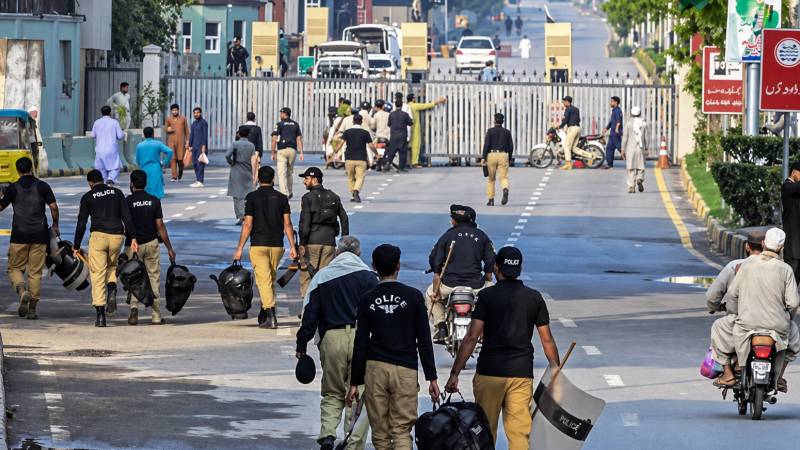
Pakistan’s decision to impose emergency measures and Governor’s Rule in Khyber Pakhtunkhwa raises a question more consequential than whether the federal government can outmanoeuvre the Pakistan Tehreek-e-Insaf (PTI): can the state confront a security crisis without turning constitutional authority into an instrument of political conflict? The government has a duty to protect citizens, but extraordinary intervention must be lawful, necessary and proportionate. PTI has the right to defend its electoral mandate, but political confrontation cannot substitute for effective governance. Meanwhile, the people of Khyber Pakhtunkhwa continue to bear the consequences of insecurity and institutional failure.
On 11 October 2026, President Asif Ali Zardari approved the federal government’s decision to proclaim an emergency and impose Governor’s Rule under Articles 232 and 234 of the Constitution. The government cited deteriorating security and what it described as the provincial administration’s disengagement from counterterrorism efforts. PTI rejected the intervention as an assault on its electoral mandate and provincial autonomy. These competing claims require scrutiny. Neither the gravity of the security situation nor the strength of an electoral mandate, on its own, resolves the constitutional question.
Khyber Pakhtunkhwa’s crisis cannot be reduced to a dispute between Islamabad and PTI. Militancy, attacks on law-enforcement personnel, displacement and economic insecurity have imposed a persistent burden on its citizens. The province’s proximity to Afghanistan compounds an already difficult security environment. Counterterrorism requires intelligence-sharing, operational coordination, adequate resources and cooperation between federal and provincial authorities. If that cooperation has broken down, the consequences are serious. But a deteriorating security situation does not automatically establish that extraordinary constitutional intervention is either lawful or effective.
The distinction between Articles 232 and 234 is fundamental. Article 232 provides for an emergency in specified circumstances, including an internal disturbance beyond the power of a provincial government to control. Its constitutional proviso requires a resolution of the Provincial Assembly for an emergency proclaimed on that ground. Article 234 addresses a different situation: the failure of constitutional machinery in a province. It provides for presidential action on receipt of a report from the Governor, subject to the conditions specified in the Constitution. Each provision has its own requirements and consequences.
The government must therefore establish the precise legal basis of each proclamation, demonstrate compliance with the applicable procedures and explain the evidence supporting its decision. In particular, the relevant Assembly resolution, the Governor’s report and the parliamentary approval requirements must be addressed in accordance with the constitutional route invoked. Parliament must scrutinise the proclamations within the prescribed periods. The existence of constitutional powers does not settle whether their exercise meets the conditions governing them. That question must be answered through evidence, law and institutional oversight.
Pakistan’s constitutional history reinforces the importance of such scrutiny. Extraordinary measures have repeatedly been justified by exceptional circumstances, sometimes leaving political and institutional consequences long after the immediate crisis has passed. The lesson is not that the state should remain passive when citizens face danger. It is that emergency powers must be judged by their legal foundation, necessity, duration and results. An intervention that weakens public confidence or deepens political exclusion may create a second crisis while attempting to address the first.
Provincial autonomy does not immunise a provincial administration from scrutiny, nor does national security give the federation an unrestricted licence to intervene.
Federalism requires accountability at both levels of government. Provincial autonomy does not immunise a provincial administration from scrutiny, nor does national security give the federation an unrestricted licence to intervene. If provincial authorities have failed in their constitutional responsibilities, the evidence must establish that failure and identify the relevant shortcomings. If federal intervention is necessary, its scope and duration must remain proportionate to the circumstances. Neither administrative failure nor political disagreement should become a pretext for abandoning constitutional discipline.
The federal government carries a particular burden of justification because it is exercising the coercive power of the state. It must demonstrate not merely that constitutional authority exists, but that its exercise is legally defensible and likely to protect citizens more effectively than available alternatives. It must also distinguish political opposition from obstruction of legitimate security efforts. A province governed by an opposition party is entitled to the same constitutional protection as one governed by the federal coalition’s allies.
PTI, however, cannot escape scrutiny. An electoral mandate confers the right to govern within the Constitution; it does not absolve a government of responsibility for public safety, administration or cooperation with other constitutional authorities. Political mobilisation is a democratic right, and questions concerning Imran Khan’s imprisonment and access to due process deserve transparent and lawful treatment. Yet a strategy centred on confrontation, ultimatums and the fortunes of a single leader cannot resolve the province’s security challenges.
If PTI considers the intervention unconstitutional, it should pursue its strongest case through the courts and Parliament while maintaining peaceful political engagement. It must also explain how its approach will strengthen security, improve administration and protect citizens. Defending provincial autonomy is a legitimate constitutional objective, but its credibility depends on demonstrating that autonomy serves the public rather than merely protecting those who exercise power.
These responsibilities are not identical. The federal government must justify extraordinary intervention; PTI must demonstrate that its opposition offers more than resistance. Both must accept constitutional limits when those limits are politically inconvenient, not merely when they serve their interests. Accountability requires different standards for different powers, not artificial equivalence between the authority to intervene and the right to oppose.
The economic consequences of prolonged confrontation are equally serious. Pakistan faces substantial debt-servicing obligations, limited fiscal space and persistent pressures involving energy, taxation and public services. Institutional conflict diverts attention from these structural challenges, delays decisions and weakens policy predictability. Investment depends not only on economic incentives but also on confidence in the rules governing public authority. When constitutional arrangements appear vulnerable to political upheaval, the credibility of economic policy suffers with them.
Security and economic recovery are inseparable. Communities affected by militancy need functioning schools, hospitals, transport, employment and local administration alongside effective law enforcement. Security operations without accountable civilian governance cannot deliver a durable settlement; development spending cannot succeed where citizens remain vulnerable to violence. The success of policy in Khyber Pakhtunkhwa must therefore be measured not simply by operations conducted or administrative control established, but by improved public safety, stronger institutions and the restoration of ordinary economic and civic life.
The immediate priority must be to prevent extraordinary constitutional measures from becoming a lasting political rupture. The federal government should publish or make available for proper scrutiny its legal justification and supporting evidence, clarify the safeguards governing its intervention, and establish measurable objectives against which its effectiveness can be assessed. Parliament must examine both the decision and its consequences. Federal and provincial institutions must preserve channels for operational cooperation, while fundamental rights and lawful political opposition remain protected. PTI should pursue its constitutional challenge through lawful means and engage in negotiations focused on security, governance and the restoration of normal democratic arrangements.
Pakistan does not need another contest in which one side’s victory is measured by the other’s humiliation. It needs institutions capable of resolving disputes without making citizens bear the cost of political rivalry. The test of leadership is not whether the federal government can impose its will or PTI can sustain confrontation. It is whether both can accept constitutional limits when those limits obstruct their immediate ambitions. Khyber Pakhtunkhwa needs security without political exclusion, provincial autonomy without administrative evasion, and federal authority without arbitrary control. The Constitution must remain the framework within which these competing responsibilities are reconciled. When constitutional power becomes political currency, the state may win an argument while losing public trust. And it is the people, not the politicians, who ultimately pay the price.