

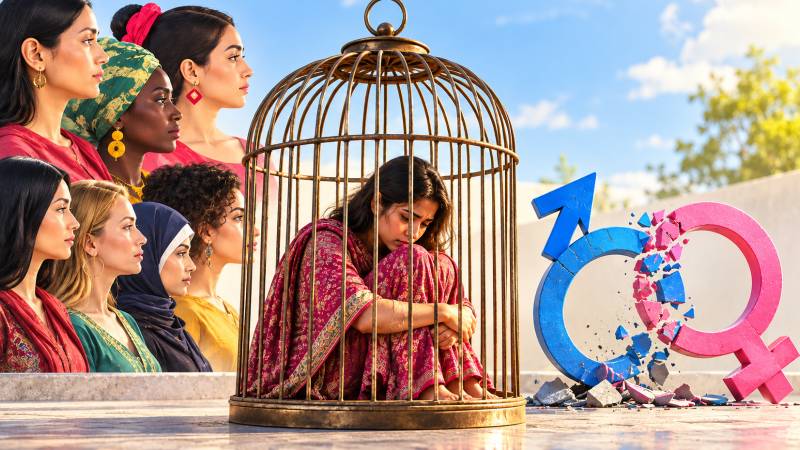
When a woman screams, someone does the arithmetic. What will it cost her family, her job, her children’s marriages, her name? In our part of the world, izzat works like currency, and it is the woman who pays, whether she speaks or keeps quiet. Whatever she does, a label is waiting. Say no in the 1600s and you were a witch; in the 1800s, unladylike; in the 1900s, hysterical; in the 1970s, frigid; by the nineties, a bitch; in the 2010s, bossy. In 2026, we have become gentler and simply say “difficult”. Different centuries, same job: the word turns a woman’s refusal into a flaw in her character. How many of us have been called hysterical and difficult, and on good days, wise and pragmatic?
What gets reported is only the tip. The distance between what happens and what gets counted is where izzat does its work. Even the tip has a class. A few cases become names we all know; the rest remain a line in a report. The woman with a surname, a lobby, a donor, who speaks the language of the press club, is more likely to be remembered. I am not against anyone’s fame. Every scream that gets heard helps all of us. But I come from subaltern roots, and I know which side of that line I stood on. I also know how easily the work of women like us gets cut off from our names. Ideas get borrowed, language gets copied, and the credit goes elsewhere. Our labour is visible while we remain invisible.
Perhaps that is why I keep returning to the freedoms we once imagined other women had, and to the assumptions we never thought to question. Why India, suddenly? Growing up, I was told India was the more liberal place. My father returned from a conference in Delhi in the late 1970s and told us about girls riding motorbikes. I was amused; I was a junior high school girl. When I finally visited in 2008, women in saris riding bikes amused me all over again. A democracy, we thought. I had linked that freedom to Indian women, perhaps too easily. Has it reached their everyday lives? Look at the girls in Delhi.
After a 17-year-old girl was allegedly gang-raped in Aastha Kunj Park by three men posing as police officers, students came out to protest, and not politely. They chanted “Ek sutta, do chai, mard jaat haay haay”—one cigarette, two teas, down with mankind. Another slogan said, “Naari apne aap ki, nahi kisi ke baap ki”: a woman belongs to herself, not to somebody’s father. These girls are demanding the freedom to move without fear, a freedom I once assumed Indian women already had.
My generation protested in a “respectable” voice. Was that partly the influence of WAF’s English-speaking, educated milieu? We asked to be believed in elegant English and sanitized Urdu, and were still called hysterical, even difficult. Much of our protest stayed within the language considered acceptable. The Aurat March has challenged some of those limits, though I am not dissecting its history here. These girls know they will be called difficult anyway, so they have decided to be difficult on purpose. They are not asking for izzat back. They are handing the shame to the men.
And what did my generation of urban, modern women do? I risk sounding self-congratulatory by asking the question, and perhaps that is another habit women have acquired: to account for their shortcomings but hesitate to name their contributions. We grew up on Angela Davis, Gloria Steinem, Frida Kahlo, Maya Angelou, Nawal El Saadawi, Kamla Bhasin, Amrita Pritam, Sara Shagufta, Fehmida Riaz and Kishwar Naheed. Some of us got through many lonely nights on Parveen Shakir.
Even people like me, carrying the burden of blame for the abuse done to us and the compulsion of earning, contributed. I worked in television, in front of the camera and behind it. I was the first woman to solo-anchor PTV’s live morning transmission, Roshan Pakistan, and then its current-affairs show Savairay Savairay. Gender Watch, which I produced, gave our television the word “sinf.” I designed the study that began data collection on violence against women and girls in Pakistan in 2000. From 1994, I campaigned against dowry violence, which until then was buried under the broader category of domestic violence. My book on taxation and women was the first of its kind in Pakistan, and I stand by that. It argued for tax relief for divorced mothers, divorced women, disabled women and never married women, shifting the focus beyond widow-centred funds for women in distress and the promises made in their name.
We too crossed lines drawn by the state in the name of parsai, and confronted many patriarchal norms. We did something, but not everything. Women and girls are still not safe, not visible, not respected, not empowered in any meaningful sense. We must be able to acknowledge our work without pretending that it was enough.
Our labour is visible while we remain invisible. Ideas get borrowed, language gets copied, and the credit goes elsewhere.
Let me say what is not the solution, because we have been selling it. Changing dress codes is not the solution. Nor is offering young women more stages on which to display their youth and bodies. Beauty ideals, surgeries and aesthetics packaged as empowerment are not the solution either. Neither is condemning purdah, nor imposing it. A woman’s clothes, her face and her veil were never the problem. The violence stayed where it was while we argued about all this. Marzi has to work both ways, and a market that sells a woman a look and calls it freedom is still a market.
Let us accept our failings. Many of us who called ourselves feminists practised classism. Some came from low- and middle-income families ourselves, yet behaved like elites once we entered influential rooms. We spoke for village women rather than with them. Then came livelihoods, and livelihoods sat on platforms: donors, ministries, conferences and UN agencies. We got attached to power and policy, and policy makes you polite. Much of our movement came to depend on grants, and grants tend to reward what is easy to communicate.
In The Friday Times this June, I wrote about the intellectually disabled girls our slogans leave out. Work with them is quiet, long and hard to fund. It does not make a good campaign photograph or fit neatly into a conference presentation. Yet their lives, their bodies and their rights cannot be left outside our feminism.
Money from powerful institutions can support a good cause, but it can also serve political interests. In 1967, Gloria Steinem’s work with the Independent Research Service, which received CIA funding for American participation in international youth festivals, became public. I do not say our movement was a plant. I ask why we so rarely questioned who paid for the platforms we stood on. What have we built that will outlast us? Lasting institutions, shared power, changed conditions for women? I ask these questions of myself as much as anyone.
I did not name my abusers. Not on social media, not at the press club, not even in writing. I counted the risks to my safety, my children, my job and my family’s name. I had no powerful class to protect me and no network to pull me through. I earned my living and paid my bills in Pakistan, as a woman already labelled difficult.
In 2019, I wrote in Daily Times: Dear daughters, keep screaming, speak up and speak out. “Stay safe” was the part I obeyed too well. That is what pragmatic meant, and those were reasons, not excuses. Now, in the autumn of my life, I am lonely, and the people I protected did not protect me back. I wish I had been blunter. More selfish. A bit more indecent. I wish I had chosen myself.
I owe younger women an apology. We did not dismantle enough of the economy of izzat that makes women calculate the cost of speaking. We taught them, sometimes without meaning to, to count that cost before they raised their voices. Some of us sat at tables that remained inaccessible to the women we claimed to represent, and called the place we had secured a victory for all women. We became too comfortable with CVs and conferences, and not uncomfortable enough with the lives still waiting outside the room.
Stop wasting your time and nerves trying to keep the economy of izzat balanced. The sums never come out right because the other side keeps changing the prices. If you choose to speak, tell someone who will hear you what was done to you. If you cannot, the shame is still not yours. Keep records. Understand the laws that may be used against you, and find informed support. We need to debate who writes and interprets defamation laws, who becomes a judge or lawyer, and whose idea of reputation the courts protect. But a badly made law is no reason to accept injustice. The choice to disclose must remain hers.
Break the silence around violence, not by blaming women who cannot speak, but by making it safe for them to. A crime that goes unrecorded disappears from public attention and from the budgets meant to address it. It cannot rest on women alone. Do not blame them for not reporting. No woman who stays silent has failed. The system has failed her. Think survivor-centred, and think about what happens after a report. Who is the police officer, the lawyer, the judge, the journalist, even the activist? Each is shaped by the same misogynistic society, built on the economy of izzat. Does she keep control over what happens next?
The State has to listen beyond its own rules, laws, clauses and SOPs, drafted by people who may never have sat across from a woman like us. A complaint that does not fit the clause becomes “difficult”, like the woman who made it. The World Economic Forum estimates that, at the current pace, global gender parity is still 120 years away. The UN has warned that full gender equality could take nearly 300 years. The time for change is now. If 2026’s word for us is difficult, let 2027’s be ours. Choice is ours.