

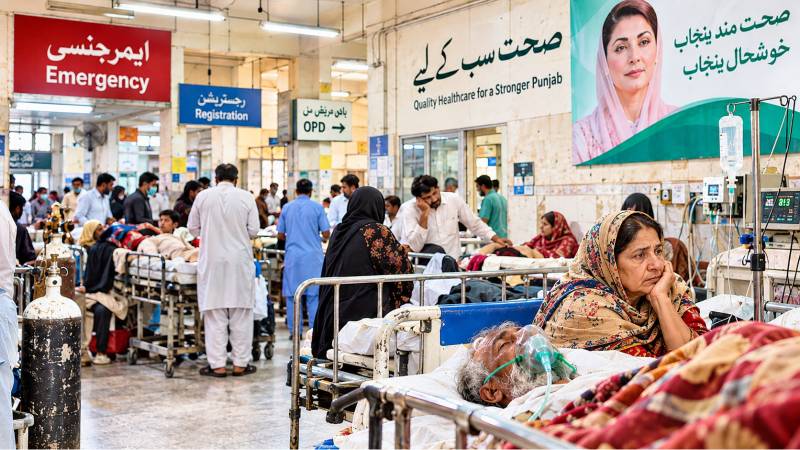
Until the state learns to glorify the health of its citizens rather than the gloss of its advertisements, the bureaucrat will always measure human suffering as a minor rounding error on a distant balance sheet. In the air-conditioned sanctuaries of Lahore, where administrative policy is manufactured, human pain is treated as a statistical inconvenience, leaving the citizen to admire the fresh paint on a crumbling wall while paying for their own quiet erasure.
Chief Minister Maryam Nawaz must step out of sanitized administrative briefings and take direct notice of the systemic collapse unfolding across Punjab’s public healthcare network. While official communications portray a seamless, modernizing medical infrastructure, the reality inside emergency wards tells a devastatingly different story. Rulers in administrative corridors may rely on sleek statistical presentations, but for millions of citizens on the ground, seeking basic medical treatment has become an exercise in indignity and financial ruin.
The visible contrast across Lahore is hard to ignore. Colorful banners, polished billboards, and PR campaigns proclaim a revolution in public welfare. Yet behind these displays, the doors of government hospitals remain effectively shut by administrative apathy and bureaucratic friction. The universal health card framework, once heralded as a transformational social safety net, has been quietly restricted. Coverage has been narrowed down to a strict, limited list of procedures—primarily cardiology, orthopedics, and selective dialysis cycles; leaving countless critical illnesses entirely uncovered.
This structural decay hits marginalized communities and rural populations hardest. Recent living standards and health demographic surveys reveal that only 20 percent of rural households live within five kilometers of a functional health facility, compared to 75 percent in urban areas. This massive gap transforms treatable conditions into fatal crises: cardiovascular diseases account for nearly 30 percent of total mortality, lower respiratory infections claim 15 percent, and maternal complications represent 10 percent in remote districts. With nearly 30 percent of the population living below the poverty line without formal social security, the human toll is severe. Pakistan’s maternal mortality ratio stands at approximately 178 per 100,000 live births (compared to Sri Lanka’s 30), while under-five mortality has climbed past 95 per 1,000 live births, falling well behind regional peers like Bangladesh.
A fundamental question demands an answer: does the state consider a destitute citizen's life worth saving only when it falls under a few pre-approved medical codes? When a poor person suffers total renal failure, liver cirrhosis, acute gallbladder disease, severe gastrointestinal conditions, or blood cancer, why are those life-threatening illnesses left off the priority list? Are these complex, agonizing diseases destined to remain a silent death warrant for the poor?
The political history of health insurance initiatives in Pakistan reflects years of short-term policy decisions. The PPP administration introduced micro-health insurance under the Benazir Income Support Programme (Waseela-e-Sehat). In 2015, Nawaz Sharif launched the Prime Minister’s National Health Insurance Programme, alongside the establishment of the Punjab Health Initiative Management Company (PHIMC) under then-Chief Minister Shahbaz Sharif. Later, the PTI government expanded the model into universal coverage, promising up to one million rupees annually per family by February 2021. However, as early as April 2019, a joint actuarial study by German GIZ and the International Labour Organization (ILO) issued a clear warning: rising public awareness and inflation would push utilization rates higher, making fixed premiums unsustainable without regular actuarial reviews. That critical recommendation was systematically ignored.
Healthcare cannot remain dependent on political cycles or cosmetic quick-fixes. Chief Minister Maryam Nawaz must look past superficial reporting, address the mismanagement on the ground, and treat healthcare access as a non-negotiable constitutional right for every citizen of Punjab.
Inside major teaching facilities like Lahore’s Services Hospital and Mayo Hospital, patients and their families navigate overcrowding and severe supply shortages daily. Services Hospital carries an official paper capacity of 1,600 beds, yet over 8,800 patients remain stuck on surgical waiting lists. Routine and neurological procedures are routinely delayed by twelve to eighteen months. At the Punjab Institute of Cardiology (PIC), patients needing urgent open-heart surgery face multi-month queues. Yet, when those same patients visit the private clinics of state-employed doctors, the required operating theatres, equipment, and surgical teams become available immediately for out-of-pocket cash. This sharp dual system forces impoverished families to pay for their poverty with their lives.
Under IMF-guided fiscal adjustments, universal healthcare faced heavy cuts. In late June 2025, the Punjab government ended universal access to the Sehet Sahulat Card in public hospitals. A notification issued by PHIMC CEO Ali Raza confirmed that starting July 1, 2025, universal coverage in public facilities was terminated, confining card usage to designated private hospitals with strict spending caps and required co-payments for orthopedic and cardiac care. Despite earlier assurances from Health Minister Khawaja Salman Rafique regarding expanded limits, budget pressures led to immediate cutbacks.
Meanwhile, temporary measures such as mobile hospital units fail to address core structural problems. While a mobile unit can provide basic consultations, a patient requiring complex surgery or emergency intervention must still report to major tertiary centers like Mayo or Jinnah Hospital, where beds and essential medicines are consistently in short supply.
The financial allocations highlight glaring contradictions in spending priorities. Out of a consolidated national health budget approaching 1.3 trillion rupees, Punjab allocated over 500 billion rupees for healthcare this year, including 9.30 billion rupees specified for DHQ cardiac units and CT scan procurement. Similarly, in Khyber Pakhtunkhwa, the provincial health budget stands at a massive 334 billion rupees. Yet despite these astronomical paper figures across provinces, basic medical care remains out of reach on the ground. During the caretaker administration under Mohsin Naqvi alone, over 60 billion rupees were directed into hospital upgrades and cosmetic facelifts. Yet, walk into an emergency ward today, and families are routinely instructed to purchase basic medicines, syringes, and oxygen support from private pharmacies outside. Polished marble floors and decorative frames cannot replace missing life-saving drugs or functional diagnostic equipment.
Medical professionals and health administrators point out that real improvement requires structural investment, not public relations crackdowns. Suspending overburdened doctors or confiscating mobile phones does nothing to resolve shortages of essential medicine or broken machinery. A hospital's performance improves through adequate funding, merit-based staffing, and reliable supplies—not by swinging a heavy club.
The policy instability is equally visible in Khyber Pakhtunkhwa, where political shifts led incoming ministers to dismiss the health card program as a fiscal fraud and subsequently restrict it. When health coverage is treated as a partisan political tool, daily-wage earners, low-income workers, and struggling families are left without a safety net during an era of high inflation. Across provinces from Peshawar to Lahore, Primary Healthcare Units (PHUs) and Specialized Healthcare Units (SHUs) risk becoming administrative overhead rather than functional service delivery centers.
Where the state steps back, civil society organizations like the Indus Health Network, the Edhi Foundation, and Aurat Foundation attempt to fill the gap through mobile clinics, community workers, and ambulance networks. International partners including WHO, UNICEF, the Global Fund, and USAID continue to support immunization and maternal care campaigns, but donor assistance cannot replace sovereign political will. To restore functionality to the health sector, the provincial leadership must enforce strict price and quality regulations on private healthcare, fully equip primary health centers, and implement digital health and telemedicine tools across rural districts.
The health hollow promise has made people go through these tough times. I've myself seen how people are maltreated in hospitals. This shallow promise has to be changed into robust one from which people of Pakistan get welfare health support. Healthcare cannot remain dependent on political cycles or cosmetic quick-fixes. Chief Minister Maryam Nawaz must look past superficial reporting, address the mismanagement on the ground, and treat healthcare access as a non-negotiable constitutional right for every citizen of Punjab.